
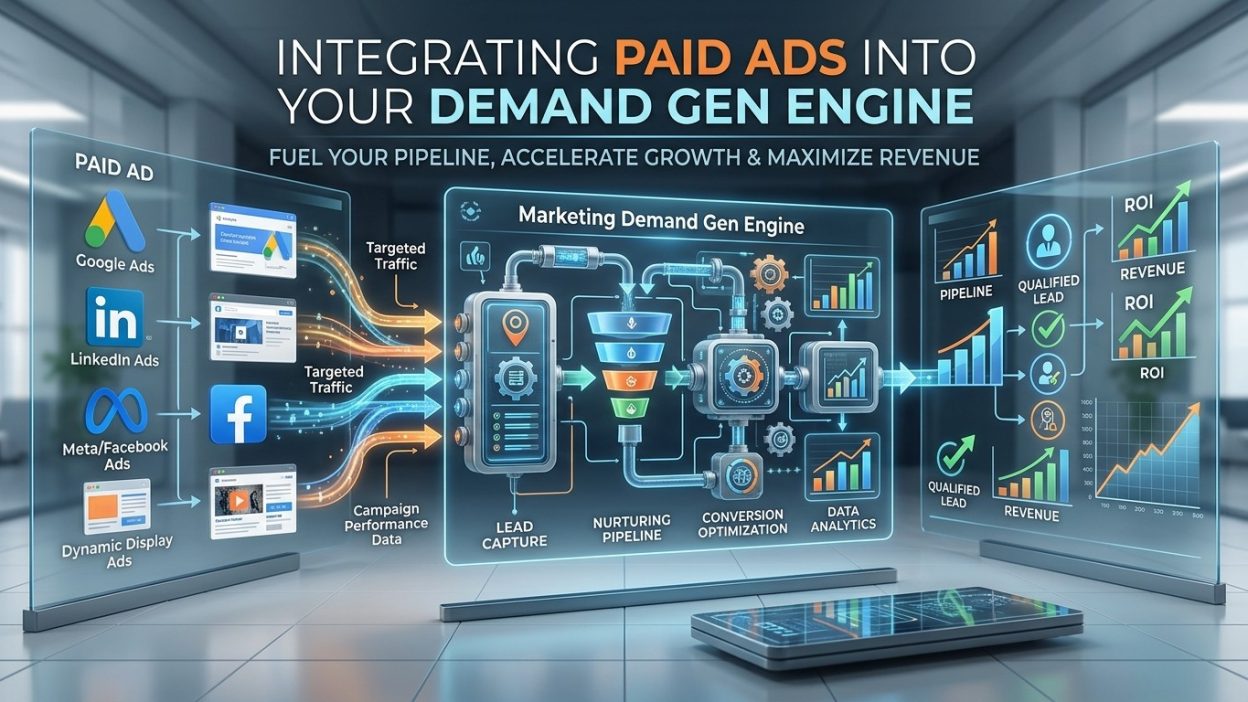
Integrating Paid Ads works best when every click feeds a larger revenue system, because the strongest demand programs educate, qualify, and convert rather than chasing cheap traffic.
A good B2B Demand Gen Engine begins with clarity about the buyer’s journey, because the channel only matters after the outcome is defined. Integrating Paid Ads should point to a stage, a pain point, and a next step that feels obvious to the audience. If the campaign is built only around impressions, it can create movement without momentum, which is why so many teams feel busy but not productive. Integrating Paid Ads becomes more useful when the message, the landing page, and the follow-up sequence are designed as one path. The path should make the next action easy to understand, easy to trust, and easy to take. Integrating Paid Ads also works better when the team agrees on what a qualified action looks like, because conversion logic needs a shared definition. That shared definition is what keeps sales and marketing aligned instead of arguing over different versions of lead quality. Integrating Paid Ads should therefore be treated as a prioritization system, not just a traffic source.
Integrating Paid Ads becomes more valuable when the team treats the campaign like a map of the buyer journey instead of a one-off media push. That means each ad should answer the stage-specific question the prospect is already asking. At the top of the funnel, the ad should name the pain and make the issue easier to understand. In the middle, it should add proof, comparison, and context. At the bottom, it should reduce doubt and make the next step feel safe. When the strategy follows this pattern, the campaign no longer behaves like random traffic generation; it behaves like a guide that helps the buyer move at a natural pace.
Understanding audience and intent
Audience research is the starting point for serious performance work. Integrating Paid Ads becomes far more efficient when the team understands what the buyer is already trying to solve, what they are trying to avoid, and how urgent the issue feels in their world. That means studying support tickets, sales calls, win-loss notes, and search behavior so the language mirrors the market instead of the product team. Integrating Paid Ads should also reflect the level of awareness. A cold audience needs framing, a warm audience needs proof, and a ready audience needs a reason to act now. When the message is mapped to that awareness level, the campaign feels more relevant and less intrusive. Integrating Paid Ads gets stronger when the creative speaks directly to the buyer’s self-image, because people respond faster to messages that feel personally accurate. The goal is not to speak to everyone; the goal is to sound unmistakably right to the right people. Integrating Paid Ads should make the buyer feel recognized in seconds.
Integrating Paid Ads becomes more persuasive when the audience sees the message as specific to their world. That is why the best campaigns often borrow words from sales calls, support conversations, and customer reviews. The copy should sound like it was written by someone who has actually heard the problem described in the wild. If the message feels generic, the audience assumes the solution is generic too. The more directly the ad reflects the real language of the market, the more likely the visitor is to keep reading. Relevance is not decoration; it is the filter that determines whether the rest of the funnel gets a chance to work.
Positioning and offer clarity

Positioning is where many campaigns either gain leverage or lose it. Integrating Paid Ads cannot rescue an offer that is vague, crowded, or hard to compare. The buyer needs a simple answer to three questions: who is this for, what does it solve, and why should I care now? Integrating Paid Ads becomes persuasive when the answer is visible without effort. The offer should feel narrow enough to be credible and broad enough to matter. If the promise is too abstract, the audience hesitates; if it is too broad, the audience forgets it. Integrating Paid Ads works best when the core promise stays consistent across the ad, the page, the email follow-up, and the sales conversation. That consistency lowers cognitive load and helps the buyer feel that the journey is coherent. Integrating Paid Ads should not introduce new stories at every touchpoint. It should reinforce the same one story until the market can repeat it back in its own words.
Integrating Paid Ads also gets stronger when the team thinks about objection handling before the click happens. Buyers do not only ask whether the solution works; they also ask whether it is worth the effort, whether it is credible, and whether now is the right time. Good creative and landing pages quietly answer those questions in advance. That can happen through proof points, short examples, customer logos, or a simple explanation of the mechanism. When the visitor feels that the main concerns have already been considered, the campaign moves faster because less mental energy is spent on doubt.
Creative that earns attention
Creative is where the campaign earns attention. Integrating Paid Ads performs better when the headline, visual, and call to action all serve the same purpose instead of competing for attention. A strong ad does not try to say everything; it says one useful thing clearly enough that the buyer keeps reading. Integrating Paid Ads should be tested in small rounds, because learning from one variable at a time is what makes optimization real instead of random. When a creative angle wins, it is usually because it matched an internal question the buyer was already asking. That is why the best copy often feels less like persuasion and more like recognition. Integrating Paid Ads can also use proof points, numbers, or short examples to reduce doubt without overwhelming the audience. The best creative does not create complexity; it removes it. Integrating Paid Ads becomes easier to scale when the team keeps a simple library of winning angles and refuses to overcomplicate the first impression.
Integrating Paid Ads should be designed so the landing page feels like the continuation of the conversation, not a detour from it. If the ad promises a useful outcome, the page should deliver that outcome in a clean and focused way. If the ad invites education, the page should make the educational value obvious immediately. The visitor should never have to wonder whether they landed in the right place. Small consistency details, such as repeated language, matching visuals, and a similar tone, often have a surprisingly large effect on conversion because they lower the feeling of risk.
Landing pages that convert
Landing pages matter because they continue the ad’s promise instead of restarting the conversation. Integrating Paid Ads loses effectiveness when the page is busy, confusing, or obviously disconnected from the message that brought the visitor there. The best pages answer four things quickly: what is this, who is it for, why should I trust it, and what do I do next? Integrating Paid Ads should be reflected in a single dominant call to action so the visitor does not have to choose between multiple routes. That does not mean the page must be empty; it means every section should earn its place. Integrating Paid Ads also works better when the form asks only for what the team truly needs at this stage, because long forms create friction and reduce completion. If more qualification is needed later, the team can collect it after trust has been established. Google Ads Help explains that conversion measurement can be set up through the Google tag and imported conversion workflows, which is why clean page tracking matters so much. Integrating Paid Ads becomes easier to optimize when every step in the page flow can be measured reliably.
Integrating Paid Ads should be matched to the level of trust the visitor already has. If the buyer came from a cold ad, the page should frame the problem and reduce confusion. If they came from a warmer retargeting click, the page can be more specific and more direct. The more closely the page matches the intent behind the click, the less friction the buyer feels and the faster the funnel tends to move.
A smart nurture layer
A smart nurture layer keeps the message moving after the first click. Integrating Paid Ads should not stop at traffic acquisition because most buyers need several touchpoints before they are ready to buy. Retargeting is especially useful here, and Google’s documentation notes that remarketing can re-engage people who have already visited your website or app. Integrating Paid Ads becomes stronger when the follow-up is specific to the behavior that happened before it, because a past pricing-page visitor should receive a different message than someone who only watched a short video. That context makes the ad feel like a continuation rather than a reset. Integrating Paid Ads should also support email and content nurture, since some buyers need more education while others need stronger proof. The best nurture sequence is patient, relevant, and simple enough that the prospect never feels lost. Integrating Paid Ads should quietly guide the buyer forward until the right moment to convert appears.
Integrating Paid Ads should use retargeting to respect intent instead of repeating the same message forever. The right message to a new visitor is usually different from the right message to someone who already watched a video or read a pricing page. That simple adjustment can make the campaign feel much more intelligent. Retargeting also helps the business stay present without becoming intrusive, because a buyer who already knows the brand is more likely to accept a useful reminder than a cold interruption. Good sequencing is what turns repetition into reinforcement.
Webinars as demand builders
Hosting Effective Webinars gives the paid system more depth because live education can answer objections before the sales conversation begins. LinkedIn’s webinar resources and lead-generation guidance emphasize targeted distribution, lead gen forms, and best-practice optimization, which shows how well webinars can fit into a modern paid strategy. Integrating Paid Ads benefits from that structure because a webinar registration is not just a click; it is a signal that the prospect is willing to invest time. The topic should solve one painful question clearly, not cover every angle at once. Integrating Paid Ads should be promoted with practical framing, because buyers respond more positively when the event promises usefulness rather than brand theater. The follow-up matters just as much as the session itself. Attendees, no-shows, and late registrants all need separate paths so the message stays relevant. Integrating Paid Ads is far more effective when the webinar is treated as a conversion asset, not just a content event.
Integrating Paid Ads becomes a better system when the webinar topic is chosen from a real demand question rather than a brand preference. The strongest live events answer something the market already wants to understand, and they do it in a way that feels practical. That is why the session title, the registration page, and the follow-up sequence all matter. Each one should promise clarity, not just attendance. A good webinar can act like a trust accelerator because the audience hears how the team thinks before they ever speak to a salesperson.
Referral systems and shared momentum

Referral systems can become powerful amplification channels, but only if the experience is easy to share. Integrating Paid Ads often exposes weak handoffs, broken links, and confusing incentives that users quietly ignore. Referral Tech Failures usually happen when the first sharing step feels awkward, or when the user cannot immediately see what happens next. Integrating Paid Ads should therefore support a referral moment that feels natural and obvious, because people are much more likely to share something they can explain in one sentence. Predictive Referral Analysis can help here by identifying which audience segments, offers, or pages are most likely to produce useful advocacy. Integrating Paid Ads becomes more valuable when it reveals where referral energy is most likely to appear, because that lets the team build around existing behavior instead of guessing. A good referral path is simple, visible, and rewarding without being complicated. Integrating Paid Ads should help the user feel proud to share, not burdened by the process.
Integrating Paid Ads can become much smarter when the team looks for patterns that indicate who is most likely to refer, invite, or advocate. The point is not to predict every person perfectly. The point is to learn which campaign paths tend to create the best share behavior. Some audiences refer because they are deeply satisfied. Others do it because the offer is novel or saves time. Once those patterns are visible, the team can shape media and nurture toward the conditions that encourage natural advocacy. That is where predictive thinking becomes practical.
Measurement and attribution
Measurement is what turns media spend into a decision-making system. Integrating Paid Ads should be judged by lead quality, pipeline influence, conversion depth, and revenue movement, not by vanity numbers alone. Google Ads Help explains that conversion data can be tracked through the Google tag and through conversion workflows that make reporting more useful across devices and browsers, which is why accurate setup matters. Integrating Paid Ads becomes harder to evaluate when the team only looks at top-level impressions or clicks, because those metrics do not show how many people actually moved deeper into the funnel. The right dashboard should show both efficiency and quality. Integrating Paid Ads should also be reviewed with sales feedback, because lead scoring on paper is not the same thing as actual sales readiness. The numbers matter, but so does the story behind them. Integrating Paid Ads works best when the reporting layer makes it easy to see what is happening after the ad is clicked.
Integrating Paid Ads should be measured through conversions, not vanity metrics. The campaign should show whether people actually completed the actions that matter to the business. That can include demo requests, form fills, webinar registrations, or high-quality product interactions. A clean measurement layer makes optimization faster because the team can compare message, audience, and offer with more confidence.
Budget pacing and financial discipline
Budget pacing is where discipline protects learning. Integrating Paid Ads should not be scaled aggressively before the team knows which audience, message, and offer combinations are actually producing valuable outcomes. Early testing is tuition, not proof of success. Integrating Paid Ads becomes more sustainable when the budget preserves room for retargeting, nurture, and creative iteration instead of spending everything on the first exposure. That balance helps the team discover what really works before the spend gets too large to change quickly. Integrating Paid Ads should also account for funnel economics, because a lead that looks cheap can still be expensive if it never converts. The team should therefore think in terms of cost per qualified action and cost per influenced opportunity, not just cost per click. When the budget is paced with restraint, the campaign learns faster and fails less expensively. Integrating Paid Ads is stronger when finance and marketing share the same expectations about what the media is supposed to do.
Integrating Paid Ads should be paced with enough patience to let the data speak. When the team pushes spend too fast, it is easy to mistake volume for learning. The better approach is to keep the test budget small enough that the team can observe what is happening, but large enough that the result is real. That balance is the difference between guessing and knowing. Over time, disciplined pacing usually produces better decisions because the organization learns from the right signals rather than from noise.
Operations matter
Operations matter because paid ads become much easier to trust when ownership is clear. Integrating Paid Ads works best when media, content, sales, and analytics each know what success looks like and when they need to react. A weekly review rhythm helps the team spot drift, identify winning angles, and retire weak tests before they waste more budget. Integrating Paid Ads should be documented well enough that someone new can understand the logic without rebuilding the whole system. That includes audience definitions, offer rules, landing page structure, conversion events, and follow-up ownership. The more visible the operating model is, the less the campaign depends on memory or heroics. Integrating Paid Ads becomes a repeatable asset once the team can explain not only what is running, but why it is running and how it should be improved next. A good system makes the right thing easier to do, which is exactly what good demand generation should accomplish.
A clean operating rhythm makes the system easier to scale because it forces the team to review what happened, what changed, and what should happen next. The goal is not to create more meetings; the goal is to protect the learning loop so the same mistakes are not repeated. When teams keep a short written record of audience choices, offer changes, landing page edits, and sales feedback, they build institutional memory. That memory usually becomes more valuable than any single campaign because it lets the next round start smarter, stay consistent, and improve faster without losing the lessons already paid for.
Scaling should happen only after proof

Scaling should happen only after the system has proven it can create useful demand in a repeatable way. Integrating Paid Ads becomes strategic when the team can move from test to pattern, from pattern to playbook, and from playbook to expansion without losing clarity. If the message needs constant rescue, scale will only make the weakness louder. Integrating Paid Ads should be localized for subsegments when different roles, company sizes, or buying stages need different proof. That kind of tailoring makes the campaign feel more relevant without changing the core offer. Integrating Paid Ads also scales better when every touchpoint tells the same story, because the buyer then experiences the whole journey as one connected path rather than a bunch of isolated ads. The best paid systems do not just create awareness; they create a better decision environment for the buyer. That is how media stops feeling like a cost and starts acting like a growth system.
Integrating Paid Ads is most valuable when it is treated as part of a connected demand system instead of a standalone traffic source. The best programs use the ad to start a conversation, the landing page to clarify it, the webinar or content offer to deepen it, and the follow-up to keep it moving. When the channels, messages, and measurements work together, the business gets more than clicks; it gets better learning, stronger qualification, and more confident pipeline decisions. Integrating Paid Ads should therefore be designed with the whole buyer journey in mind, because the highest return comes from coherence, not isolated tactics. Integrating Paid Ads also helps teams reduce waste by showing what really deserves more budget and what should be revised or stopped.
Conclusion
Integrating Paid Ads is most valuable when it is treated as part of a connected demand system instead of a standalone traffic source. The best programs use the ad to start a conversation, the landing page to clarify it, the webinar or content offer to deepen it, and the follow-up to keep it moving. When the channels, messages, and measurements work together, the business gets more than clicks; it gets better learning, stronger qualification, and more confident pipeline decisions. Integrating Paid Ads should therefore be designed with the whole buyer journey in mind, because the highest return comes from coherence, not isolated tactics. Integrating Paid Ads also helps teams reduce waste by showing what really deserves more budget and what should be revised or stopped.
Frequently asked Questions (FAQ)
What does this approach actually do?
Integrating Paid Ads helps the team use paid traffic to move buyers through awareness, education, trust, and action rather than chasing clicks alone.
Why are webinars so useful?
Integrating Paid Ads becomes stronger when a webinar gives the buyer practical value and a reason to continue the conversation after the event.
How should success be measured?
Integrating Paid Ads should be measured by qualified actions, pipeline influence, and downstream conversions instead of impressions by themselves.
Why is retargeting important?
Integrating Paid Ads works better when retargeting follows the visitor’s prior behavior so the message feels relevant and timely.
What role does landing page design play?
Integrating Paid Ads performs best when the landing page continues the ad’s promise and makes the next step obvious.
How do teams avoid waste?
Integrating Paid Ads avoids waste when the budget is paced carefully, the audience is specific, and the test plan is disciplined.
What causes referral systems to fail?
Integrating Paid Ads can expose Referral Tech Failures when the sharing experience is confusing, slow, or hard to explain.
How can referrals be improved?
Integrating Paid Ads becomes more effective when Predictive Referral Analysis helps identify which audiences are most likely to share and advocate.
What makes lead quality improve?
Integrating Paid Ads improves lead quality when sales and marketing agree on what a qualified action actually means.
What is the biggest strategic lesson?
Integrating Paid Ads works best when the company treats paid media as one part of a broader demand engine.