

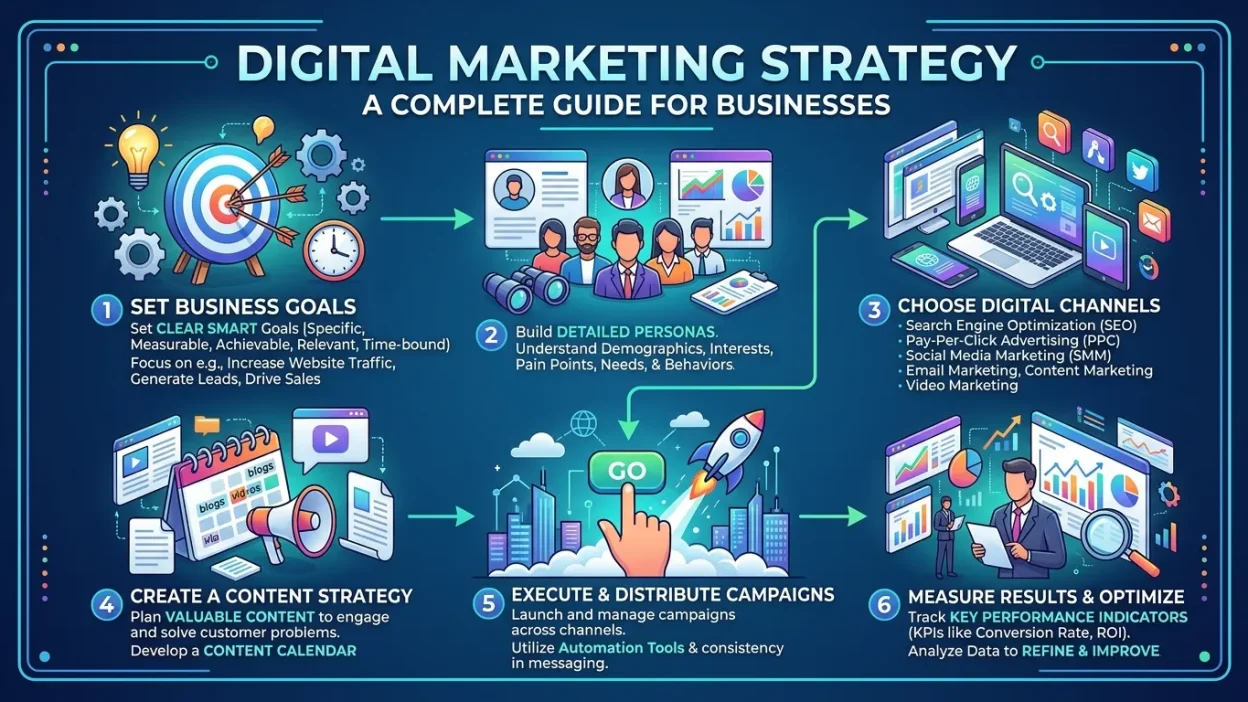
A digital marketing strategy is a structured plan for promoting a business online, reaching the right audience, generating leads, and increasing conversions. It combines SEO, content marketing, social media, email, and paid advertising to achieve measurable goals and support sustainable business growth.
What Is a Digital Marketing Strategy?
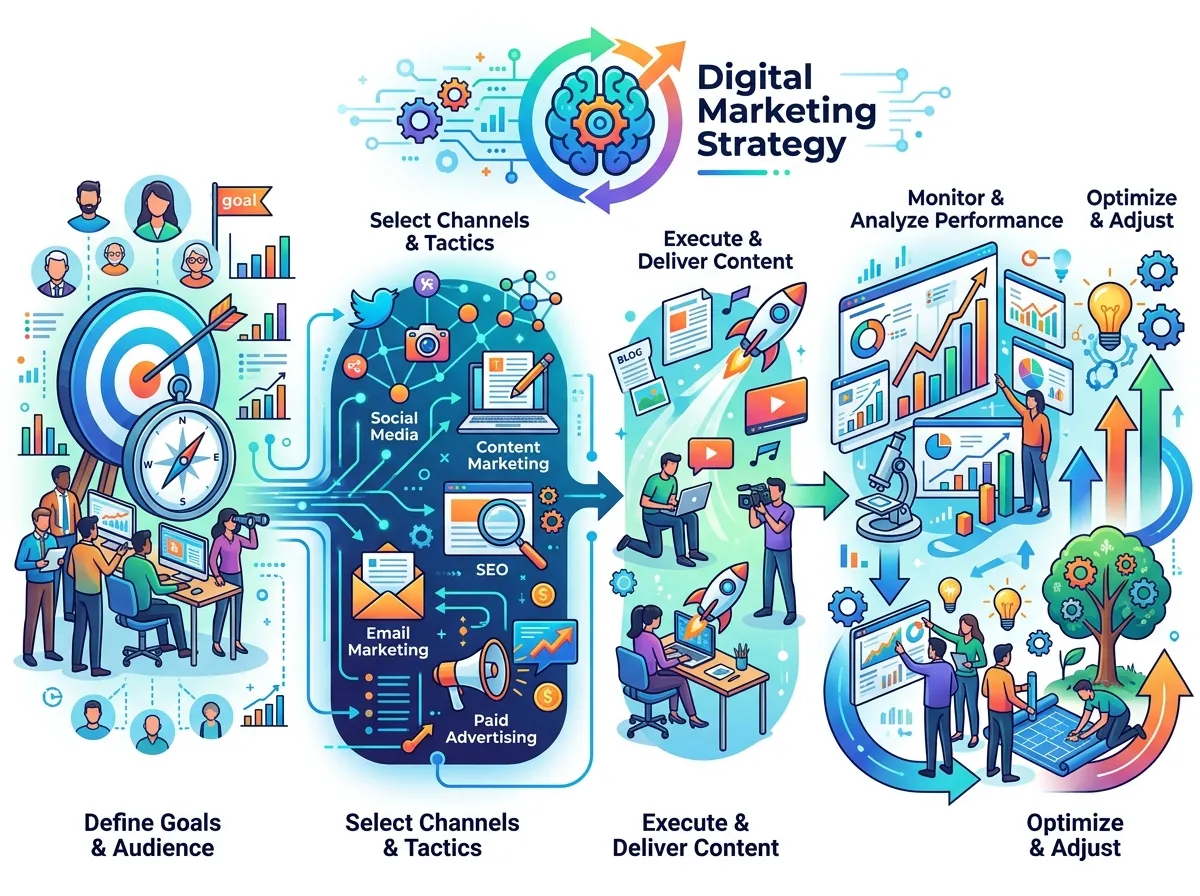
A digital marketing strategy is a structured approach that explains how a business will use online marketing methods to achieve specific goals. These goals may include increasing brand awareness, attracting website visitors, generating qualified leads, increasing sales, improving customer retention, or entering a new market.
The strategy brings different marketing activities together so they work toward a common objective. For example, a company may use SEO to attract people searching for relevant information, content marketing to educate those visitors, social media to build brand awareness, and email marketing to nurture potential customers. Paid advertising can then be used to reach a larger audience or reconnect with people who have already interacted with the business.
The most important part of a strategy is not simply choosing digital channels. It is understanding why each channel is being used and how it contributes to the customer journey. A business should be able to explain who it wants to reach, what it wants those customers to do, what message it wants to communicate, and how success will be measured.
Why Is a Digital Marketing Strategy Important?
Without a clear strategy, digital marketing can quickly become a collection of disconnected activities. A company may publish blog posts without understanding search intent, spend money on advertising without tracking conversions, or post on social media without knowing whether the audience is interested in its products.
A strategic approach creates direction. It helps businesses prioritize activities and use their resources more efficiently. Instead of creating content simply because competitors are doing it, marketers can create content based on customer needs, business objectives, and measurable opportunities.
Another important advantage is that digital marketing can be measured. Businesses can analyze website traffic, search visibility, engagement, leads, sales, conversion rates, and other performance indicators. These insights make it possible to identify what is working and what needs improvement.
A strong strategy also helps create consistency. When SEO, content, social media, email, advertising, and website optimization support the same goals, customers receive a more consistent brand experience across different touchpoints.
Developing a Digital Marketing Plan
A digital marketing plan turns a broader strategy into practical actions. While the strategy explains the overall direction, the plan describes what will actually be done, when it will be done, who will be responsible, and how the results will be evaluated.
The first step is to establish clear objectives. A business should know exactly what it wants to achieve from digital marketing. For one company, the main objective may be generating more leads. For another, it could be increasing ecommerce sales or improving brand awareness.
Once the objectives are defined, the business can determine which activities are most appropriate. For example, a company focused on organic traffic may invest heavily in SEO and content creation. A business launching a new product may combine paid advertising, influencer marketing, social media, email, and landing page optimization.
A good plan should also include a realistic timeline and budget. Digital marketing is not simply about spending as much as possible. It is about allocating resources to activities that have the strongest potential to produce valuable results.
Understanding Your Target Audience
Audience research is one of the most important parts of any digital marketing strategy. A business cannot create effective marketing messages without understanding the people it wants to reach.
Businesses should consider the problems customers are trying to solve, the questions they ask, the products they compare, the objections they have, and the factors that influence their purchasing decisions. Search behavior can provide useful information because the words people use in search engines often reveal their needs and intent.
For example, someone searching for “what is email marketing” is probably in an information-gathering stage, while someone searching for “best email marketing software for small business” may be closer to evaluating solutions. Understanding these differences allows businesses to create content and campaigns that match the customer’s stage in the buying journey.
Audience research should also consider demographics, interests, location, purchasing behavior, and preferred communication methods. The more clearly a business understands its audience, the easier it becomes to create relevant messages and experiences. For B2B companies, understanding these preferences can also help shape an effective B2B email marketing strategy for reaching and nurturing potential customers.
Choosing the Right Digital Marketing Channels
Digital marketing channels provide different ways for businesses to reach and communicate with customers. However, businesses do not necessarily need to use every available channel.
Search engine optimization is useful for businesses that want to attract people actively searching for information, products, or services. Content marketing can help establish expertise and provide value to potential customers. Social media can support brand awareness, community building, and customer engagement. Email marketing can help businesses nurture leads and maintain relationships with existing customers.
Paid advertising can provide faster visibility and allow businesses to target specific audiences. Video marketing can explain complex products or demonstrate services in an engaging format, while influencer and affiliate marketing can help brands reach established audiences.
The right combination depends on the target audience and business goals. A B2B company may receive strong results from SEO, LinkedIn, webinars, and email marketing, while an ecommerce brand may focus more heavily on product content, social media, paid advertising, and email campaigns.
The goal is not to be everywhere. The goal is to be visible where the target audience is most likely to engage.
Creating Digital Marketing Tactics
Once the channels are selected, businesses need specific digital marketing tactics to execute their strategy. Tactics are the practical actions that turn strategic objectives into measurable activities.
For example, if the goal is to increase organic search traffic, the business may conduct keyword research, create topic-focused content, improve existing pages, optimize technical SEO, strengthen internal linking, and build relevant backlinks.
If the objective is lead generation, the business might create dedicated landing pages, develop downloadable resources, improve forms, add clear calls to action, and create an email nurturing sequence. A well-defined process can help businesses identify and prioritize sales-ready leads for SDR teams so sales representatives can focus on prospects with stronger buying intent.
The important thing is that tactics should always have a clear purpose. A business should avoid using tactics simply because they are popular. Every activity should contribute to a defined objective and have a reasonable way of measuring its impact. Regularly reviewing marketing analytics and data-driven insights can help marketers determine which tactics are producing meaningful results and where improvements are needed.
Building a Digital Marketing Campaign
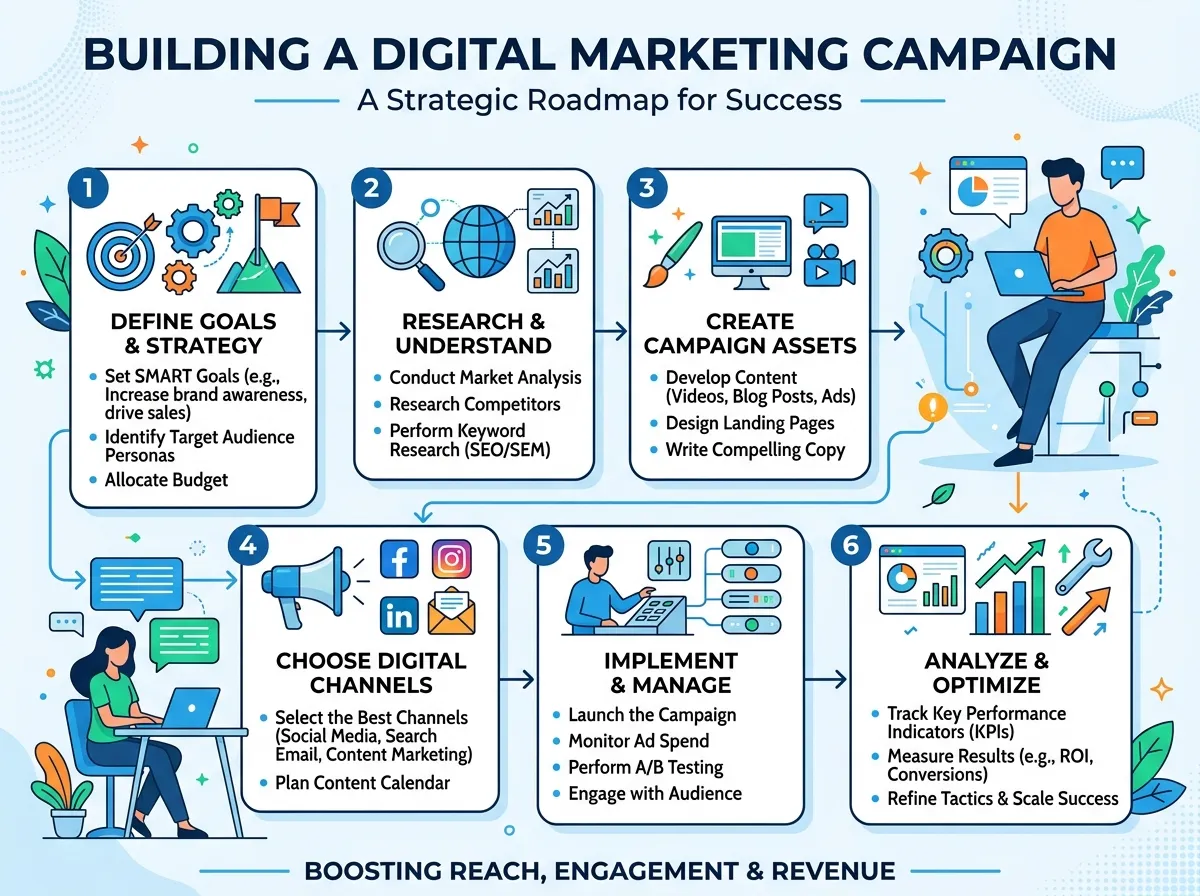
A digital marketing campaign is a coordinated marketing effort created around a particular objective, product, service, audience, or promotion.
For example, a business launching a new service could build a campaign around increasing awareness and generating consultations. The campaign might begin with educational content that explains the problem the service solves. Social media posts could distribute that content, while paid advertisements introduce the service to a larger audience. A dedicated landing page could explain the benefits and encourage visitors to request a consultation.
Email marketing could then be used to communicate with existing subscribers. Retargeting could help reconnect with visitors who viewed the landing page but did not convert.
The effectiveness of a campaign depends on how well these elements work together. The message should remain consistent across channels, and the customer should have a clear path from initial awareness to conversion.
After the campaign begins, marketers should monitor its performance. If an advertisement generates clicks but few conversions, the landing page may need improvement. If content receives traffic but little engagement, the topic or format may not match user intent. Continuous optimization allows campaigns to become more effective over time.
Creating a Digital Marketing Strategy Framework
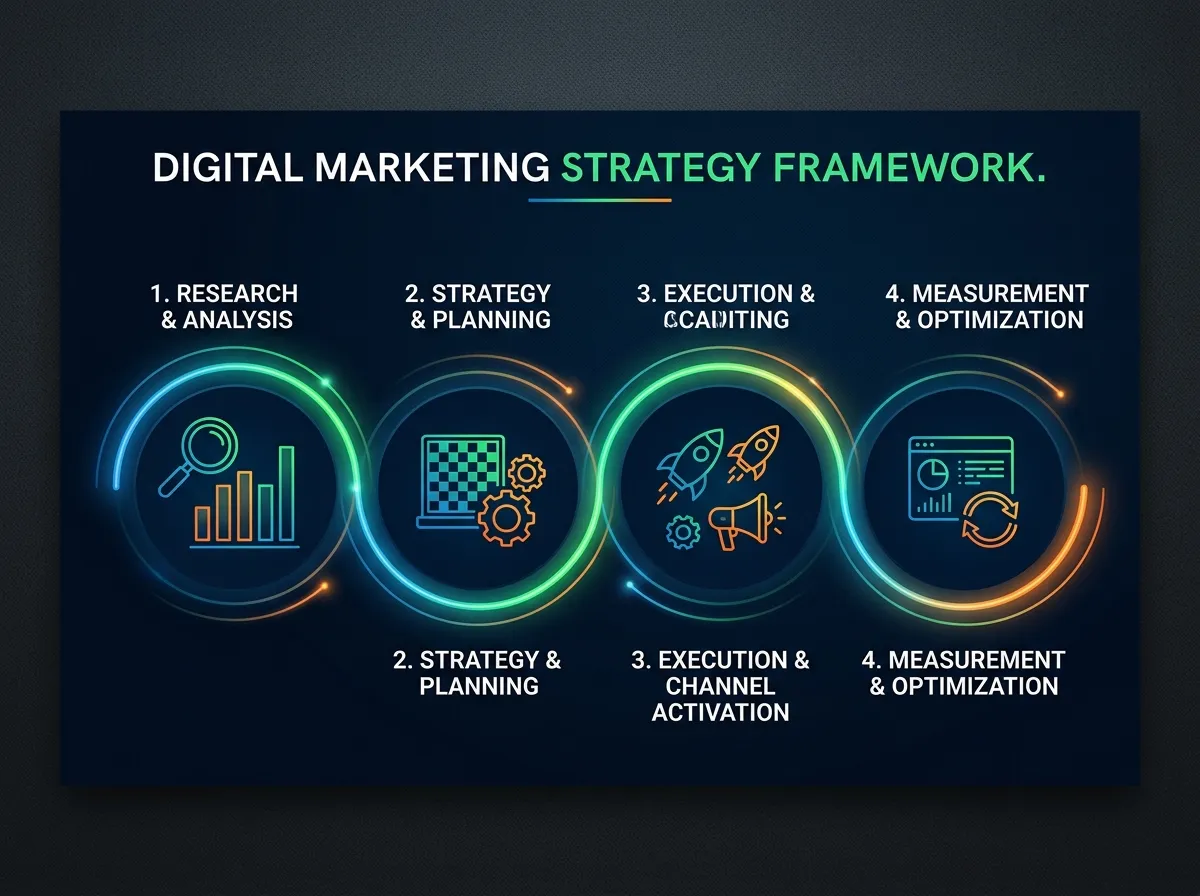
A digital marketing strategy framework provides a repeatable process for planning, executing, and improving marketing activities. A simple framework can begin with research and move through goals, audience, channels, content, campaigns, measurement, and optimization.
Research helps the business understand the market and competitive environment. Goals provide direction and establish what success should look like. Audience research identifies the people the business needs to reach.
The next stage involves selecting appropriate channels and developing content. Campaigns can then be created around specific objectives, products, services, or promotions. Once activities are running, performance data should be collected and analyzed.
The final stage is optimization. Digital marketing should not be treated as a one-time project. Customer behavior changes, search trends evolve, advertising costs fluctuate, and competitors introduce new approaches. Regular analysis allows businesses to adjust their strategy and respond to these changes.
How to Create an Effective Digital Marketing Strategy
An effective digital marketing strategy begins with customer needs rather than promotional messages. Businesses should first understand what their audience is looking for and then create experiences that provide useful answers and solutions.
Content plays an important role in this process. Instead of focusing only on product promotion, businesses can create educational articles, guides, tutorials, comparisons, case studies, videos, and other resources that help customers make informed decisions.
The website should also support the strategy. Visitors need to understand what the business offers, why it is valuable, and what they should do next. Clear navigation, compelling calls to action, mobile-friendly design, fast loading times, and straightforward forms can improve the customer experience.
Trust is equally important. Customer reviews, testimonials, case studies, transparent information, and consistent branding can help reduce uncertainty and encourage potential customers to take action.
An effective strategy also requires flexibility. If one channel consistently produces strong results, the business may decide to invest more in it. If another channel fails to produce meaningful results despite optimization, resources may need to be redirected.
Developing a Digital Marketing Growth Strategy
A digital marketing growth strategy focuses on creating continuous improvements in visibility, engagement, leads, conversions, revenue, and customer retention.
Growth can come from attracting new audiences, but it can also come from improving the performance of existing marketing assets. For example, a business may discover that several older blog posts already receive significant search traffic. Updating those articles with current information, better internal links, stronger calls to action, and improved structure could increase their value without requiring entirely new content.
Conversion optimization is another important growth opportunity. A website may already receive thousands of visitors, but if only a small percentage become leads or customers, improving the conversion process could produce significant results.
Businesses can also grow by repurposing successful content. A detailed blog post could become a video, social media content, email newsletter, infographic, or downloadable guide. This allows marketers to extend the value of existing content while reaching people who prefer different formats. Businesses can also use influencer marketing automation to streamline influencer campaigns, manage creator relationships, and expand the reach of successful marketing content.
Customer retention should also be part of a growth strategy. Email communication, personalized offers, useful educational content, customer support, and loyalty initiatives can help businesses maintain relationships with existing customers.
Digital Marketing Strategy for Businesses
A digital marketing strategy for businesses should be customized according to the company’s industry, audience, resources, and objectives.
Small businesses often need to focus on efficient channels that can generate measurable results without requiring large budgets. Local SEO, useful content, social media, email marketing, and targeted advertising can help smaller organizations compete for attention.
Ecommerce businesses may require a different approach. Product pages, category pages, shopping campaigns, customer reviews, email automation, remarketing, social media, and conversion optimization can all play important roles.
B2B companies often have longer sales cycles, which means their strategy may need to focus heavily on education and lead nurturing. Detailed content, case studies, webinars, whitepapers, email campaigns, and professional social platforms can help potential customers move through the decision-making process.
The key principle is that there is no single digital marketing formula that works for every company. Businesses should develop their strategy based on their specific customers and commercial objectives.
Measuring Digital Marketing Performance
Measurement is essential because it allows businesses to understand whether their strategy is producing meaningful results.
Website traffic can show whether marketing activities are attracting visitors, but traffic alone does not indicate business success. Marketers should also consider engagement, lead quality, conversion rates, customer acquisition costs, sales, and revenue.
For SEO, businesses may monitor organic traffic, keyword visibility, impressions, clicks, and conversions from search. For advertising, they may analyze click-through rates, cost per click, conversion rates, customer acquisition costs, and return on advertising spend.
Email marketing can be evaluated through delivery rates, opens, clicks, conversions, and revenue. Social media performance can include engagement, reach, referral traffic, and conversions where appropriate.
The most important metrics depend on the objective. If the primary goal is lead generation, lead quality and conversion rates may be more important than overall website traffic. If the goal is brand awareness, reach and engagement may receive greater attention.
Improving Your Strategy Through Data
One of the biggest strengths of digital marketing is the ability to learn from real user behavior. Analytics can reveal which pages attract visitors, which content generates leads, where users leave a website, and which campaigns produce customers.
This information should be used to improve future decisions.
For example, if a blog post attracts significant traffic but has a low conversion rate, marketers can experiment with stronger calls to action, relevant internal links, lead magnets, or improved page structure.
If an advertising campaign generates many clicks but few sales, marketers may need to examine audience targeting, ad messaging, offer quality, or landing page performance.
Testing is another important part of optimization. Businesses can compare different headlines, images, calls to action, landing page layouts, offers, or advertisements to determine which versions perform better.
Over time, these improvements can make the overall marketing system more efficient.
Digital Marketing Best Practices
Following digital marketing best practices can help businesses create a stronger and more sustainable online presence. One of the most important practices is to prioritize quality over quantity. Publishing large amounts of low-value content is unlikely to produce the same long-term benefits as creating useful resources that genuinely address customer needs.
Businesses should also maintain consistency across their digital channels. Branding, messaging, tone, and customer experience should feel connected whether a customer discovers the company through search, social media, email, or advertising.
Mobile optimization is also essential because many customers access digital content from smartphones. Websites should load quickly, display correctly on different screen sizes, and make important information easy to access.
Businesses should also make their calls to action clear. Visitors should understand what action they can take next, whether that means making a purchase, requesting information, scheduling a consultation, subscribing to an email list, or contacting the business.
Finally, businesses should regularly review their strategy rather than assuming that a successful approach will work forever. Digital platforms and customer expectations continue to change, so ongoing optimization is necessary.
Common Digital Marketing Strategy Mistakes
One common mistake is trying to use every marketing channel at once. Managing too many channels can spread resources too thin and reduce the quality of execution. Businesses should prioritize the channels that are most relevant to their customers.
Another mistake is focusing entirely on traffic. A website can receive thousands of visitors without generating meaningful business results. Quality traffic, engagement, leads, conversions, and revenue are often more important.
Ignoring existing content is another missed opportunity. Older pages may already have backlinks, search visibility, and authority. Improving these pages can sometimes produce faster results than starting from scratch.
Businesses also sometimes create campaigns without clearly defined goals. Without a measurable objective, it becomes difficult to determine whether a campaign succeeded.
Finally, some businesses fail to give their strategies enough time to produce results. While certain activities, such as paid advertising, can produce relatively quick feedback, SEO and content marketing often require consistent effort over a longer period.
Final Thoughts
A successful digital marketing strategy is not simply a collection of online promotional activities. It is a structured approach that connects business goals with customer needs, digital channels, useful content, targeted campaigns, and measurable outcomes.
The strongest strategies begin with research. Businesses need to understand their customers, competitors, market conditions, and current digital performance before deciding where to invest their resources.
From there, clear objectives can guide channel selection and content development. SEO, social media, email marketing, paid advertising, content marketing, and other channels can work together to guide customers through different stages of their journey.
Most importantly, digital marketing should be treated as an ongoing process. Businesses should monitor performance, learn from customer behavior, test new ideas, and improve their activities over time.
When strategy, execution, measurement, and optimization work together, businesses can create a stronger digital presence, reach more relevant customers, generate better opportunities, and build sustainable long-term growth.
Frequently Asked Questions
What is a digital marketing strategy?
A digital marketing strategy is a structured approach that explains how a business will use online marketing channels and activities to achieve specific objectives. It may include SEO, content marketing, social media, email marketing, paid advertising, and conversion optimization.
Why does a business need a digital marketing strategy?
A strategy gives a business clear direction and helps it focus its time and resources on activities that support specific goals. It also makes it easier to measure performance and improve marketing decisions using data.
What are the main components of a digital marketing strategy?
The main components usually include business objectives, audience research, competitor analysis, channel selection, content development, campaigns, measurement, and ongoing optimization.
What is the difference between a digital marketing strategy and a digital marketing plan?
A digital marketing strategy describes the overall approach a business will take to achieve its goals. A digital marketing plan turns that strategy into specific activities, timelines, budgets, responsibilities, and measurable actions.
Which digital marketing channels are most effective?
There is no single channel that is best for every business. SEO, content marketing, social media, email marketing, paid advertising, video, and other channels can all be effective depending on the target audience, industry, budget, and marketing objectives.
How can I create an effective digital marketing strategy?
Start by defining clear goals and researching your target audience. Then analyze competitors, select appropriate channels, create useful content, develop campaigns, establish KPIs, measure performance, and continuously optimize your approach.
How long does a digital marketing strategy take to produce results?
The timeframe depends on the channels and objectives involved. Paid advertising can generate results relatively quickly, while SEO and content marketing often require consistent effort over several months. Results also depend on competition, industry, budget, and execution quality.
What metrics should I use to measure digital marketing performance?
Useful metrics may include website traffic, organic search traffic, engagement, leads, conversion rate, customer acquisition cost, advertising return, sales, and revenue. The most relevant metrics should be selected according to the business objective.
Is digital marketing effective for small businesses?
Yes. Small businesses can use digital marketing to reach highly relevant audiences without relying exclusively on large advertising budgets. SEO, local search, content marketing, social media, email marketing, and targeted advertising can all support small-business growth.
How often should a digital marketing strategy be updated?
A strategy should be reviewed regularly rather than only once a year. Monthly performance reviews can identify immediate opportunities, while larger strategic reviews can help businesses respond to changes in customer behavior, competition, technology, and digital platforms.