

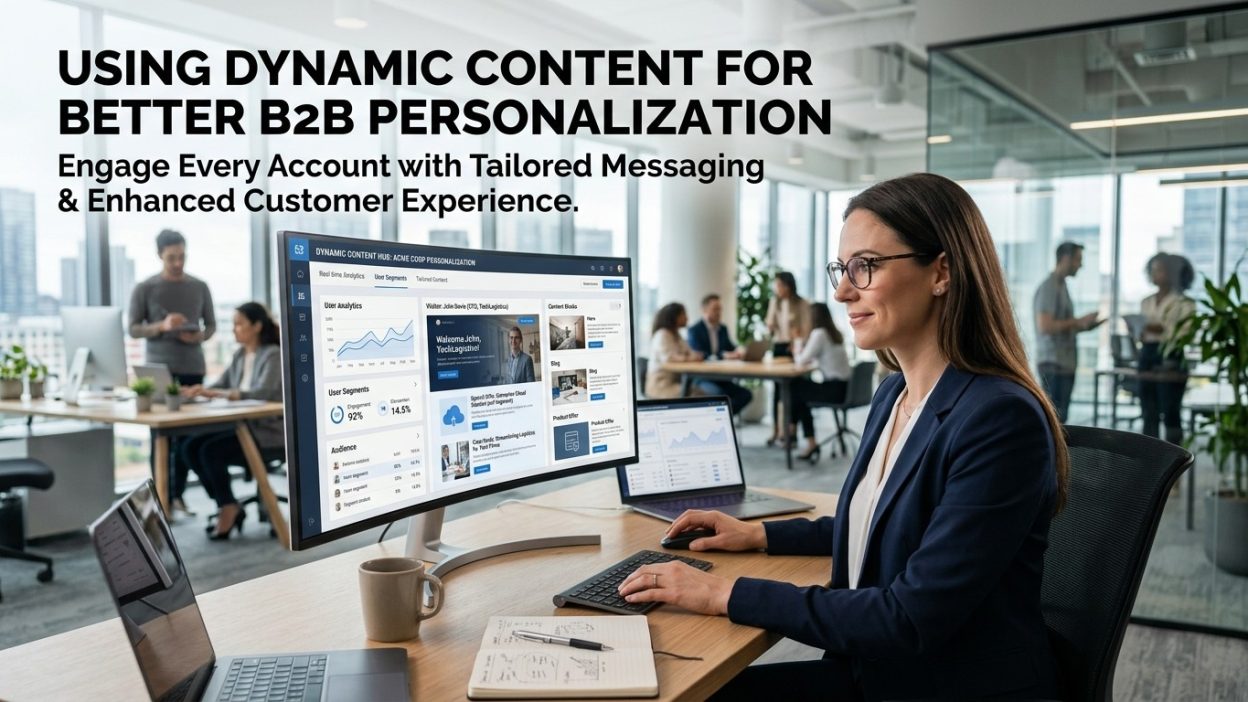
B2B Personalization works best when Dynamic Content aligns message, timing, and intent, so every touchpoint feels more relevant, useful, and easier to act on.
Modern buyers do not want generic messages that ignore role, industry, behavior, or journey stage. B2B Personalization has become central to growth strategy because it can turn a broad campaign into a conversation that feels specific and timely.
Many teams still personalize only at the surface. They change a first name in a subject line and call it progress. Real B2B Personalization goes deeper because Dynamic Content can change the message itself, not just the label on top.
This guide shows how to use Dynamic Content in a practical way, how to think about buyer psychology, and how to build a personalization system that scales without becoming chaotic.
Why personalization matters more in B2B
B2B Personalization matters because B2B buyers compare options, seek internal approval, and worry about making the wrong choice, so relevance becomes a trust signal as much as a conversion tactic.
B2B Personalization also reduces decision fatigue. When the buyer sees a message that reflects a real problem, the mind spends less energy decoding vague claims and more energy evaluating fit.
B2B Personalization becomes stronger when the audience feels understood. That feeling is not cosmetic; it is a psychological shortcut that makes the next step seem easier and safer.
A personalization program should always have a simple governance model. Someone has to own the data fields, someone has to approve copy changes, and someone has to review performance. Without ownership, Dynamic Content can drift into inconsistency very quickly.
Teams also need to define which signals are strong enough to change the message. A page view may be interesting, but a pricing visit may deserve a different response. That distinction keeps B2B Personalization useful rather than random.
A practical rollout should begin with one journey and one audience segment. That limited scope makes it easier to learn what the audience prefers, what the data can support, and where the process slows down.
It also helps to write the rules in plain language before connecting them to tools. If the team cannot explain the logic without jargon, the workflow probably needs to be simplified first.
What Dynamic Content actually does
Dynamic Content lets a page, email, or asset change automatically based on data or behavior, and that is what makes B2B Personalization more precise than a static template.
B2B Personalization works better when the system adapts to the viewer instead of forcing the viewer to adapt to the content, because relevance reduces friction at the moment of attention.
The real power of Dynamic Content is not the technology itself; it is the way it removes unnecessary effort, which allows B2B Personalization to feel more helpful and less generic.
Good creative still matters. A personalized message that is badly written will not perform well simply because it is more specific. Relevance should support clarity, not replace good copy, clear proof, or a strong offer.
The most effective teams treat personalization as a quality system. They improve the content, the rules, the data, and the follow-up together so the experience feels coherent at every step.
Dynamic Content is most useful when it supports a real buying question. If the message does not help the buyer decide, then the variation may be clever but not effective. Relevance should solve doubt, not simply decorate the page or email.
Strong personalization systems also depend on patience. Results do not always appear in the first test, and that is normal. The goal is to learn which signals matter most so the team can build a cleaner model over time.
The psychology behind relevance

Relevance works because people filter noise quickly, and B2B Personalization gains attention when it matches a real concern rather than speaking in broad, forgettable claims.
B2B Personalization also builds trust because buyers infer that the company understands their context. That should feel helpful, not invasive, and the tone matters as much as the data.
When the message aligns with stage and intent, B2B Personalization feels like a natural next step instead of a forced marketing move.
Segment discipline matters because one broad audience can hide several different buying motives. If the team groups everyone together, the personalization layer may become too shallow to matter.
That is why performance reviews should include both volume and quality. A campaign can generate clicks while still failing to create meaningful sales conversation. The deeper signal is usually the better one.
The page should answer the buyer’s hidden question quickly. What is this, why does it matter, and why should I care right now? If those answers are easy to see, the buyer stays longer.
Dynamic Content also makes it easier to use proof strategically. One segment may need a case study, another may need technical reassurance, and another may need business value. The message can shift without losing the core promise.
A buyer who sees consistent logic across channels is more likely to trust the brand. That consistency becomes a quiet advantage because the company seems organized and attentive rather than loud and random.
How to decide where to personalize first
The best place to begin is with the most visible and repeatable touchpoints, because B2B Personalization creates the fastest lift when it appears where buyers already pay attention.
Industry, company size, role, and lifecycle stage are practical starting points for B2B Personalization because they are meaningful enough to influence message choice without becoming impossible to manage.
Focus first where irrelevance is most likely. If a page, email, or ad risks feeling generic, that is usually the best place to apply B2B Personalization.
Personalization should also respect privacy expectations. People appreciate relevance, but they do not want to feel watched. Good judgment keeps the experience helpful and credible.
Email can become noisy if the sequence is not designed carefully. Useful workflows move the buyer forward with small, logical steps instead of repeating the same pitch again and again.
The handoff between marketing and sales matters too. If the lead was nurtured around one pain point, sales should know that context and continue the conversation instead of resetting it.
Deliverability should be monitored as an ongoing health metric. If inbox placement weakens, even the best personalization logic will underperform, so list quality and sending reputation need regular attention.
Landing pages that adapt to intent
Landing pages are ideal for B2B Personalization because the visitor has already signaled intent, and the page should reflect what they likely came for.
With Dynamic Content, the same landing page can speak to efficiency, security, or scale depending on the visitor, which helps B2B Personalization feel more focused and less cluttered.
When the click path and page message match, B2B Personalization feels coherent, and that coherence lowers hesitation at a critical moment.
The best personalized pages usually reduce uncertainty first. They explain the problem, show the result, and make the next step feel safe. If the buyer has to work too hard to understand the offer, the message is doing too much of the wrong work.
Personalization should also support sales efficiency. If a lead arrives with a clearer context, the conversation starts at a deeper point and the sales team saves time. That improvement can be more valuable than a simple increase in lead volume.
The strongest programs use personalization to clarify, not to impress. A buyer does not need to notice every rule in the background. They only need to feel that the content is appropriate, timely, and worth reading.
Email nurture that changes with behavior
Email sequences become much stronger when Dynamic Content reacts to behavior, because B2B Personalization should respond to what the lead actually did, not what the team hoped they would do.
If someone viewed pricing, opened a case study, or downloaded a guide, B2B Personalization can shift the next email so the conversation continues naturally instead of restarting from zero.
That behavior-based sequence feels more human because B2B Personalization mirrors the buyer’s pace instead of forcing every lead through the same rigid message path.
Lead Nurturing Workflows become more effective when they are supported by Dynamic Content and built around meaningful triggers rather than rigid sequences.
Email Deliverability to Avoid Spam Folders matters because the best B2B Personalization program still fails if the message never reaches the inbox.
When follow-up is timely, relevant, and well-delivered, B2B Personalization feels like a helpful continuation rather than another broadcast.
The most persuasive pages usually reduce uncertainty first. They explain the problem, show the result, and make the next step feel safe. If the buyer has to work too hard to understand the offer, the message is doing too much of the wrong work.
How to avoid over-personalization
Too much personalization can feel unnatural, so B2B Personalization should focus on the parts that matter most rather than changing every line in the message.
B2B Personalization can weaken trust if it feels creepy or overconfident, especially when the data signal is weak and the content shift is too dramatic for the buyer’s stage.
The goal is not to make the message look clever; the goal is to keep B2B Personalization useful, coherent, and believable.
Not every personalization opportunity needs heavy engineering. Sometimes the best change is a smaller one, such as swapping a case study, changing a headline, or adjusting the call to action. Those modest improvements can create meaningful gains when they are tied to the right segment.
The best teams document their content logic. They record which audience sees which version, why that version exists, and what outcome it is supposed to influence. That documentation makes future updates easier and helps new teammates understand the system quickly.
Dynamic Content is most useful when it supports a real buying question. If the message does not help the buyer decide, then the variation may be clever but not effective. Relevance should solve doubt, not simply decorate the page or email.
How data quality shapes results
Personalization is only as good as the data behind it, and B2B Personalization fails quickly when company size, role, or behavior fields are incomplete or wrong.
A strong data map makes B2B Personalization easier to trust because the team knows what each signal means before it uses that signal to change content.
If the data is stale, B2B Personalization can create strange experiences, so freshness and validation should be part of the operating routine.
Teams should keep one shared source of truth for segment definitions. If marketing, sales, and operations describe the same audience in different ways, the personalization layer becomes harder to manage. Clean definitions make it easier to connect content, reporting, and outcomes without confusion.
A useful program also needs a fallback experience. If the dynamic rules fail or a data field is unavailable, the page or email should still read clearly. That safety net protects the user experience and prevents awkward gaps that can damage trust.
It helps to compare performance by segment, not only by channel. A campaign may look average overall while performing very well for one audience and poorly for another. Segment analysis reveals the hidden story behind the averages.
How to structure personalization across the funnel

The funnel is a relevance model, and B2B Personalization should change with the buyer’s stage so the message always matches the next question they are asking.
Early-stage visitors need clarity, mid-stage leads need proof, and late-stage prospects need confidence, which means B2B Personalization must support the journey rather than overwhelm it.
When stages are mapped well, B2B Personalization helps the buyer feel guided instead of pushed, and that reduces friction across the whole journey.
Good content teams think in layers. One layer handles the core promise, another layer handles audience-specific proof, and another layer handles timing. When those layers work together, the buyer experiences a message that feels natural instead of forced.
The most effective pages usually reduce uncertainty first. They explain the problem, show the result, and make the next step feel safe. If the buyer has to work too hard to understand the offer, the message is doing too much of the wrong work.
Personalization should also support sales efficiency. If a lead arrives with a clearer context, the conversation starts at a deeper point and the sales team saves time. That improvement can be more valuable than a simple increase in lead volume.
Why timing changes everything
A message that is relevant at the wrong time can still underperform. Timing is part of personalization because buyers move at different speeds. Some are researching quietly. Some are actively evaluating. Some are waiting for internal approval. Dynamic Content helps the message stay aligned with where the buyer actually is.
This matters because timing affects emotion. A rushed message can feel pushy. A delayed message can feel irrelevant. B2B Personalization works best when the buyer receives the right amount of information at the right moment. That creates momentum without pressure.
Lead history helps here. A first visit, a repeat visit, a pricing page view, and a form submission all indicate different levels of intent. Dynamic Content can adapt to those signals and respond more precisely. That keeps the communication useful and reduces the chance that the buyer feels like just another contact in a list.
It also helps to compare performance by segment, not only by channel. A campaign may look average overall while performing very well for one audience and poorly for another. Segment analysis reveals the hidden story behind the averages.
Good content teams think in layers. One layer handles the core promise, another layer handles audience-specific proof, and another layer handles timing. When those layers work together, the buyer experiences a message that feels natural instead of forced.
The strongest programs use personalization to clarify, not to impress. A buyer does not need to notice every rule in the background. They only need to feel that the content is appropriate, timely, and worth reading.
The role of trust in every personalized message
Personalization can either build trust or weaken it. When the buyer feels understood, trust rises. When the content feels too scripted or too invasive, trust falls. That is why B2B Personalization should always be designed with restraint and usefulness in mind.
Trust grows when the content is genuinely helpful. It is not enough to mention a company name or job title. The message should reflect the actual problem the buyer may be trying to solve. Dynamic Content helps create that relevance, but the team still has to choose the right substance.
That is also why proof matters so much. Testimonials, case studies, and specific examples can strengthen the message. The buyer wants to know that the promise is real. B2B Personalization becomes stronger when the message is both relevant and credible.
Teams that work across multiple countries need extra care because language, expectations, and proof points can change across regions. That is where thoughtful variation beats generic reuse and keeps the brand experience coherent.
Once the team understands the signals that matter, the workflow becomes easier to maintain. The library of approved messages grows, the reporting becomes clearer, and the future campaigns get built faster because fewer decisions have to be reinvented.
In the end, the most durable advantage comes from repeated usefulness. Buyers come back to brands that consistently provide the right information at the right moment, and that habit is what turns a good message system into a real growth asset.
Personalization by funnel stage
| Funnel stage | Main buyer question | Best content shift |
|---|---|---|
| Awareness | What problem is this solving? | Educational framing |
| Consideration | Why this option over others? | Proof and comparison |
| Decision | Why trust this vendor now? | Risk reduction and action |
Why process and testing matter
Testing is essential because assumptions can be misleading, and B2B Personalization should be measured in a way that teaches the team something useful.
Dynamic Content works best when the team tests one meaningful element at a time, because clean tests make B2B Personalization easier to understand and improve.
A careful process keeps B2B Personalization grounded, which protects both performance and brand trust as the program scales.
A good personalization program should always have a simple governance model. Someone has to own the data fields, someone has to approve copy changes, and someone has to review performance. Without ownership, Dynamic Content can drift into inconsistency very quickly.
Teams should keep one shared source of truth for segment definitions. If marketing, sales, and operations describe the same audience in different ways, the personalization layer becomes harder to manage. Clean definitions make it easier to connect content, reporting, and outcomes without confusion.
A useful program also needs a fallback experience. If the dynamic rules fail or a data field is unavailable, the page or email should still read clearly. That safety net protects the user experience and prevents awkward gaps that can damage trust.
How to test without disrupting the experience
Testing is essential because assumptions can be misleading. A variation may look smarter to the team than it feels to the buyer. A/B testing and segmented experiments help reveal what really works. Dynamic Content is especially useful here because it allows teams to compare variations in a controlled way.
The best tests are focused. Change one meaningful element at a time: headline, proof point, CTA, or offer. If too many things change, the result becomes hard to interpret. B2B Personalization should be measured in a way that teaches the team something useful, not just in a way that creates statistics.
Testing also reduces risk. A new message might perform well for one segment and poorly for another. Dynamic Content lets teams learn that safely before expanding the variation. That makes personalization smarter, not just more ambitious.
Final Quality Check
One final habit is to keep a small archive of winning variations. When the team can reuse proven messages, it moves faster and spends less time guessing. That archive becomes a practical advantage every time a new campaign needs to launch quickly.
At that point, the program is no longer just a marketing tactic. It becomes a system for making every message more timely, more useful, and more aligned with what the buyer actually needs.
Ongoing Quality Checks
One of the easiest ways to keep the system healthy is to review the audience paths every month. Even a strong setup can drift when campaigns change, the product changes, or the market shifts. A short monthly review keeps the personalization logic aligned with current reality.
It also helps to compare the personalized version against the generic version from time to time. That comparison reminds the team whether the added complexity is actually earning its place. If the simpler version performs almost as well, the rule set may need to be trimmed.
Training matters because the people building the campaigns have to understand the logic behind them. A short internal guide that explains what each segment means and why each variation exists will save time later. It also makes the system easier to scale across the team. Even a simple reference like Email Tracking Toolse can be documented the same way, so everyone knows what each tool is meant to solve.
Good personalization often feels simple to the buyer because the hard work happens behind the scenes. That is a sign the system is working well. The best outcome is not a flashy display of data; it is a smooth experience that helps the buyer make progress. In a different operational context, even a specialized item such as Inner Track Rod Removal Tool shows the same principle: use the right tool for the right job.
When the brand uses relevance carefully, the audience feels respected instead of managed. That feeling can be subtle, but it is powerful. Over time, it supports stronger engagement, better retention, and a more dependable reputation in the market.
Additional Implementation Notes

Personalization programs also benefit from a clear approval process. If every variation can change without review, the brand voice can drift and the data rules can become inconsistent. A short approval step keeps the system aligned and prevents easy mistakes from spreading across multiple campaigns.
Segment discipline matters because one broad audience can hide several different buying motives. If the team groups everyone together, the personalization layer may become too shallow to matter. That is why it is usually better to define the audience carefully before adding more content variants.
The best teams document their content logic. They record which audience sees which version, why that version exists, and what outcome it is supposed to influence. That documentation makes future updates easier and helps new teammates understand the system quickly.
Dynamic Content is most useful when it supports a real buying question. If the message does not help the buyer decide, then the variation may be clever but not effective. Relevance should solve doubt, not simply decorate the page or email.
Strong personalization systems also depend on patience. Results do not always appear in the first test, and that is normal. The goal is to learn which signals matter most so the team can build a cleaner model over time.
Good creative still matters. A personalized message that is badly written will not perform well simply because it is more specific. Relevance should support clarity, not replace good copy, clear proof, or a strong offer.
The most effective teams treat personalization as a quality system. They improve the content, the rules, the data, and the follow-up together so the experience feels coherent at every step.
Conclusion
When teams use Dynamic Content with discipline, B2B Personalization becomes more than a campaign tactic; it becomes a way to make communication feel clearer, calmer, and more useful to the buyer.
The biggest advantage is consistency. B2B Personalization works best when the data is clean, the stages are mapped, and the message changes only where it truly improves relevance.
Frequently sked Questions (FAQ)
1. What is the main benefit of B2B Personalization?
It helps messages feel more relevant, which improves trust, engagement, and conversion quality, especially when the content reflects the buyer’s real stage.
2. How does Dynamic Content help?
It changes the message automatically based on data or behavior, making the experience more context-aware and easier to scale.
3. Where should I start?
Begin with high-impact touchpoints like landing pages, nurture emails, and demo follow-ups, because those are usually the clearest places for B2B Personalization to matter.
4. Is too much personalization a problem?
Yes. If the content feels unnatural or intrusive, it can reduce trust instead of improving it, so B2B Personalization should stay restrained and useful.
5. What data is most useful?
Industry, company size, role, lifecycle stage, and recent behavior are usually the most practical starting points for B2B Personalization.
6. How does personalization affect email?
It helps sequences respond to real behavior instead of sending the same message to everyone, which makes B2B Personalization feel more human.
7. Why does deliverability matter here?
Even a great personalized message is useless if it lands in spam folders or never reaches the inbox, so the system has to protect B2B Personalization with good sending habits.
8. How do I know if it is working?
Look for stronger response quality, better conversion, and lower unsubscribe rates, because those signals usually show that the system is helping.
9. Can small teams use this approach?
Yes. Small teams often benefit quickly because a few well-placed changes can have a large effect without needing a huge stack.
10. What is the biggest mistake to avoid?
Using weak or inaccurate data to personalize too aggressively is one of the biggest mistakes, because it can undermine the brand at the same time.