
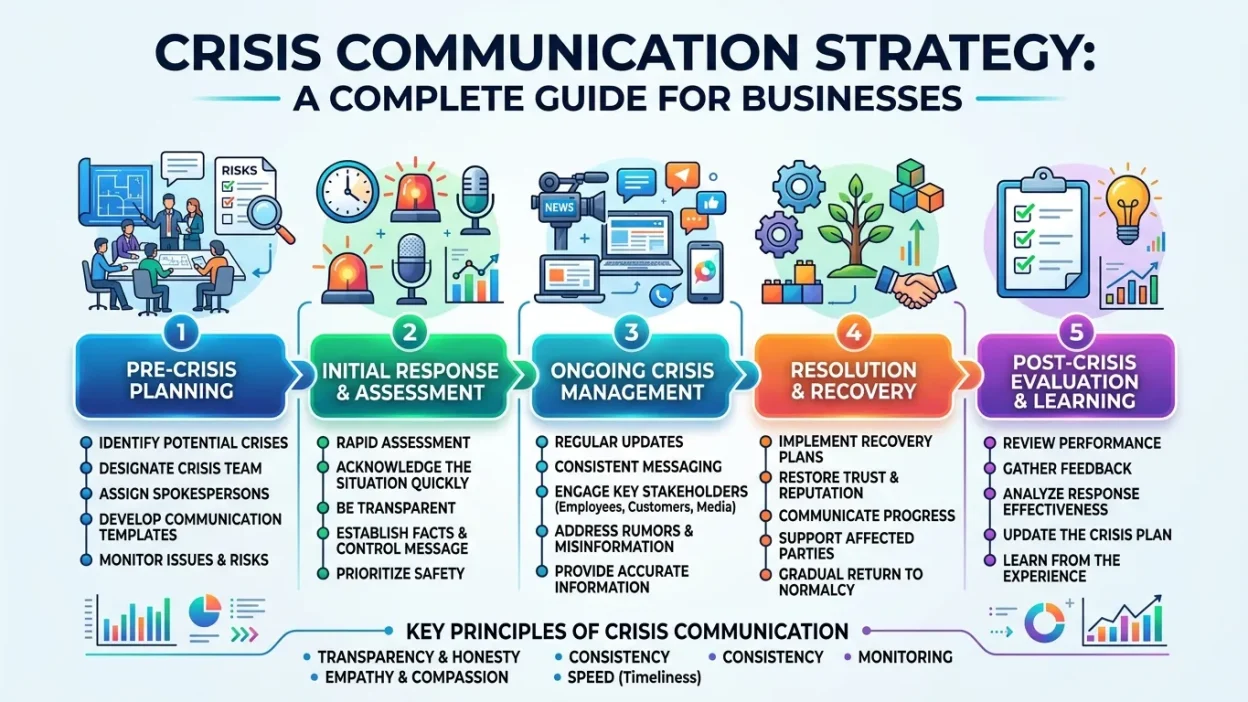
A crisis communication strategy helps businesses respond clearly during unexpected events. A strong crisis communication plan uses prepared messaging and reliable channels to reduce confusion, maintain trust, and protect the business’s reputation.
Every business can face unexpected situations that affect customers, employees, partners, or the public. A product problem, data incident, service interruption, executive controversy, workplace incident, or negative public story can quickly develop into a serious business challenge.
How a company communicates during such a situation can have a major effect on how people respond to the crisis. Silence, inconsistent statements, delayed responses, or unclear information can increase uncertainty and damage trust. On the other hand, clear and responsible communication can help stakeholders understand what happened and what the business is doing about it.
This is why a crisis communication strategy should be developed before a crisis occurs. Businesses need to know who is responsible for communication, which channels will be used, how information will be approved, and how updates will be provided.
Crisis communication is not simply about protecting a company’s image. It is about providing accurate information, addressing concerns, supporting affected people, and helping the organization respond responsibly.
What Is a Crisis Communication Strategy?
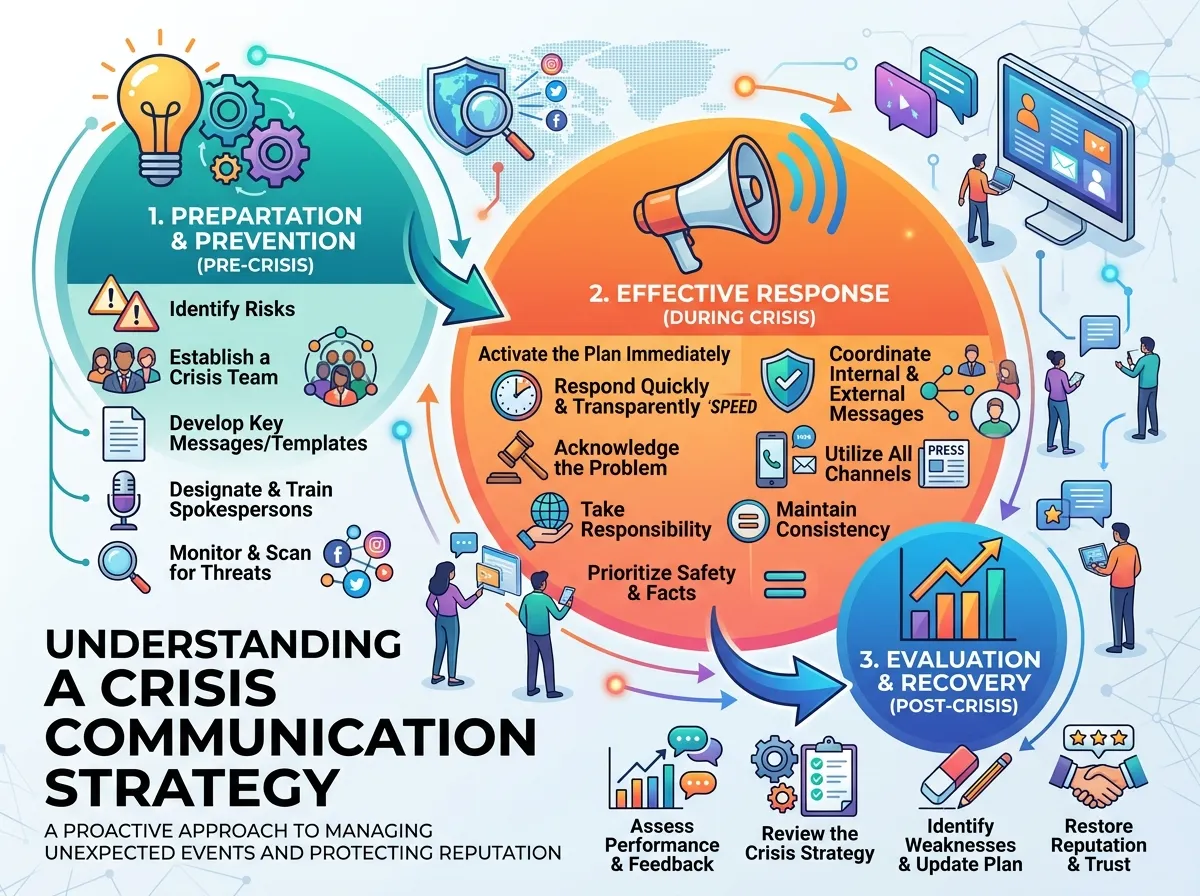
A crisis communication strategy is a structured approach for communicating with stakeholders during and after an unexpected event that could negatively affect a business.
The strategy explains how the company will communicate with employees, customers, investors, partners, media organizations, regulators, and other relevant audiences.
A crisis may develop quickly, leaving little time to create messages from scratch. A prepared strategy gives the organization a framework for responding under pressure.
The goal is to make communication timely, accurate, consistent, and appropriate to the situation.
A strong strategy also recognizes that different audiences may need different information. Employees may need operational instructions, customers may need information about products or services, and the media may require a clear explanation of the company’s response.
Why Crisis Communication Matters
During a crisis, people often want answers immediately. If a company does not provide reliable information, stakeholders may look elsewhere for explanations.
Social media can make this particularly challenging because inaccurate information can spread quickly. A small issue can become a larger reputational problem if the organization appears unprepared or unwilling to communicate.
Effective crisis communication can reduce uncertainty and show stakeholders that the company is taking the situation seriously.
Communication also helps employees understand what they should do and prevents different departments from providing contradictory information.
The objective is not to make a crisis disappear through messaging. Instead, communication should support responsible action and help stakeholders understand what is happening.
Crisis Communication Plan
A crisis communication plan provides the practical foundation for responding to an emergency or serious business issue.
The plan should establish who has authority to communicate publicly, who approves statements, which teams need to be involved, and which communication channels should be used.
It should also identify key stakeholder groups and explain what types of information they may need.
A useful plan should be easy to access during an emergency. If employees have to search through complicated documents while a crisis is unfolding, valuable time may be lost.
Businesses should periodically review the plan and update contact information, responsibilities, communication channels, and procedures.
Crisis Management Strategy
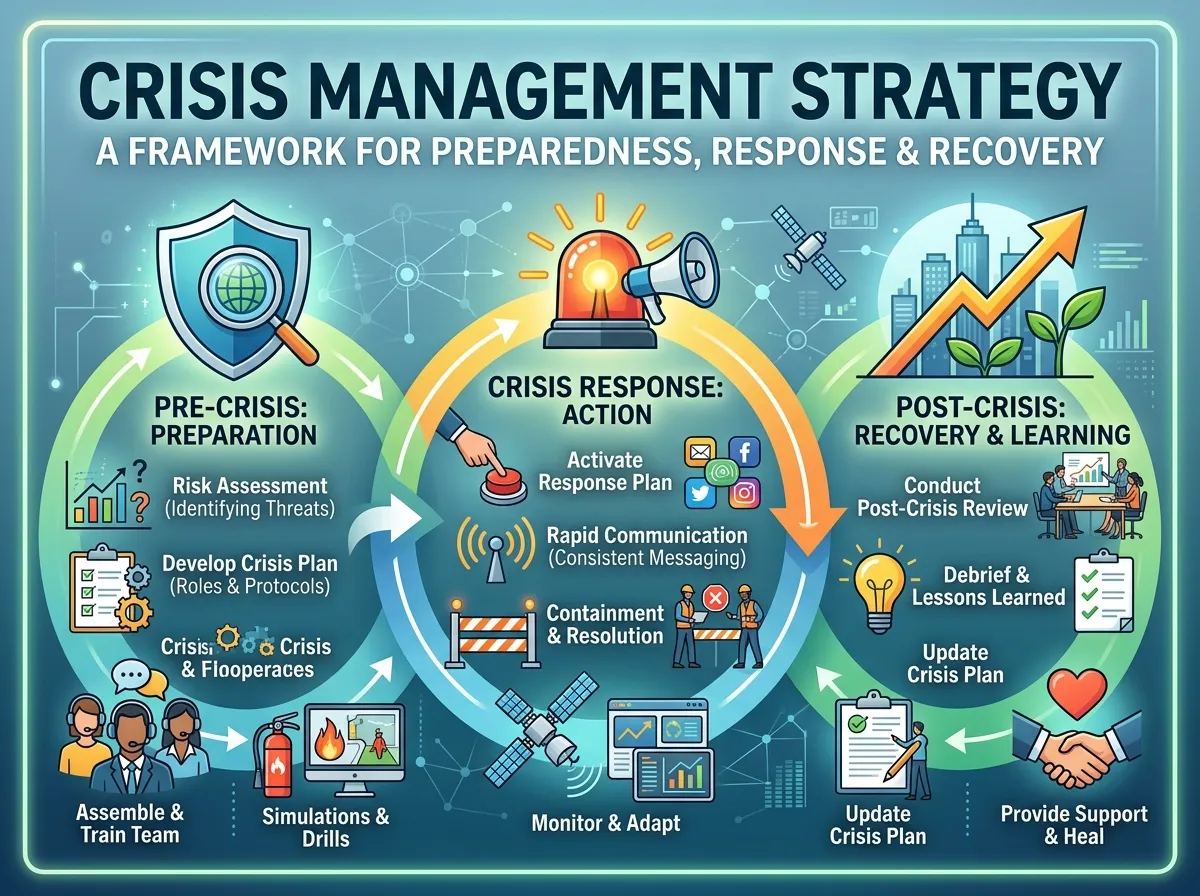
A crisis management strategy goes beyond communication. It focuses on how the organization identifies, responds to, manages, and recovers from a crisis.
Communication is an important part of that larger process.
A company may have an excellent communication plan, but if it does not address the underlying problem, stakeholders may quickly lose trust.
Crisis management should therefore combine operational action with transparent communication. The business should identify the problem, protect affected stakeholders, investigate what happened, take appropriate corrective action, and communicate meaningful updates.
The communication strategy should reflect the actual actions being taken.
Business Crisis Communication
Business crisis communication involves managing information between a company and the people affected by or interested in a crisis.
These audiences may include customers, employees, suppliers, business partners, shareholders, regulators, journalists, and members of the public.
Each audience may have different concerns. Customers may want to know whether they are affected. Employees may need instructions about their responsibilities. Business partners may need information about operational changes.
Messages should therefore be adapted to the needs of each audience while maintaining consistent facts.
The company should avoid providing different versions of the truth to different groups. The emphasis and level of detail can vary, but important facts should remain consistent.
Identifying Potential Crises
A strong strategy begins before a crisis happens. Businesses should identify the situations that could significantly disrupt operations or damage stakeholder trust.
Potential risks vary by industry. A technology company may face a cybersecurity incident, while a manufacturer may deal with product safety problems. A service company may experience a major outage, and a public-facing organization may face reputational controversy.
Identifying potential scenarios allows businesses to prepare appropriate communication procedures.
Companies should also consider how different risks could affect customers, employees, operations, finances, and reputation.
The purpose is not to predict every possible event. It is to prepare for the types of situations that could realistically have a significant impact.
Crisis Communication Tactics
Crisis communication tactics are the specific actions used to communicate during a crisis.
One important tactic is acknowledging the situation quickly when sufficient information is available. A company does not always need to have every answer immediately, but it should avoid making unsupported claims.
Another tactic is providing regular updates. Even when there is little new information, communicating what the organization is currently doing can help reduce uncertainty.
Businesses should also make information easy to access. Depending on the crisis, this could involve a dedicated webpage, email updates, social media posts, customer support announcements, or direct communication with affected stakeholders. Maintaining relevant communication throughout the customer journey can also complement lead nurturing workflows by helping businesses stay connected with audiences over time.
The communication channel should match the audience and urgency of the situation.
Crisis Response Plan
A crisis response plan defines how the organization will react when a serious incident occurs.
The plan should establish how the crisis is identified, who takes control of the response, how information is collected, and how communication decisions are made.
A designated crisis team can help coordinate information across departments. This prevents different teams from releasing contradictory statements.
The response plan should also establish an approval process that is fast enough for urgent situations while still providing appropriate oversight.
Regular simulations or exercises can help employees understand their responsibilities before a real crisis occurs.
Corporate Crisis Communication
Corporate crisis communication focuses on protecting trust and maintaining effective communication during serious issues affecting an organization.
Large organizations may have several departments, locations, brands, and stakeholder groups. This can make crisis communication more complicated.
A central communication process can help ensure that important messages remain consistent across different business units.
Corporate communications teams may coordinate with legal, public relations, customer service, human resources, security, and senior leadership.
However, legal considerations should not result in communication that is unnecessarily vague or misleading. Companies should work with appropriate professionals to ensure that information is accurate and responsible.
Choosing the Right Communication Channels
The right communication channel depends on the type of crisis and the affected audience.
A company may use its website for detailed information, email for direct communication, social media for timely updates, and customer support channels for individual questions.
Employees may receive information through internal communication systems, email, meetings, or workplace platforms.
The company should avoid relying on only one channel when a crisis affects a large audience. Multiple appropriate channels can improve access to important information.
At the same time, businesses should ensure that all channels communicate consistent core information. For B2B organizations, communication should also align with the broader B2B email marketing strategy used to maintain professional relationships.
Transparency During a Crisis
Transparency is one of the most important principles of crisis communication.
Being transparent does not mean sharing every piece of information immediately. Some information may need to be verified first, or there may be legitimate privacy, security, or legal restrictions.
However, businesses should avoid deliberately misleading stakeholders or making claims they cannot support.
If an investigation is still underway, the company can explain what is known, what remains uncertain, and what steps are being taken to learn more.
Admitting uncertainty can be more credible than providing an inaccurate answer simply to appear confident.
Crisis Response Communication
Crisis response communication should focus on facts, actions, and the needs of affected stakeholders.
A useful message should help people understand what happened, whether they are affected, what the company is doing, and what they should do next.
The language should be clear and easy to understand. Technical terms and corporate jargon can create additional confusion.
Messages should also avoid unnecessary defensiveness. Trying to shift blame before the facts are established can make the situation worse.
The tone should be professional, empathetic, and appropriate to the seriousness of the event.
Reputation Management Strategy
A reputation management strategy becomes especially important after a crisis. Reputation can be affected not only by the original incident but also by how the organization responds.
A company that acknowledges mistakes, takes corrective action, and communicates responsibly may be able to rebuild trust over time.
After the immediate crisis has passed, businesses should continue monitoring customer feedback, media coverage, social conversations, reviews, and other relevant sources.
The organization should also demonstrate meaningful improvements rather than relying only on public statements.
Actions often have a greater long-term impact on reputation than communication alone. For organizations managing multiple B2B relationships, these efforts can also work alongside a scale account based marketing framework for growth to maintain consistent communication with high-value accounts.
Social Media During a Crisis
Social media can be valuable during a crisis because it allows businesses to communicate quickly with large audiences.
However, it can also increase the risk of misinformation and rapid public criticism.
Companies should monitor relevant social channels and respond to significant concerns with verified information.
They should avoid arguing with individual users or responding emotionally to criticism.
Social media updates should direct people to reliable sources when more detailed information is available.
Businesses should also remember that social posts can be shared widely and may remain accessible long after the crisis ends. Every public message should therefore be carefully considered.
Internal Communication During a Crisis

Employees are an important stakeholder group and should not be overlooked.
Employees may hear about a crisis through social media or news coverage before receiving official information from the organization. This can create uncertainty and lead to rumors.
Internal communication should provide employees with accurate information and clear instructions about their responsibilities.
Employees who interact directly with customers should know what information they can provide and where they should direct questions.
Good internal communication can help employees feel informed while reducing inconsistent external messaging.
Crisis Communication Best Practices
Crisis communication best practices include preparing before problems occur, communicating accurate information, responding promptly, and maintaining consistency across channels.
Businesses should avoid speculation and should not make promises they cannot keep.
Messages should acknowledge legitimate concerns and explain the steps being taken to address the problem.
Organizations should also maintain records of major communications during the crisis. This can help with later analysis and improve future planning.
After the crisis, businesses should review what happened and identify what worked and what did not.
Emergency Communication Strategy
An emergency communication strategy focuses on situations where information needs to reach stakeholders quickly.
Emergencies can include natural disasters, major operational disruptions, safety incidents, cybersecurity events, or other situations requiring immediate action.
The strategy should establish which channels are most reliable during different types of emergencies. Organizations can also consider broader approaches to mobilizing community resilience when emergencies affect employees, customers, and local communities.
For example, if a website becomes unavailable, the organization may need an alternative communication channel. If employees cannot access internal systems, another method may be necessary.
Redundancy is therefore important. Businesses should have backup communication methods and updated contact information.
Common Crisis Communication Mistakes
One of the biggest mistakes is waiting too long to respond. Silence can create uncertainty and allow others to control the narrative.
Another mistake is releasing unverified information. A quick but inaccurate statement can create more problems than a short delay while facts are confirmed.
Companies may also use overly complicated language that makes their message difficult to understand.
Ignoring employees is another common problem. Internal stakeholders need reliable information just as much as customers do.
Finally, businesses sometimes focus too heavily on reputation and not enough on the people affected by the crisis. Effective communication should prioritize safety, responsibility, and useful information.
Preparing for Future Crises
Crisis preparation should be an ongoing process. Businesses should regularly review potential risks and update their communication procedures.
Training can help employees understand who is responsible for communication and how information should be handled.
Organizations can also conduct crisis simulations to test their response. These exercises may reveal problems with approval processes, contact lists, communication channels, or internal coordination.
After a real crisis, the company should conduct a review to understand what happened and how its response can be improved.
Learning from previous incidents can make future crisis communication more effective.
Measuring Crisis Communication Effectiveness
Measuring crisis communication is not as simple as tracking marketing performance. The goal is to determine whether stakeholders received accurate information and whether communication supported the broader response.
Businesses can examine response times, customer inquiries, employee feedback, media coverage, social media reactions, website traffic, and stakeholder sentiment.
They can also evaluate whether customers understood important instructions and whether employees received the information they needed.
Post-crisis surveys can provide additional insight into how stakeholders perceived the company’s communication.
These findings can then be used to improve the organization’s crisis plan.
Final Thoughts
A strong crisis communication strategy helps businesses prepare for unexpected situations and communicate responsibly when problems occur. Effective communication cannot eliminate a crisis, but it can reduce confusion, support affected stakeholders, and help protect long-term trust.
A complete approach should include a practical crisis communication plan, clear responsibilities, appropriate communication channels, prepared response procedures, and regular training.
Businesses should focus on accurate information, timely updates, transparency, empathy, and meaningful action. Crisis response communication should support the organization’s actual efforts to solve the underlying problem rather than attempting to hide or minimize it.
With proper preparation and a commitment to responsible communication, businesses can respond more confidently when serious challenges arise and create a stronger foundation for recovery afterward.
Frequently Asked Questions
1. What is a crisis communication strategy?
A crisis communication strategy is a plan for communicating with customers, employees, media, partners, and other stakeholders during and after a serious business incident.
2. Why is a crisis communication plan important?
A crisis communication plan helps businesses respond quickly and consistently. It establishes responsibilities, communication channels, approval processes, and procedures before a crisis occurs.
3. What is the difference between crisis management and crisis communication?
Crisis management focuses on managing and resolving the overall situation, while crisis communication focuses specifically on providing information to stakeholders throughout the crisis.
4. What should a company communicate during a crisis?
A company should communicate verified information about what happened, who may be affected, what actions are being taken, and what stakeholders should do next.
5. How quickly should a business respond to a crisis?
Businesses should respond as quickly as reasonably possible with accurate information. If all facts are not yet available, the company can acknowledge the situation and explain that additional information will follow.
6. Why is transparency important during a crisis?
Transparency can reduce uncertainty and help maintain trust. Businesses should communicate honestly about what is known, what is still being investigated, and what actions are being taken.
7. What channels can businesses use during a crisis?
Businesses can use websites, email, social media, customer support, internal communication systems, press statements, and direct communication depending on the situation and affected audience.
8. How can social media help with crisis communication?
Social media allows businesses to distribute timely updates and direct audiences toward reliable information. However, companies should monitor responses carefully and avoid emotional or speculative communication.
9. What is reputation management after a crisis?
Reputation management involves rebuilding stakeholder trust after a crisis through responsible communication, corrective action, monitoring public perception, and demonstrating meaningful improvements.
10. How can businesses prepare for a crisis?
Businesses can prepare by identifying potential risks, creating a crisis communication plan, assigning responsibilities, preparing communication procedures, maintaining updated contact information, and conducting regular crisis response exercises.