
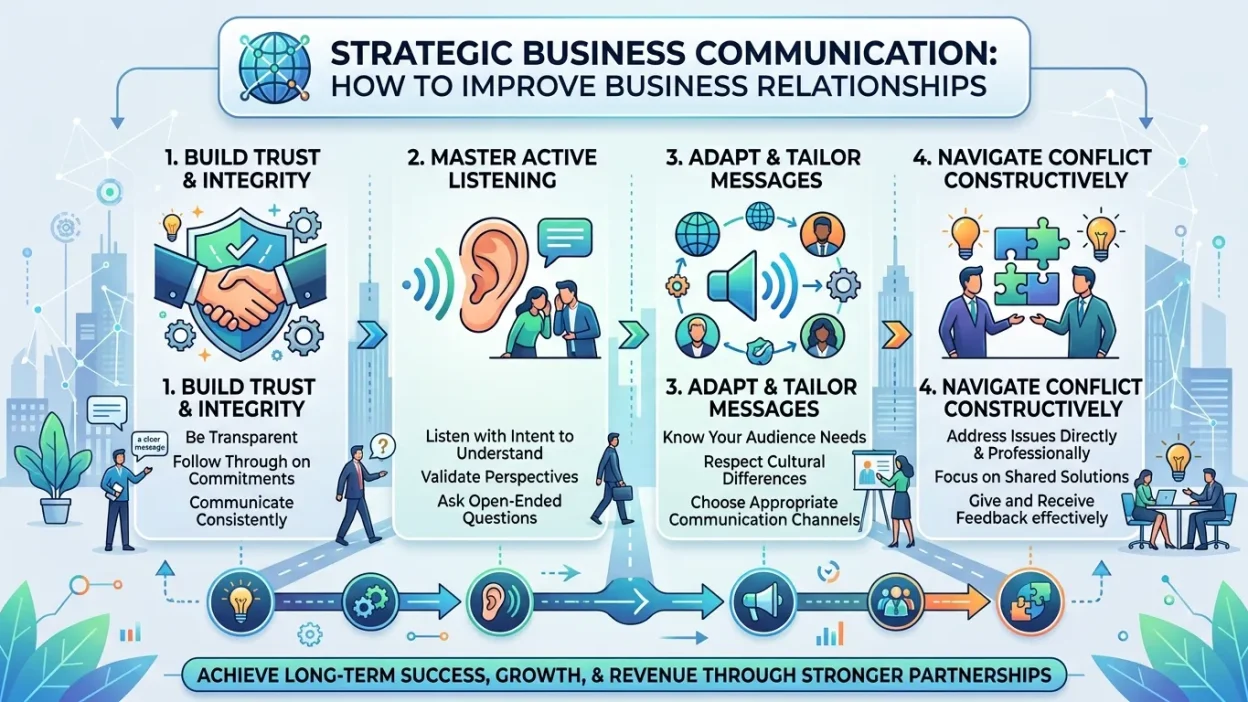
Strategic business communication helps organizations deliver clear, consistent, and purposeful messages across internal and external channels. Effective planning, professional communication skills, stakeholder engagement, and performance measurement can strengthen business relationships and support organizational goals.
Strategic business communication plays an important role in how organizations share information, build relationships, coordinate teams, and communicate with customers and stakeholders. Businesses rely on communication every day, but effective communication requires more than simply exchanging messages. It needs clear objectives, consistent messaging, appropriate channels, and an understanding of the people receiving the information.
Whether communication takes place inside an organization or with customers, partners, investors, suppliers, or the wider market, the quality of communication can influence trust and collaboration. A structured approach helps businesses communicate their goals clearly while maintaining consistency across different departments and communication channels.
As businesses become more connected through digital platforms, communication has also become more complex. Companies may communicate through email, websites, social media, video meetings, messaging platforms, events, newsletters, and other channels. Strategic planning helps ensure that these interactions support broader business objectives.
What Is Strategic Business Communication?
Strategic business communication is the planned use of communication to support an organization’s goals, relationships, and overall business direction. Instead of treating every message as an isolated activity, businesses consider what they want to communicate, who needs to receive it, which channel is appropriate, and what action or understanding should result.
This approach can apply to internal communication between employees and departments as well as external communication with customers, partners, investors, media, and other stakeholders.
A strong communication strategy helps create consistency. When employees, marketing teams, sales representatives, executives, and customer service teams communicate around the same core objectives, the organization can present a more unified message.
Strategic communication is particularly valuable during periods of change. Product launches, organizational changes, new partnerships, business expansions, and major events often require coordinated communication across multiple audiences.
Why Strategic Business Communication Matters
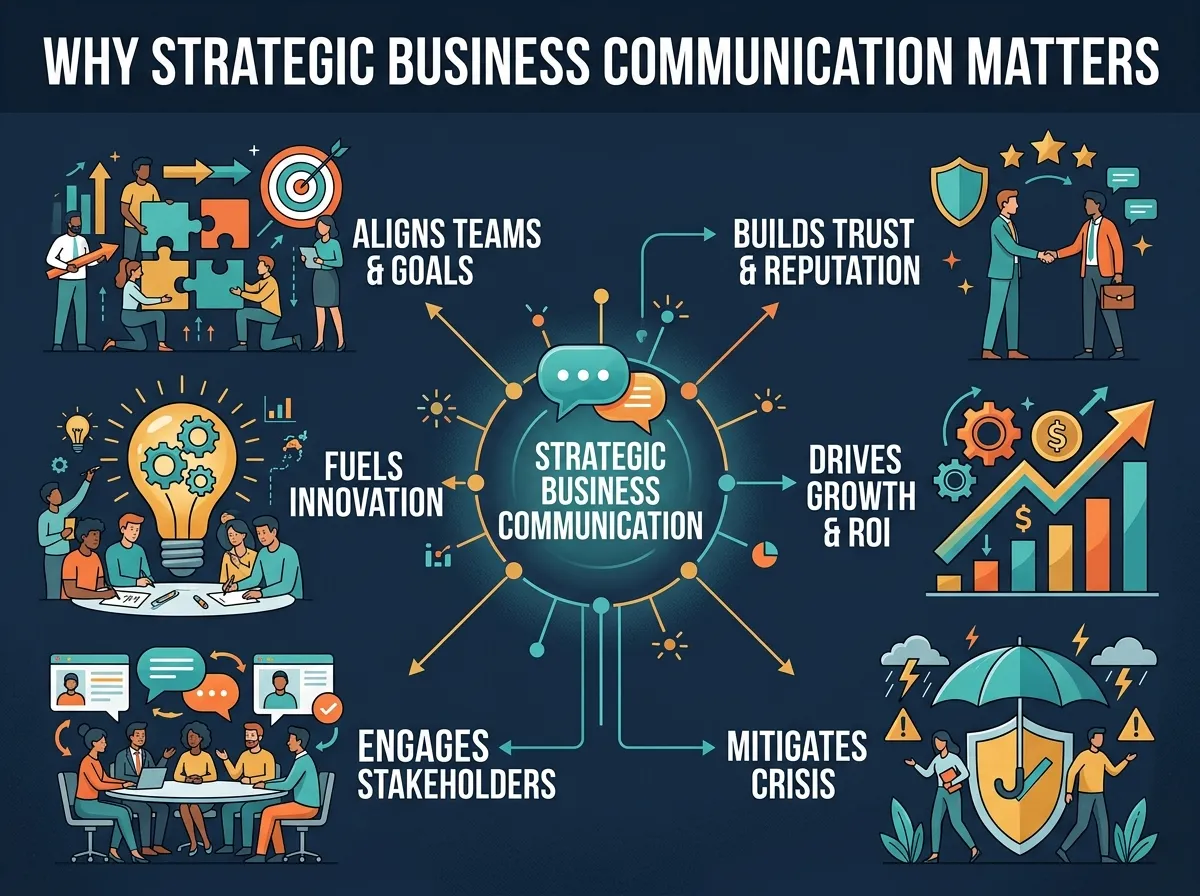
Communication affects almost every area of business operations. Employees need clear information to understand responsibilities and priorities. Customers need accurate information about products and services. Partners need reliable communication to coordinate activities. Leadership teams need effective channels for sharing decisions and receiving feedback.
Poor communication can create confusion, delays, inconsistent messaging, and misunderstandings. In contrast, effective communication can help people understand expectations and make informed decisions.
A clear communication framework also supports brand consistency. Businesses need to ensure that their messages reflect their values, positioning, and customer experience across different touchpoints. A strong brand marketing strategy can work alongside communication planning to maintain a consistent identity and message.
Building a Business Communication Strategy
A business communication strategy begins with clear objectives. Businesses should determine what they want communication to achieve before deciding what messages or channels to use.
Objectives may include improving employee collaboration, increasing customer awareness, supporting a product launch, strengthening stakeholder relationships, managing organizational change, or improving customer service.
The next consideration is the audience. Different groups may have different information needs, expectations, and communication preferences. Employees may require detailed operational information, while customers may need concise explanations of products or services.
Businesses should also determine which channels are most appropriate. Email may work well for formal information, while meetings or video calls may be more suitable for complex discussions. Social media and websites can support public communication, while internal platforms can be used for employee updates.
Strategic Communication Planning
Strategic communication planning provides a structured framework for organizing communication activities around business priorities. It helps organizations determine what needs to be communicated, when it should be communicated, who is responsible, and which audiences should receive the information.
Planning can reduce inconsistent messaging because teams have a shared understanding of communication priorities. It can also help businesses prepare for important events and potential communication challenges.
For example, a company launching a new product may need coordinated communication across its website, email campaigns, sales materials, customer service teams, social media channels, and internal employees. A communication plan can ensure that these channels provide consistent and accurate information.
Planning should also allow room for feedback. Communication is not only about sending information. Organizations need to understand how audiences respond and whether additional clarification is required.
Effective Business Communication
Effective business communication is clear, relevant, timely, and appropriate for the intended audience. The message should be easy to understand without unnecessary complexity.
Clarity is especially important when communicating important decisions or instructions. Ambiguous language can result in different interpretations and create operational problems.
Tone also matters. A message intended for employees may use a different style from a customer-facing announcement, even when both communicate the same organizational objective.
Good communication also considers timing. Delivering the right information too late can reduce its usefulness. Businesses should establish communication schedules for recurring information and coordinate timing for major announcements.
Listening is another important element. Effective communication includes receiving feedback, asking questions, and understanding concerns rather than focusing entirely on delivering messages.
Corporate Communication Strategy
A corporate communication strategy brings together communication activities that influence how an organization communicates with internal and external audiences. It can cover corporate announcements, media communication, investor relations, employee communication, customer messaging, public relations, and brand communication.
Consistency is important because different audiences may encounter information from multiple sources. If corporate messaging differs significantly between the company website, executives, employees, and public communications, stakeholders may become uncertain about the organization’s position.
Corporate communication should therefore be connected to organizational objectives and brand values. Teams responsible for communication should understand the company’s priorities and maintain alignment across channels.
During periods of change or uncertainty, corporate communication can become especially important. Organizations need to provide accurate information, address questions, and communicate updates in a timely manner.
Business Communication Techniques

Several business communication techniques can help organizations make their messages clearer and more useful. One important technique is audience-focused communication. Instead of starting with what the company wants to say, communicators can consider what the audience needs to know.
Storytelling can also make complex information easier to understand. Businesses can use examples, customer experiences, scenarios, and real-world situations to explain ideas.
Visual communication can support written messages as well. Charts, diagrams, presentations, videos, and other visual formats can make information easier to process when used appropriately.
Another useful technique is message prioritization. Important information should be easy to identify, particularly when audiences are receiving large amounts of communication.
Businesses can also use feedback mechanisms such as surveys, meetings, polls, customer reviews, and employee discussions to understand how communication is being received.
Internal Communication Strategy
An internal communication strategy focuses on communication between employees, managers, departments, and leadership teams. Its purpose is to ensure that employees have access to the information they need to perform their roles effectively.
Internal communication can include company announcements, team meetings, newsletters, training materials, employee portals, messaging platforms, and leadership updates.
Transparency is important when communicating internally. Employees are more likely to understand organizational decisions when leaders provide relevant context and explain how changes may affect teams.
Internal communication should also be two-way. Employees should have appropriate opportunities to ask questions, provide feedback, and raise concerns.
A strong internal communication approach can support collaboration by helping different departments understand how their work contributes to broader organizational objectives.
External Business Communication
External business communication involves communication with audiences outside the organization. This can include customers, prospects, suppliers, partners, investors, media organizations, industry communities, and other stakeholders.
External messages should reflect the organization’s identity and provide accurate, relevant information. Websites, social media, email marketing, press releases, advertisements, customer support interactions, events, and sales communications can all form part of external communication.
Consistency across these channels is important. Customers may interact with a company through several touchpoints before making a purchase, so different channels should communicate compatible information.
Businesses can also use external communication to educate audiences. Helpful content, industry insights, research, and customer resources can build awareness and support longer-term relationships.
An inbound marketing strategy can complement external communication by attracting audiences through useful content and guiding them toward relevant business resources.
Professional Communication Skills
Strong professional communication skills are valuable at every level of an organization. Employees often need to communicate with colleagues, managers, customers, suppliers, and business partners.
Written communication requires clarity, structure, and appropriate tone. Emails, reports, proposals, presentations, and other business documents should make their main message easy to understand.
Verbal communication also requires active listening. Professionals should pay attention to questions, concerns, and context before responding.
Presentation skills can be particularly useful for meetings, sales discussions, training sessions, and industry events. A clear presentation can help audiences understand complex information and remember important points.
Emotional awareness also supports professional communication. Different people may interpret messages differently, so communicators should consider context and respond respectfully when disagreements occur.
Stakeholder Communication Strategy
A stakeholder communication strategy helps businesses organize communication with groups that have an interest in the organization. Stakeholders can include employees, customers, investors, suppliers, partners, regulators, and community groups.
Different stakeholders may require different information. Investors may be interested in business performance and strategic direction, while customers may focus on product quality and service. Employees may need information about organizational priorities and operational changes.
Businesses should identify important stakeholder groups and determine what information each group needs. Communication frequency and channel selection can then be adapted accordingly.
Stakeholder communication should also create opportunities for feedback. Understanding stakeholder concerns can help organizations identify potential issues and improve their decision-making processes.
Business Communication Management
Business communication management involves organizing, coordinating, and monitoring communication activities across an organization. It helps ensure that messages are accurate, timely, consistent, and aligned with business objectives.
Communication management becomes increasingly important as organizations grow. Larger companies may have multiple departments creating content and communicating with different audiences. Without coordination, inconsistent messaging can occur.
Businesses can establish communication guidelines that define tone, terminology, approval processes, brand standards, and channel usage. These guidelines can help employees communicate more consistently.
Technology can also support communication management. Collaboration platforms, customer relationship management systems, email tools, analytics platforms, and content management systems can help teams organize communication activities.
Data can provide additional insight into communication performance. Marketing analytics and data-driven insights can help businesses understand how audiences interact with digital content and identify areas where communication may need improvement.
Communication During Business Events
Business events require coordinated communication before, during, and after the event. Attendees need information about registration, schedules, speakers, locations, access instructions, and follow-up resources.
Communication should also remain consistent across promotional channels. Social media, email, websites, registration pages, and event materials should provide accurate and compatible information.
During an event, communication may involve presenters, moderators, attendees, sponsors, and event teams. Clear responsibilities and communication channels can help reduce confusion.
For organizations using events as part of their marketing activities, digital marketing for events can support audience awareness, engagement, registration, and post-event communication.
Measuring Communication Effectiveness
Businesses need to evaluate whether their communication activities are achieving their intended objectives. Measurement can vary depending on the type of communication.
For internal communication, organizations may examine employee engagement, participation, feedback, understanding of key initiatives, and response rates. External communication may be evaluated through website engagement, email performance, social interactions, customer feedback, lead generation, and conversions.
Qualitative feedback is also valuable. Numbers can show what happened, but conversations and surveys can help explain why audiences responded in a particular way.
Regular evaluation allows businesses to identify communication gaps and improve future campaigns. The goal is not simply to increase the volume of communication but to improve its relevance and effectiveness.
Common Challenges in Business Communication
Businesses can face several communication challenges. Information overload is one common problem. Employees and customers may receive large amounts of information across multiple channels, making it difficult to identify what is most important.
Inconsistent messaging can also create confusion. Different departments may communicate similar topics using different terminology or information.
Another challenge is poor audience targeting. A message may be accurate but still ineffective if it is delivered to the wrong audience or through an unsuitable channel.
Delayed communication can create additional problems, especially when stakeholders need timely information to make decisions.
Businesses can address these challenges through clear communication planning, audience segmentation, consistent guidelines, appropriate technology, and regular performance evaluation.
Building a Strong Communication Culture

Strategic communication should become part of the broader organizational culture rather than being limited to marketing or public relations teams. Employees at different levels influence how an organization communicates.
Leadership plays an important role because employees often look to executives and managers for clarity about organizational priorities. Consistent leadership communication can help reinforce important messages.
Training can also improve communication capabilities. Employees can benefit from learning how to write professional messages, conduct meetings, present information, listen actively, and communicate with different audiences.
A communication culture should encourage both clarity and feedback. Employees should feel able to ask questions and share relevant information while maintaining professional standards.
Conclusion
Strategic business communication helps organizations connect their goals with the way they communicate internally and externally. A clear communication strategy can improve collaboration, strengthen stakeholder relationships, support customer engagement, and maintain consistency across different channels.
From internal communication and corporate messaging to customer communication and event promotion, every interaction contributes to how an organization is understood. Businesses that plan their communication carefully can make information more relevant, timely, and useful.
By combining strategic planning, effective communication techniques, professional skills, appropriate technology, and regular measurement, organizations can build a communication system that supports both everyday operations and long-term business objectives.
FAQs About Strategic Business Communication
1. What is strategic business communication?
Strategic business communication is the planned use of communication to support organizational goals. It includes internal and external communication with employees, customers, partners, investors, and other stakeholders.
2. Why is strategic business communication important?
It helps businesses communicate clearly, maintain consistent messaging, improve collaboration, strengthen relationships, and support business objectives. It can also reduce misunderstandings and communication gaps.
3. What is a business communication strategy?
A business communication strategy is a structured plan that defines communication objectives, target audiences, key messages, communication channels, timing, responsibilities, and methods for measuring results.
4. What is strategic communication planning?
Strategic communication planning involves organizing communication activities around specific business objectives. It helps determine what information should be communicated, to whom, through which channels, and when.
5. What are effective business communication techniques?
Useful techniques include audience-focused messaging, active listening, clear writing, storytelling, visual communication, message prioritization, appropriate tone, and structured feedback.
6. What is an internal communication strategy?
An internal communication strategy organizes how information is shared among employees, managers, departments, and leadership. It can include meetings, emails, newsletters, employee platforms, training, and leadership communication.
7. What is external business communication?
External business communication refers to communication with audiences outside the organization, including customers, prospects, suppliers, partners, investors, media, and other stakeholders.
8. Why are professional communication skills important?
Professional communication skills help employees express ideas clearly, listen effectively, collaborate with others, handle business conversations, create professional documents, and communicate appropriately with different audiences.
9. How can businesses improve stakeholder communication?
Businesses can improve stakeholder communication by identifying different stakeholder groups, understanding their information needs, choosing suitable channels, communicating consistently, providing timely updates, and creating opportunities for feedback.
10. How can businesses measure communication effectiveness?
Businesses can use metrics such as engagement, response rates, website activity, email performance, employee feedback, customer feedback, participation, and conversions. Qualitative feedback can provide additional context about communication quality.