
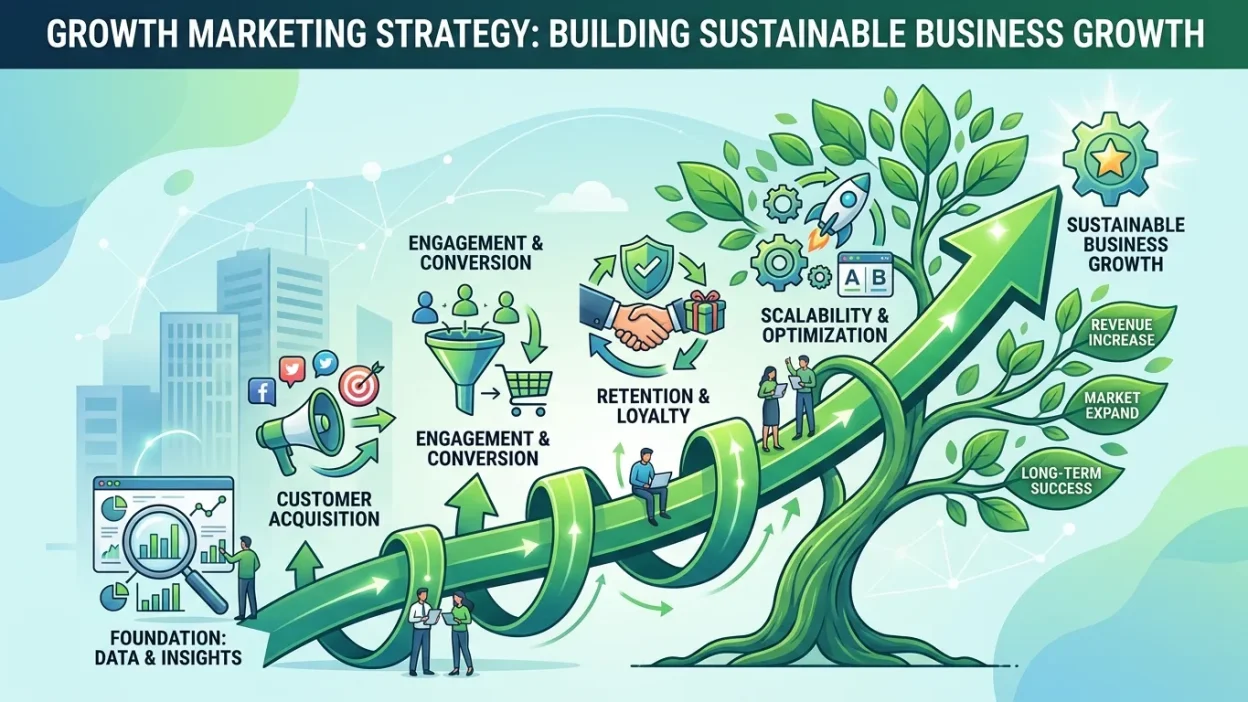
A growth marketing strategy uses experimentation, customer insights, data, and continuous optimization to improve business growth across the entire customer journey. By combining acquisition, retention, analytics, personalization, and scalable marketing methods, businesses can identify growth opportunities and build sustainable long-term results.
Business growth rarely comes from a single marketing campaign. While traditional marketing often focuses heavily on attracting attention and generating leads, modern businesses need to consider the entire customer journey. Acquiring customers is important, but retaining them, increasing engagement, improving conversions, and encouraging referrals can also contribute significantly to long-term growth.
This is where a growth marketing strategy becomes valuable. Growth marketing takes a broader approach by combining creativity, experimentation, customer insights, technology, and data to identify opportunities across the marketing funnel.
Instead of assuming that one campaign or channel will continue producing the same results, growth marketers continually test ideas, analyze performance, and make improvements. This approach can help businesses understand what customers respond to and where opportunities exist for better acquisition, engagement, conversion, and retention.
A strong growth strategy also needs to support sustainable business objectives. Rapid growth without a clear understanding of customer needs can create problems with retention, service quality, and profitability. The goal is to build a repeatable marketing system that can evolve as the business grows.
What Is a Growth Marketing Strategy?
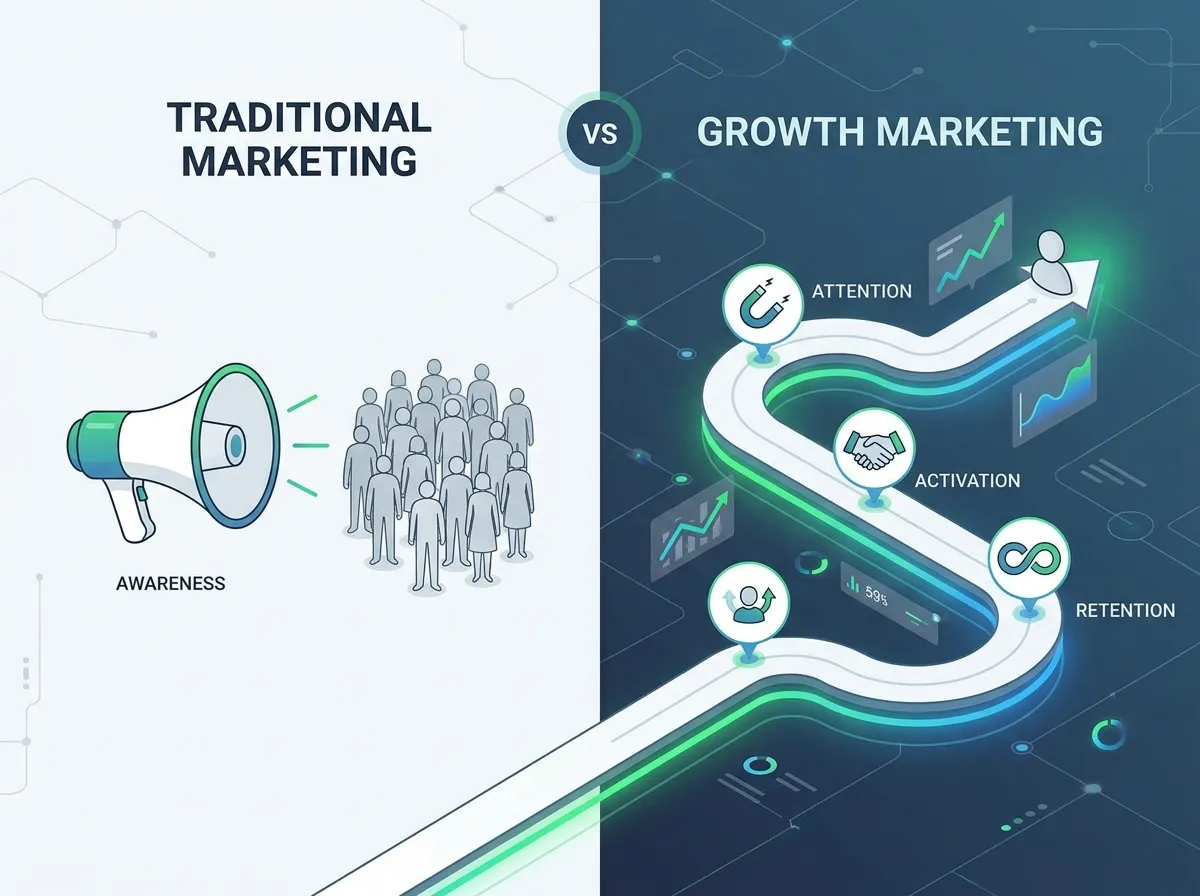
A growth marketing strategy is a structured approach to achieving business growth through continuous experimentation and optimization across the customer lifecycle. It looks beyond customer acquisition and considers activation, engagement, conversion, retention, and advocacy.
Growth marketing teams may test different messages, landing pages, content formats, pricing approaches, channels, offers, onboarding experiences, and customer communication methods.
The results of these experiments provide information that can be used to improve future decisions. A campaign that performs well can be expanded, while an approach that produces weak results can be changed or discontinued.
This makes growth marketing an ongoing process rather than a one-time campaign. The strategy evolves as customer behavior, market conditions, technology, and business objectives change.
Building a Growth Marketing Strategy Framework
A growth marketing strategy framework provides a structure for organizing growth activities. It can begin with business objectives and then connect those objectives to customer needs, marketing channels, experiments, metrics, and optimization.
The first step is usually understanding the target audience. Businesses need to know who they are trying to reach, what problems those customers have, what motivates them, and how they make purchasing decisions.
The next step is identifying the customer journey. A potential customer may discover a business through search or social media, visit the website, explore products, sign up for an account, make a purchase, and later become a repeat customer.
Each stage provides opportunities for optimization. Businesses can then determine which metrics matter at each stage and develop experiments designed to improve performance.
A framework should also establish a process for prioritizing experiments. Teams can consider the potential impact, effort required, available evidence, and relevance to business objectives before deciding which ideas to test.
Understanding the Growth Marketing Funnel
The growth marketing funnel represents the stages customers move through as they interact with a business. While funnel models vary, they commonly include awareness, acquisition, activation, conversion, retention, and advocacy.
At the awareness stage, customers become familiar with a brand or solution. Acquisition focuses on attracting people to the website, application, store, or other relevant channel.
Activation occurs when users take a meaningful action, such as signing up, completing onboarding, using a key feature, or engaging with content.
Conversion focuses on actions that directly support business objectives, such as purchases, subscriptions, bookings, or qualified leads.
Retention focuses on keeping customers engaged over time, while advocacy can involve referrals, reviews, recommendations, and other forms of customer-driven growth.
Looking at the entire funnel helps businesses identify where potential customers are being lost and where improvements may create meaningful results.
Growth Marketing Tactics for Acquisition
Effective growth marketing tactics can help businesses attract relevant audiences while testing which channels and messages produce the strongest results.
Search marketing can capture customers who are already looking for relevant products or services. Content marketing can attract audiences through useful information and educational resources. Social media can support awareness and engagement, while paid advertising can provide more immediate reach.
Partnerships and referral programs can create additional acquisition opportunities. Email marketing can also support lead nurturing and conversion.
The important point is that growth marketers do not necessarily treat every channel equally. They use data and experimentation to determine which channels are appropriate for the target audience and business model.
Acquisition should also be evaluated based on customer quality rather than traffic volume alone. A channel that generates many visitors but few qualified customers may be less useful than a smaller channel that consistently attracts customers with strong long-term value.
Growth Marketing Techniques for Continuous Improvement
Growth marketing techniques often focus on testing small changes and measuring their impact. A business may test different landing page headlines, call-to-action wording, email subject lines, pricing presentations, onboarding steps, or content formats.
A/B testing can help compare different versions of a customer experience. Customer interviews and surveys can provide qualitative information about why users behave in certain ways.
Cohort analysis can reveal how groups of customers behave over time. Funnel analysis can show where users stop progressing toward a desired action.
Personalization can also be used to create more relevant experiences. Businesses may tailor content, recommendations, offers, or communication based on customer characteristics and behavior.
The purpose of these techniques is not to conduct experiments simply for the sake of testing. Each experiment should be connected to a specific question or business objective.
Data-Driven Growth Marketing
Data-driven growth marketing uses customer and marketing data to inform decisions. Rather than relying entirely on assumptions, businesses can examine evidence from website analytics, customer behavior, advertising platforms, CRM systems, surveys, sales data, and other sources.
Data can help identify which channels attract customers, which campaigns generate conversions, where users abandon the funnel, and which customers remain engaged.
However, data needs context. A sudden increase in traffic may look positive but may not translate into conversions or revenue. Similarly, a campaign with a lower click-through rate may still generate more valuable customers.
Businesses should therefore select metrics that reflect their objectives and analyze relationships between different stages of the customer journey.
Daily KPIs to Boost ROI provides additional context on using performance indicators to monitor marketing and business results.
Customer Acquisition Strategy
A strong customer acquisition strategy connects audience research, messaging, channels, offers, and conversion experiences. Businesses should understand where their potential customers spend time and what information they need before making a decision.
Content can educate customers during the research stage. Search optimization can help businesses become visible when customers have active needs. Paid advertising can reach specific audiences, while partnerships can introduce a business to new customer groups.
The landing page and conversion experience are equally important. Sending traffic to a confusing or irrelevant page can reduce the value of an otherwise effective campaign.
Acquisition costs should also be evaluated alongside customer value. Businesses need to understand whether the customers generated through a particular channel are likely to remain engaged and produce sustainable revenue.
Customer Retention Strategy
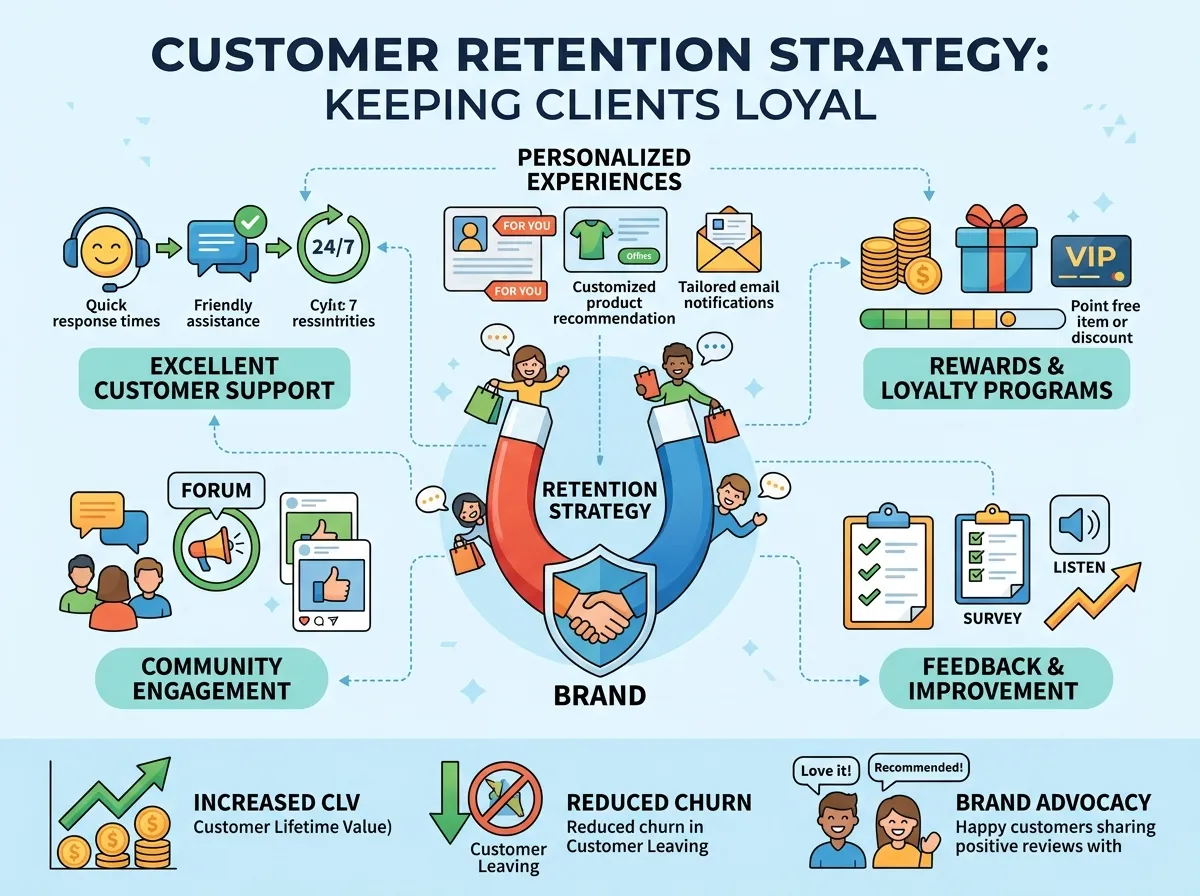
Acquisition is only one part of growth. A customer retention strategy focuses on keeping existing customers engaged and encouraging them to continue using a product or service.
Retention can involve onboarding, customer support, personalized communication, loyalty programs, educational content, product improvements, and proactive engagement.
Understanding why customers leave is particularly valuable. Businesses can analyze cancellation reasons, support requests, customer feedback, usage patterns, and other signals to identify potential retention problems.
Retention should not rely entirely on discounts. Customers may stay because they receive consistent value, convenient experiences, helpful support, useful features, or strong relationships with a brand.
Customer-Centric Marketing explores how placing customer needs at the center of marketing can support stronger relationships.
Growth Hacking Strategies and Experimentation
Growth hacking strategies are often associated with creative, rapid, and resource-efficient experiments designed to identify opportunities for growth. These approaches can include referral systems, viral loops, product-led acquisition, partnerships, content experiments, and unusual promotional campaigns.
The term is sometimes associated with startups because smaller companies may need to find efficient ways to grow with limited resources. However, the underlying principle of experimentation can be useful for businesses of different sizes.
Referral programs are one example. Existing customers may be encouraged to invite others by offering useful incentives or creating a product experience that naturally encourages sharing.
Mastering Mobile App Referral Programs provides additional information on referral programs designed to support mobile app growth.
Growth experiments should still be measured carefully. A creative idea may generate attention but fail to create meaningful customers. The goal is to identify experiments that contribute to sustainable business outcomes.
Digital Growth Marketing
Digital growth marketing uses online channels, technology, analytics, automation, and customer data to support business growth. It can include SEO, content marketing, paid advertising, email, social media, referral programs, websites, mobile applications, and marketing automation.
One advantage of digital channels is the ability to measure customer interactions in greater detail. Businesses can monitor campaign performance, website behavior, conversions, customer engagement, and retention patterns.
Digital marketing also makes experimentation more accessible. Businesses can often launch different versions of a campaign, measure the response, and make adjustments without completely rebuilding their marketing system.
However, digital growth should still be customer-focused. Data and technology are useful only when they help businesses create better experiences and stronger relationships.
Creating a Scalable Marketing Strategy
A scalable marketing strategy is designed to support growth without requiring costs and resources to increase at the same rate as customer acquisition.
Automation can help make certain processes more efficient. Email sequences, lead nurturing, customer onboarding, reporting, and other repetitive activities can often be automated.
Content can also support scalability because a useful article, video, resource, or tool may continue attracting customers over an extended period.
Technology can help teams organize customer information and coordinate communication across multiple channels.
However, scalability should not come at the expense of customer experience. Businesses need systems that can maintain quality as customer numbers increase.
Processes should therefore be documented, measured, and regularly improved. A scalable system should make it easier to grow while maintaining consistent service and communication.
Brand Strategy and Sustainable Growth
Growth marketing should work alongside broader brand-building efforts. Short-term acquisition campaigns can generate customers, but a strong brand can help businesses create recognition, trust, and long-term relationships.
Brand Marketing Strategy explains how brand marketing can contribute to long-term business development.
A growth strategy should therefore consider both immediate performance and long-term brand value. Excessive focus on short-term conversions may lead to aggressive communication or inconsistent messaging.
Customers need to understand what a brand represents and why they should continue engaging with it. Strong positioning and consistent experiences can support retention and advocacy while acquisition activities bring new customers into the funnel.
Customer-Centric Growth
Customer needs should remain at the center of growth marketing. Businesses can use customer research, feedback, support conversations, reviews, surveys, and behavioral data to understand what customers value.
Customer-centric growth involves solving real problems rather than simply optimizing metrics. A higher conversion rate is useful, but it should not come from misleading messaging or an experience that creates problems later.
Businesses can also use customer feedback to identify new product opportunities. Frequently asked questions, common complaints, and recurring requests may reveal areas where products or services can be improved.
When customer needs and business objectives are aligned, marketing experiments can produce more meaningful insights.
Measuring Growth Marketing Performance
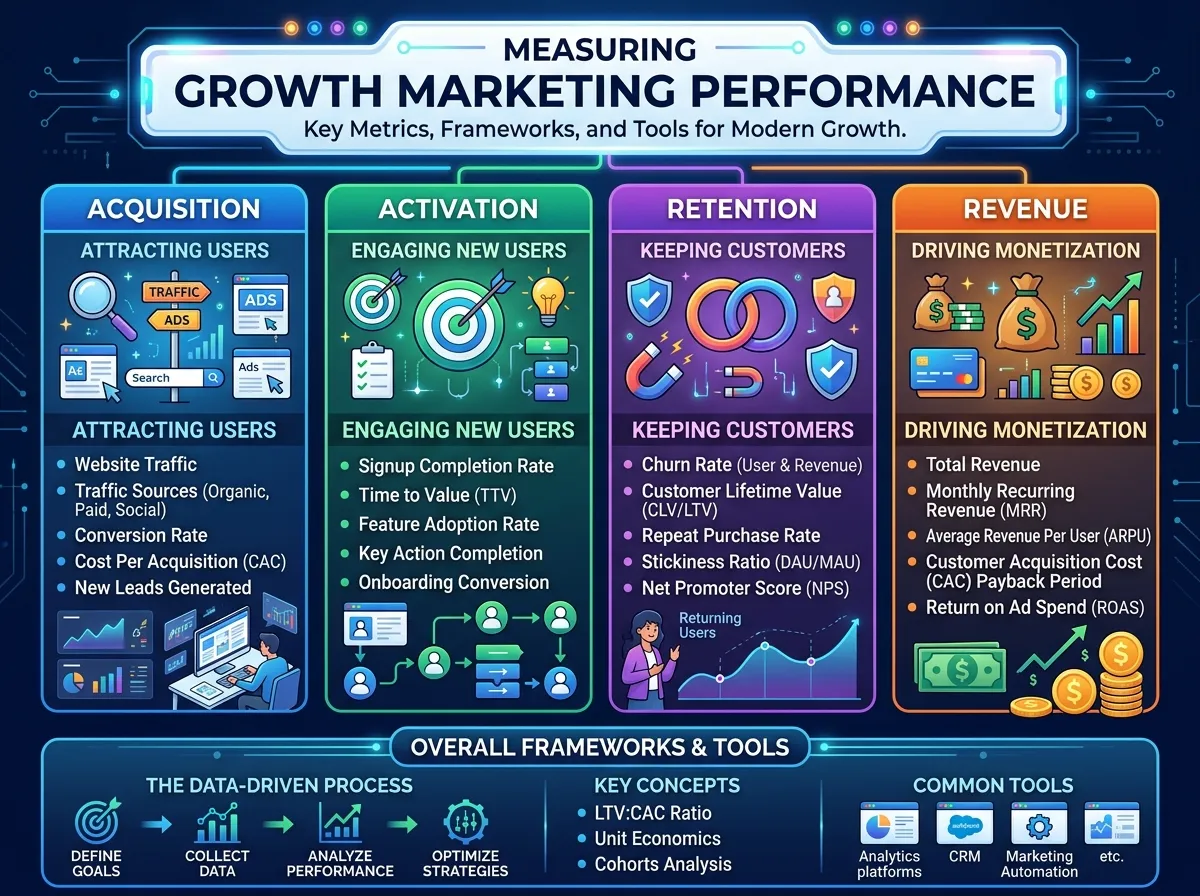
Growth marketing requires consistent measurement. Important metrics vary by business model, but they may include customer acquisition cost, conversion rate, customer lifetime value, retention rate, churn, revenue, engagement, and referral activity.
The growth marketing funnel can provide a useful structure for connecting these metrics to customer stages.
For example, acquisition metrics can show how effectively campaigns attract potential customers. Activation metrics can show whether new users experience early value. Conversion metrics can measure business actions, while retention metrics reveal whether customers remain engaged.
Teams should avoid measuring too many metrics without a clear purpose. A smaller set of meaningful indicators can make it easier to identify trends and make decisions.
Metrics should also be reviewed over time. One campaign may produce strong short-term results but weak long-term retention, while another may acquire fewer customers but generate greater lifetime value.
Building a Culture of Experimentation
Growth marketing works best when experimentation becomes part of the organization’s regular process. Teams should be able to propose ideas, test assumptions, analyze results, and learn from unsuccessful experiments.
Not every experiment will produce a positive result. A test that does not improve performance can still provide useful information by showing what customers do not respond to.
Documentation is important because it prevents teams from repeating the same experiments without learning from previous results.
Businesses can maintain an experiment log containing the hypothesis, audience, change being tested, measurement criteria, results, and lessons learned.
Over time, these insights can build a stronger understanding of customer behavior and improve future marketing decisions.
Common Challenges in Growth Marketing
One common challenge is focusing too heavily on short-term metrics. A campaign may produce clicks or leads without creating valuable long-term customers.
Another challenge is running too many experiments without clear priorities. Testing becomes less useful when teams cannot explain what they are trying to learn.
Poor data quality can also lead to incorrect conclusions. Businesses should make sure their analytics systems are configured properly and that teams understand what the metrics actually represent.
Growth marketing can also become fragmented when acquisition, product, sales, and customer success teams work independently. Growth opportunities often exist between departments, so collaboration can be important.
Finally, businesses should avoid copying growth tactics without considering their own customers and market. An approach that works for one company may not produce the same results elsewhere.
Long-Term Growth Through Continuous Optimization
A strong growth marketing strategy is not based on finding one perfect campaign. It is based on creating a repeatable process for learning and improvement.
Businesses can identify customer needs, develop ideas, run experiments, measure results, and apply what they learn. Over time, this process can improve different parts of the customer journey.
The most valuable growth opportunities may come from unexpected areas. Improving onboarding, reducing customer friction, increasing retention, strengthening referrals, or simplifying checkout can sometimes have as much impact as acquiring more traffic.
Growth marketing therefore requires a broad perspective. Businesses should continuously ask where customers experience friction and where the company can provide greater value.
Conclusion
A growth marketing strategy combines experimentation, data, customer insights, creativity, and continuous optimization to support sustainable business growth. Instead of focusing only on acquiring customers, it considers the complete journey from awareness and acquisition to activation, conversion, retention, and advocacy.
A clear growth marketing strategy framework can help businesses organize experiments and priorities, while data-driven growth marketing provides evidence for better decision-making. Customer acquisition and retention strategies can work together to create a healthier growth system.
From growth marketing tactics and growth hacking strategies to digital channels, automation, referral programs, and scalable processes, businesses have many opportunities to improve performance. The key is to connect each activity with customer needs and measurable business objectives.
By continually testing, learning, and improving, businesses can build a more adaptable marketing system that supports growth while maintaining strong customer relationships and long-term value.
FAQs About Growth Marketing Strategy
1. What is a growth marketing strategy?
A growth marketing strategy is an approach that uses experimentation, customer insights, data, and continuous optimization to improve growth throughout the customer journey. It considers acquisition, activation, conversion, retention, and advocacy.
2. What is a growth marketing strategy framework?
A growth marketing strategy framework provides a structured system for organizing growth objectives, customer research, marketing channels, experiments, metrics, and optimization activities.
3. What are common growth marketing tactics?
Common growth marketing tactics include content marketing, SEO, paid advertising, email marketing, referral programs, personalization, A/B testing, partnerships, social media campaigns, and conversion optimization.
4. How does data-driven growth marketing work?
Data-driven growth marketing uses information from analytics, customer behavior, CRM systems, surveys, campaigns, and other sources to identify opportunities, test ideas, measure results, and make marketing decisions.
5. What is the difference between growth marketing and traditional marketing?
Traditional marketing often focuses heavily on awareness and acquisition, while growth marketing considers the entire customer lifecycle. Growth marketing emphasizes continuous experimentation and optimization across acquisition, conversion, retention, and advocacy.
6. What is a customer acquisition strategy?
A customer acquisition strategy is a structured approach to attracting and converting potential customers. It can include SEO, content, paid advertising, social media, partnerships, referrals, and optimized conversion experiences.
7. Why is customer retention important for growth?
Customer retention can support sustainable growth by encouraging existing customers to continue purchasing or using a service. Retention can also increase customer lifetime value and create opportunities for referrals and advocacy.
8. What are growth hacking strategies?
Growth hacking strategies are creative and experimental approaches designed to identify efficient growth opportunities. Examples can include referral programs, viral loops, partnerships, product-led growth, and rapid marketing experiments.
9. What is a growth marketing funnel?
A growth marketing funnel represents the different stages customers move through, commonly including awareness, acquisition, activation, conversion, retention, and advocacy. Businesses can use the funnel to identify opportunities for improvement.
10. How can businesses create a scalable marketing strategy?
Businesses can create a scalable marketing strategy by using automation, reusable content, efficient technology, documented processes, analytics, and repeatable acquisition and retention systems. Scalability should be balanced with maintaining a consistent customer experience.