

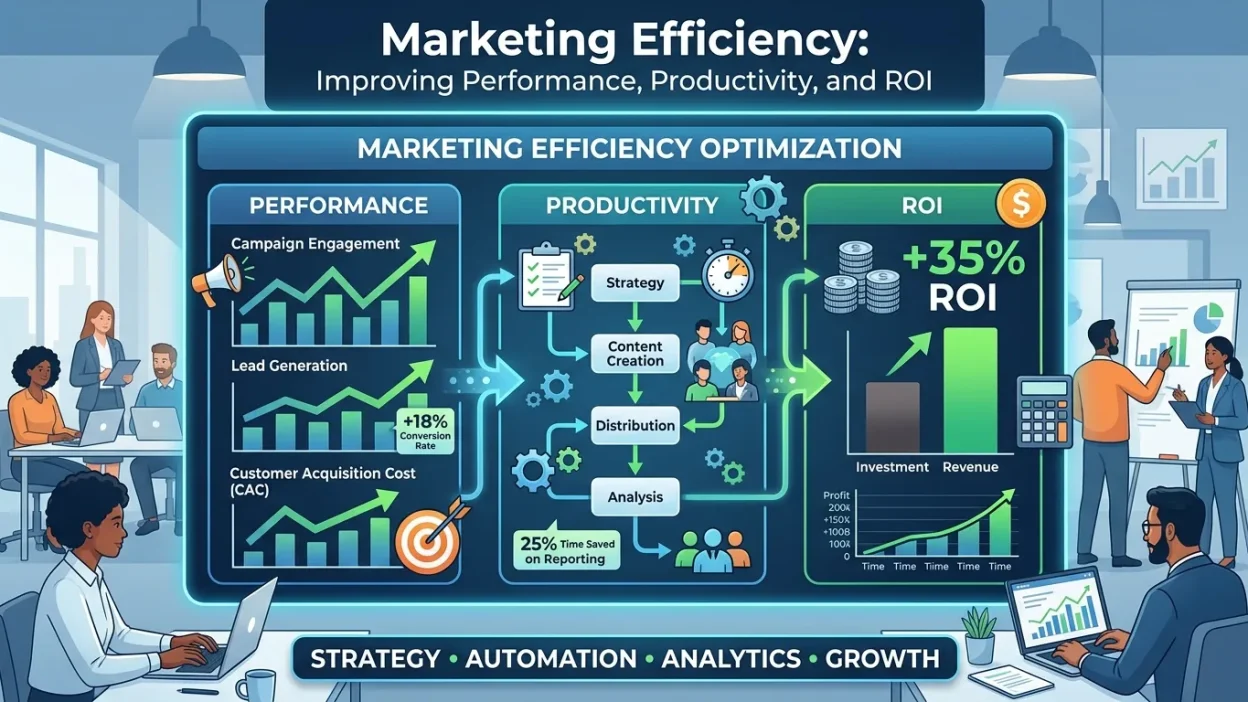
Marketing Efficiency is the ability of a business to achieve meaningful marketing results while making effective use of its time, budget, people, technology, and other resources. Improving efficiency is not simply about spending less. It involves improving processes, reducing unnecessary work, measuring performance accurately, automating repetitive activities, and directing resources toward marketing activities that contribute to business objectives. A well-planned approach can help organizations improve productivity, control costs, strengthen customer engagement, and make marketing investments more measurable.
What Is Marketing Efficiency?
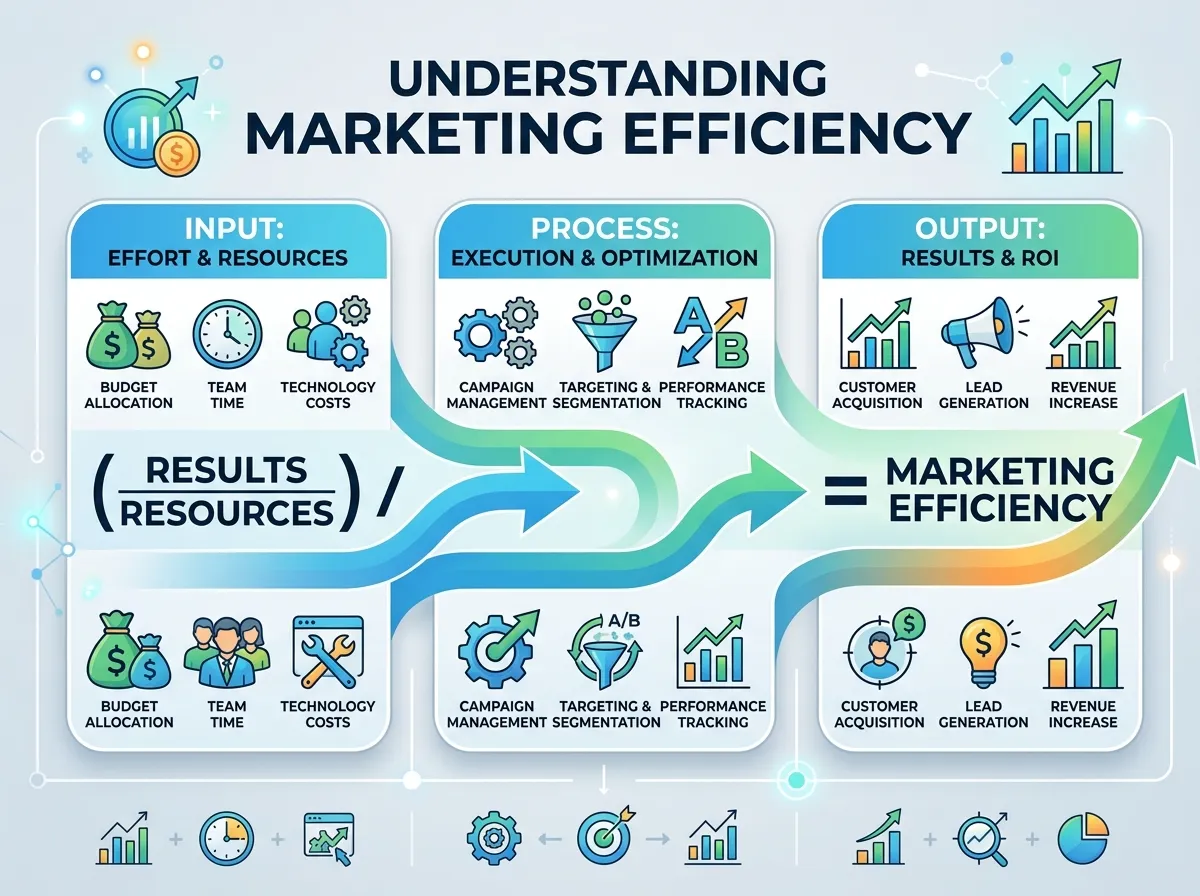
Marketing Efficiency refers to how effectively a business transforms its marketing resources into measurable outcomes. These resources can include advertising budgets, employee time, content production, marketing technology, customer data, creative resources, and communication channels.
An efficient marketing operation does not necessarily mean using the smallest possible budget. A campaign that costs more but generates substantially better business results may be more efficient than a cheaper campaign that produces little value. The focus is therefore on the relationship between resources used and results achieved.
Businesses can evaluate efficiency across many areas, including lead generation, customer acquisition, content production, advertising, email marketing, social media, automation, and campaign management. By examining these areas together, marketing teams can identify where resources are being used effectively and where processes may need improvement.
Developing a Marketing Efficiency Strategy
A strong Marketing Efficiency Strategy connects marketing resources with clearly defined business objectives. Instead of evaluating individual campaigns in isolation, businesses can examine how their overall marketing operation contributes to growth, customer acquisition, retention, and revenue.
The first consideration is alignment. Marketing activities should support measurable objectives rather than existing simply because they have traditionally been part of the marketing calendar. When teams understand what they are trying to achieve, they can make better decisions about where to allocate budgets, personnel, technology, and time.
A marketing efficiency strategy can also help organizations identify duplicated work. Different teams may sometimes create similar content, run overlapping campaigns, or use separate tools for similar purposes. Bringing these activities into a more coordinated structure can reduce unnecessary effort and improve consistency.
Efficiency also depends on flexibility. Customer behavior, market conditions, technology, and competitive activity can change over time. Marketing teams should therefore regularly evaluate whether their current processes are still producing the desired results.
Marketing Performance Optimization
Marketing Performance Optimization focuses on improving the results produced by marketing campaigns, channels, and activities. Performance optimization requires marketers to understand which activities are generating meaningful engagement and which ones are consuming resources without producing sufficient results.
Campaign performance can be examined through metrics such as conversion rates, cost per lead, customer acquisition cost, engagement, revenue contribution, and return on marketing investment. The appropriate measurements depend on the business model and campaign objectives.
Optimization is more effective when marketers look beyond surface-level metrics. A campaign may generate a large amount of traffic but relatively few qualified leads. Another campaign may attract fewer visitors but produce customers with higher lifetime value. Examining the complete customer journey provides a more useful view of efficiency.
Marketing teams can also compare performance across channels and audience segments. These comparisons can reveal where different types of customers respond most effectively and where marketing resources may be better concentrated.
Improving Marketing Process Optimization
Marketing Process Optimization involves examining how marketing work moves from planning to execution, measurement, and improvement. Inefficient processes can create delays, unnecessary manual work, communication problems, and inconsistent campaign execution.
Content creation is one example. A company may have separate people responsible for research, writing, editing, design, publishing, optimization, and promotion. If responsibilities are unclear or approvals repeatedly move between teams, the production process can become unnecessarily slow.
The same issue can occur in campaign management. Multiple approvals, manual data transfers, repetitive reporting, and disconnected marketing platforms can consume valuable employee time.
Process optimization can involve simplifying workflows, defining responsibilities, improving communication between departments, and connecting appropriate technology platforms. The objective is to create a smoother marketing operation without sacrificing quality.
Marketing Productivity and Team Performance
Marketing Productivity is closely connected to efficiency because marketing teams need to achieve meaningful outcomes without spending excessive time on repetitive or low-value activities.
Productivity should not be measured simply by the number of tasks completed. Producing hundreds of social posts, emails, or content pieces does not automatically mean that a team is productive if those activities do not contribute to business goals.
A more useful approach is to consider output alongside impact. A marketing employee who creates fewer but higher-performing assets may contribute more value than someone producing a large volume of low-performing material.
Technology can also influence productivity. Marketing automation, project management platforms, analytics systems, content management tools, and customer relationship management systems can reduce manual administrative work and allow employees to focus on strategic activities.
At the same time, adding more technology does not automatically improve productivity. Too many disconnected platforms can create additional complexity. Marketing teams should therefore evaluate whether each tool genuinely solves a problem or simply adds another layer to the workflow.
Marketing Resource Optimization
Marketing Resource Optimization involves allocating people, budgets, technology, content, and time according to business priorities. Every organization has limited resources, which means marketers must decide where those resources can create the greatest practical value.
Budget allocation is one important area. Businesses may distribute spending across search advertising, social media, content marketing, email, events, influencer activity, or other channels. Performance data can help teams understand how each investment contributes to broader objectives.
Human resources are equally important. A marketing team may have strong creative skills but limited analytical capacity, or excellent campaign management capabilities but insufficient content resources. Understanding these strengths and limitations can help managers assign work more effectively.
Resource optimization also means avoiding unnecessary duplication. Existing content can sometimes be updated and repurposed instead of creating entirely new assets. Existing customer data can support better segmentation instead of requiring separate campaigns for every audience.
Marketing Cost Efficiency
Marketing Cost Efficiency focuses on achieving useful marketing outcomes while maintaining appropriate control over expenses. Cost efficiency is particularly important when organizations need to improve profitability or operate within limited budgets.
Reducing costs should not mean automatically cutting activities. Eliminating an effective marketing channel simply because it has a higher upfront cost may reduce overall performance. Instead, marketers should examine the relationship between cost and business outcome.
Metrics such as cost per acquisition, cost per lead, customer acquisition cost, cost per conversion, and marketing ROI can provide useful perspectives. However, these metrics should be interpreted according to customer value and the length of the buying cycle.
For example, a B2B campaign may initially appear expensive because customers take longer to convert. If those customers generate substantial long-term revenue, the campaign may still contribute significant business value.
Building an Efficient Marketing Strategy
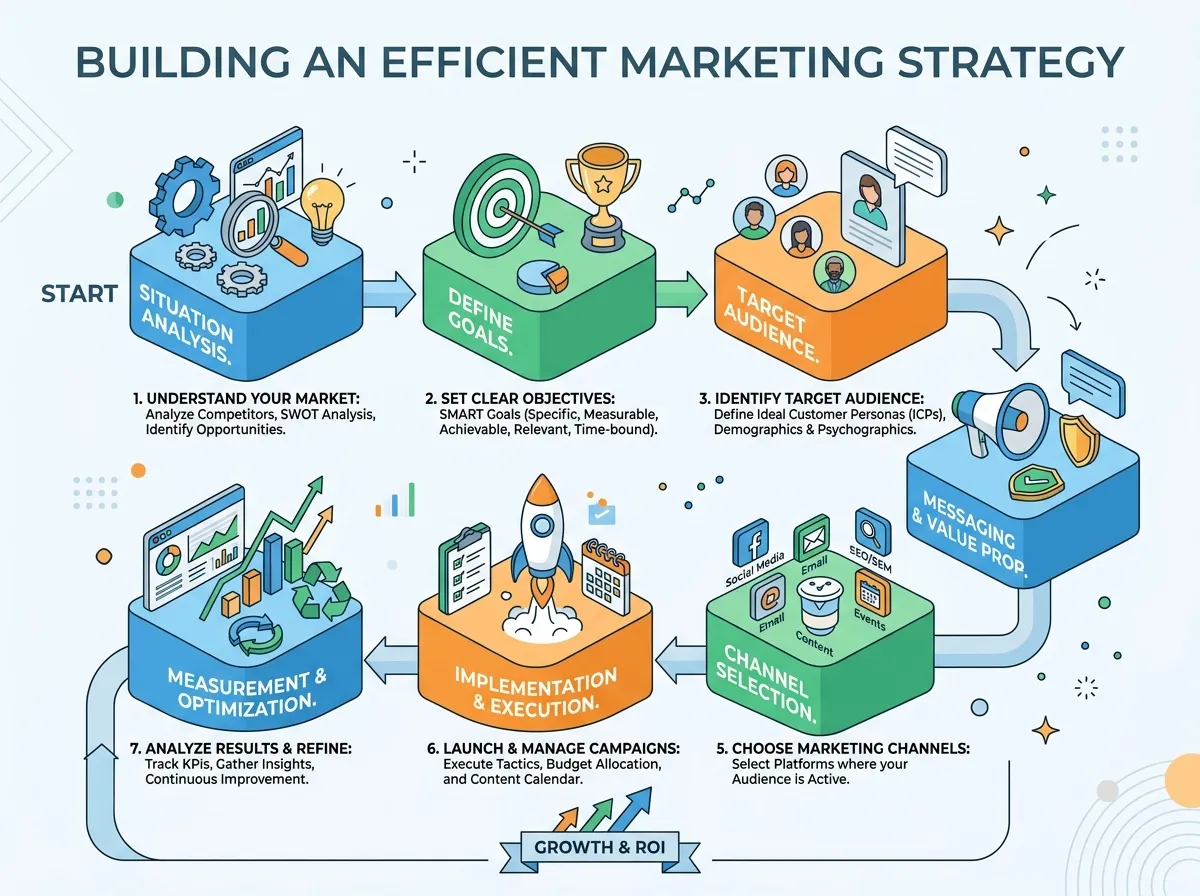
An Efficient Marketing Strategy brings together planning, execution, measurement, technology, and resource allocation. It gives marketing teams a framework for deciding what activities deserve attention and how those activities should be evaluated.
A useful strategy starts with customer understanding. Marketing becomes more efficient when businesses know which audiences they want to reach, what problems those audiences are trying to solve, and which channels they use during the buying journey.
Content should also support specific customer needs. Instead of creating large quantities of generic content, businesses can prioritize topics that address important customer questions and support meaningful stages of the customer journey.
Channel selection matters as well. Businesses do not necessarily need to maintain the same level of activity across every marketing platform. Focusing resources on channels that align with audience behavior and business objectives can make marketing operations more manageable.
Competitive positioning should also be considered. A company can use a broader Competitive Marketing Strategy to understand how its marketing activities relate to competitors, market expectations, and customer needs.
Marketing ROI Optimization
Marketing ROI Optimization involves improving the return generated by marketing investments. It requires businesses to connect marketing activity with meaningful business outcomes rather than focusing exclusively on impressions, clicks, or engagement.
ROI analysis can become difficult when customers interact with several marketing channels before converting. A potential customer may discover a company through search, read several articles, receive emails, interact with an advertisement, and eventually become a customer through a sales conversation.
For this reason, marketers need to consider the broader customer journey when evaluating performance. Attribution models, CRM information, analytics, and conversion data can help create a more complete view.
ROI optimization also benefits from experimentation. Businesses can compare different messages, audiences, content formats, offers, landing pages, and campaign approaches. The resulting information can then inform future resource allocation.
A broader Digital Marketing Strategy can provide useful context for connecting digital channels with broader business and marketing objectives.
Marketing Automation Efficiency
Marketing Automation Efficiency is achieved when technology reduces repetitive marketing work while maintaining quality and relevance. Automation can support activities such as email sequences, lead nurturing, audience segmentation, campaign scheduling, customer communications, and reporting.
Automation can be especially valuable for repetitive processes. For example, a business may automatically send relevant follow-up communication after a customer downloads a resource or completes a particular action.
However, automation should not replace strategic thinking. Poorly designed automated campaigns can produce irrelevant communication, excessive messaging, or poor customer experiences.
Data quality also plays an important role. Automation systems depend on accurate customer information. If contact records, segmentation data, or behavioral information are incorrect, automated actions can produce inappropriate results.
Marketing automation should therefore be treated as an efficiency tool rather than an independent marketing strategy. The technology becomes valuable when it supports well-designed processes and meaningful customer experiences.
Using Data to Improve Marketing Performance
Marketing efficiency depends heavily on reliable data. Businesses need accurate information to understand which campaigns are producing results, which audiences are responding, and where resources are being consumed.
Data can also support more precise customer segmentation. For example, businesses may segment customers according to industry, behavior, purchase history, engagement, or other relevant characteristics.
Lead scoring can provide another layer of analysis. A resource such as Building a Demographic Scoring Model in Marketo demonstrates how demographic information can be incorporated into lead evaluation. When appropriate data is combined with behavioral and engagement information, marketers can gain a broader understanding of potential customer value.
The key is not to collect as much data as possible. Instead, marketing teams should identify the information that directly supports better decisions.
Marketing Performance Measurement
Marketing Performance Measurement provides the evidence businesses need to understand whether their marketing activities are achieving their objectives. Without measurement, it becomes difficult to determine whether improvements are actually producing better outcomes.
The appropriate metrics vary by campaign and business model. Awareness campaigns may focus on reach, visibility, and engagement, while lead-generation campaigns may emphasize qualified leads, conversion rates, and acquisition costs.
Revenue-focused organizations may pay closer attention to customer acquisition cost, customer lifetime value, pipeline contribution, and marketing-generated revenue. Content teams may evaluate organic traffic, engagement, conversions, rankings, and assisted conversions.
The important factor is connecting metrics to objectives. A large amount of data can make marketing reporting more complicated rather than more useful if teams do not understand what the numbers mean.
Regular measurement also creates opportunities for continuous improvement. Marketing teams can identify patterns, investigate underperforming areas, and make informed adjustments to future campaigns.
The Relationship Between Efficiency and Customer Experience
Marketing efficiency should not be separated from customer experience. A campaign can be operationally efficient but still create a poor experience if customers receive irrelevant or excessive communication.
Personalization should therefore be used carefully. Customers should receive information that is useful to their situation rather than simply receiving more automated messages.
Landing pages, emails, advertisements, content, and sales communication should also provide a consistent experience. When customers move between different marketing channels, inconsistent messaging can create confusion and reduce trust.
Efficiency should ultimately help businesses deliver better experiences with fewer unnecessary resources. When processes become simpler and data becomes more useful, teams can spend more time understanding customer needs and improving communication.
The Role of Technology in Marketing Efficiency
Technology continues to influence how marketing teams plan, execute, measure, and optimize campaigns. CRM platforms, analytics tools, automation systems, advertising platforms, artificial intelligence, and content technologies can reduce manual work and improve access to information.
Mobile applications also create opportunities for businesses to build direct customer relationships. Modern approaches to app acquisition, engagement, and retention are explored through Next-Gen App Marketing Strategies, demonstrating how marketing activities can extend beyond traditional channels.
Technology should nevertheless be selected according to actual business requirements. A sophisticated platform cannot solve a poorly designed process by itself. Businesses should first understand their workflow and objectives, then select technology that supports those needs.
Creating a Culture of Continuous Marketing Improvement

Marketing efficiency is not a one-time project. Markets, customers, competitors, platforms, and technologies continue to change, which means marketing teams need to regularly evaluate their processes and results.
A culture of continuous improvement encourages teams to learn from campaign performance instead of treating every campaign as an isolated activity. Successful campaigns can provide patterns worth repeating, while weaker results can reveal opportunities for testing and refinement.
Teams can also benefit from sharing performance insights across departments. Sales teams may provide information about lead quality, customer service teams may identify recurring customer concerns, and marketing teams can contribute behavioral and campaign data. Combining these perspectives can create better decisions.
The long-term objective is to make marketing more focused, measurable, adaptable, and productive without sacrificing customer experience.
Conclusion
Marketing Efficiency is about achieving stronger marketing outcomes through better use of budgets, people, technology, time, and information. It involves more than reducing expenses. Businesses need to understand how their marketing processes operate, how resources are allocated, which activities generate meaningful results, and where technology can reduce unnecessary work.
A strong Marketing Efficiency Strategy can connect performance optimization, process improvement, productivity, resource allocation, cost management, automation, and ROI measurement. When these areas work together, marketing teams can make more informed decisions and create a more consistent relationship between marketing investment and business results.
Efficiency ultimately comes from continuous evaluation. By measuring performance, understanding customer behavior, improving workflows, and allocating resources based on meaningful evidence, businesses can create marketing operations that are both productive and adaptable.
Frequently Asked Questions
1. What is Marketing Efficiency?
Marketing Efficiency is the relationship between the resources a business uses for marketing and the results those activities produce. It considers factors such as budget, employee time, technology, content, leads, conversions, revenue, and customer acquisition.
2. Why is Marketing Efficiency important?
Marketing Efficiency helps businesses make better use of limited resources. It can help identify unnecessary processes, improve campaign performance, control costs, increase productivity, and support more informed marketing investment decisions.
3. How can a business improve its Marketing Efficiency?
Businesses can improve efficiency by evaluating marketing processes, measuring meaningful performance metrics, reducing repetitive manual work, improving resource allocation, using appropriate automation, and focusing marketing activities on clearly defined business objectives.
4. What is Marketing Performance Optimization?
Marketing Performance Optimization involves improving the results produced by marketing campaigns and channels. It can include analyzing conversion rates, acquisition costs, engagement, revenue contribution, and customer behavior to identify opportunities for improvement.
5. What is Marketing Process Optimization?
Marketing Process Optimization focuses on improving how marketing work is planned, created, approved, launched, measured, and refined. It can reduce unnecessary delays, duplicated work, manual tasks, and communication problems.
6. How does Marketing Automation Efficiency improve productivity?
Marketing automation can reduce repetitive tasks such as campaign scheduling, email follow-ups, segmentation, lead nurturing, and reporting. This allows marketing teams to spend more time on strategy, creative work, analysis, and customer-focused activities.
7. What is Marketing Cost Efficiency?
Marketing Cost Efficiency measures how effectively marketing spending produces valuable business outcomes. It does not necessarily mean spending less; instead, it focuses on achieving appropriate results from the resources invested.
8. How can companies improve Marketing ROI Optimization?
Companies can improve Marketing ROI Optimization by connecting campaigns with measurable business outcomes, analyzing customer acquisition costs, evaluating conversion performance, testing different approaches, and allocating resources toward activities that demonstrate meaningful value.
9. Which metrics are useful for Marketing Performance Measurement?
Useful metrics depend on business objectives but may include conversion rate, customer acquisition cost, cost per lead, marketing-generated revenue, customer lifetime value, return on investment, engagement, qualified leads, and pipeline contribution.
10. Is marketing efficiency the same as marketing productivity?
They are closely related but not identical. Marketing productivity focuses more on how effectively teams produce valuable outputs, while marketing efficiency considers the relationship between resources used and the results generated. Both contribute to stronger overall marketing performance.