
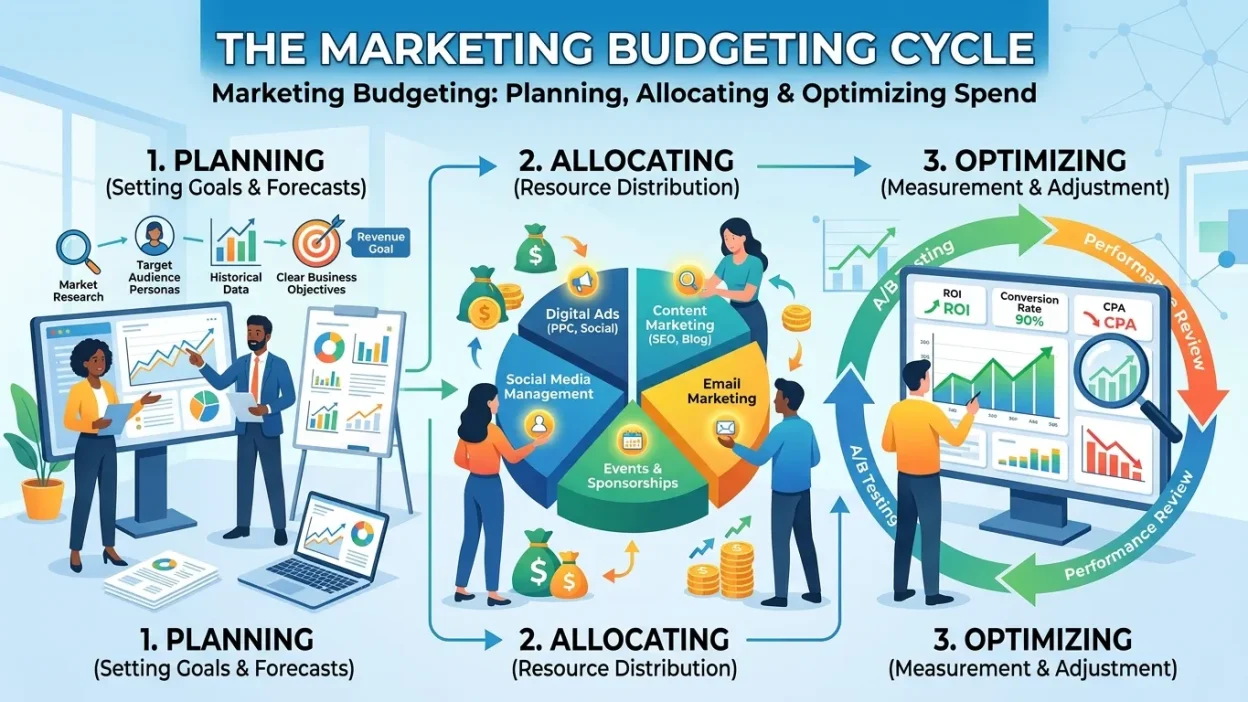
Marketing Budgeting helps businesses plan, allocate, manage, and optimize marketing expenditure according to their objectives. Effective budgeting covers digital marketing, campaign costs, social media, demand generation, technology, content, and other marketing activities while connecting spending with measurable performance. Regular monitoring and flexible allocation can help businesses use available resources more effectively and maintain better control over marketing expenses.
Marketing Budgeting plays an important role in helping businesses determine how much they should invest in marketing activities and where that investment should be directed. Marketing involves multiple channels, campaigns, technologies, content initiatives, advertising platforms, events, and customer acquisition activities, making it important to have a clear financial structure behind these efforts. Without proper budgeting, businesses may spend heavily on activities that generate limited value while underfunding channels that contribute to sustainable growth.
A well-planned marketing budget connects financial resources with business objectives. It allows marketing teams to understand available funds, establish spending priorities, monitor expenses, and evaluate whether marketing investments are producing meaningful results. Budgeting is therefore not simply about limiting expenditure. It is about creating a financial framework that supports marketing performance while maintaining control over costs.
Understanding Marketing Budgeting
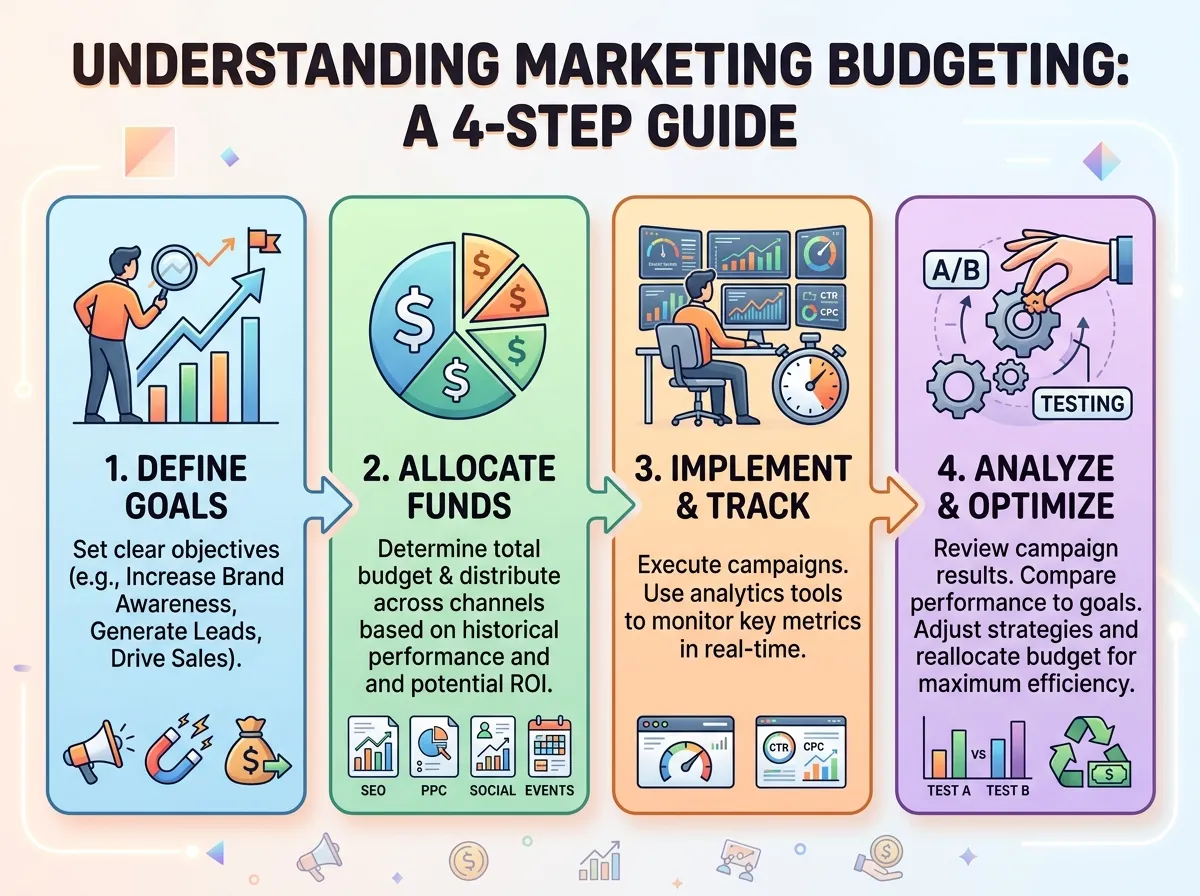
Marketing Budgeting refers to the process of estimating, organizing, allocating, and monitoring the money a business plans to spend on marketing activities. These activities can include search engine optimization, paid advertising, social media, content marketing, email marketing, influencer campaigns, events, marketing software, public relations, and customer acquisition programs.
The purpose of marketing budgeting is to create a connection between marketing objectives and financial resources. A company may want to increase brand awareness, generate leads, improve customer retention, enter a new market, or increase sales. Each objective requires different resources, and the budget should reflect those priorities.
A strong budget also gives marketing teams greater visibility into their expected expenses. Instead of making spending decisions independently across different channels, teams can understand how individual investments fit within the broader marketing plan.
Marketing Budget Planning
Marketing Budget Planning provides the foundation for effective financial management across marketing activities. It involves reviewing business goals, previous marketing performance, expected revenue, available resources, customer acquisition objectives, and upcoming campaigns before determining spending requirements.
Historical performance can provide useful information during planning. If a particular marketing channel consistently generates qualified traffic or leads, the organization may consider its role when developing future budgets. At the same time, previous spending should not automatically determine future allocation because market conditions, customer behavior, competition, and business objectives can change.
Planning should also account for both predictable and variable costs. Software subscriptions, agency retainers, salaries, and recurring advertising expenses may be easier to estimate, while campaign launches, events, content projects, and promotional activities can vary considerably.
Developing a Marketing Budget Strategy
A Marketing Budget Strategy should connect spending decisions with measurable business objectives. Instead of treating every marketing channel equally, organizations can consider which activities support their current priorities and customer journey.
For example, a business focused on lead generation may allocate more resources toward search marketing, paid campaigns, content, landing pages, and conversion optimization. A company focused on brand expansion may invest more heavily in content, public relations, social media, partnerships, and awareness campaigns.
The strategy should remain flexible enough to respond to performance. If a campaign performs differently from expectations, the business may need to adjust spending rather than continue following an unchanged allocation.
Marketing strategy also needs to consider the competitive environment. A business evaluating its market position may use a broader Competitive Marketing Strategy to understand how marketing investments relate to competitors, customer expectations, and overall positioning.
Managing a Digital Marketing Budget
A Digital Marketing Budget typically covers online channels such as search engine optimization, paid search, social media advertising, email marketing, content creation, influencer marketing, display advertising, marketing technology, and analytics.
Digital marketing can provide detailed performance data, but that does not automatically mean every digital channel should receive equal investment. Businesses need to examine metrics such as traffic quality, conversion rates, customer acquisition costs, engagement, revenue contribution, and return on investment.
Budget decisions should also account for the complete customer journey. A campaign may generate awareness without producing immediate conversions, while another channel may capture customers later in the buying process. Looking at these activities together can provide a more complete understanding of marketing performance.
Marketing Budget Allocation
Marketing Budget Allocation determines how available funds are distributed among different campaigns, channels, teams, and marketing activities. This is one of the most important aspects of budgeting because even a large marketing budget can produce limited results if resources are poorly distributed.
Allocation decisions should consider business objectives, historical performance, customer behavior, market opportunities, and expected returns. A company may divide its budget between brand awareness, demand generation, customer acquisition, retention, content, technology, and experimentation.
A balanced allocation can also reduce dependence on a single marketing channel. When all spending is concentrated in one area, changes in platform algorithms, advertising costs, competition, or audience behavior can create significant financial risk.
Marketing Cost Planning
Marketing Cost Planning involves identifying expected expenses before campaigns and activities begin. These costs may include advertising spend, creative production, software, consultants, agencies, events, content production, influencer partnerships, marketing staff, analytics tools, and promotional materials.
Accurate cost planning helps businesses avoid unexpected financial pressure during campaign execution. It also allows teams to compare expected costs with available resources before committing to major activities.
Marketing cost planning should distinguish between fixed and variable expenses. Fixed costs may remain relatively stable over a period, while variable costs can increase or decrease based on campaign volume, audience size, advertising performance, or project requirements.
Marketing Budget Optimization

Marketing Budget Optimization focuses on improving how existing resources are used rather than simply increasing total spending. Optimization can involve identifying inefficient campaigns, improving conversion rates, reducing unnecessary costs, and shifting investment toward activities that demonstrate stronger performance.
Optimization requires reliable performance data. Marketing teams need to understand which channels generate useful outcomes and which activities consume resources without producing sufficient value. This does not mean that every activity with a slower immediate return should be eliminated because some marketing investments support long-term brand visibility and customer relationships.
Continuous testing can also support optimization. Different audiences, messages, creative formats, landing pages, and channels may produce different results. Learning from these experiments can help businesses make more informed allocation decisions over time.
Creating a Marketing Spending Strategy
A Marketing Spending Strategy gives businesses a structured approach to deciding when, where, and how marketing funds should be used. Spending decisions can be organized around campaigns, business quarters, product launches, seasonal opportunities, customer acquisition objectives, or market expansion plans.
Timing is particularly important. Some businesses experience seasonal demand, while others may need increased marketing investment before product launches or major events. A spending strategy helps teams anticipate these periods rather than making financial decisions at the last moment.
A spending strategy should also include room for experimentation. Allocating a controlled portion of the budget to new channels or emerging opportunities can allow businesses to test potential growth areas without disrupting core marketing activities.
Marketing Budget Management
Marketing Budget Management involves monitoring actual spending against planned expenditure throughout the budgeting period. A budget should not be treated as a document created at the beginning of the year and forgotten afterward. Regular monitoring helps marketing teams identify differences between expected and actual costs.
Budget management can become more effective when marketing and finance teams maintain clear communication. Campaign managers should understand financial limits, while finance teams should understand the objectives and expected outcomes behind marketing expenditure.
Clear reporting can also help decision-makers determine whether additional investment is justified. When spending information is connected with performance data, teams can make financial adjustments based on evidence rather than assumptions.
Marketing ROI Budgeting
Marketing ROI Budgeting connects financial investment with the outcomes generated by marketing activities. Return on investment can help businesses understand whether marketing expenditure is contributing to revenue, qualified leads, customer acquisition, retention, or other measurable objectives.
ROI should be interpreted within the context of each marketing activity. Some campaigns may produce direct sales, while others contribute to awareness or consideration that influences future purchases. Using only immediate revenue as the measurement for every marketing activity can overlook important parts of the customer journey.
For businesses focused on measurable performance, connecting budget decisions with broader business metrics is particularly useful. Regular monitoring of Daily KPIs to Boost ROI can help marketing teams understand how spending relates to ongoing performance and identify areas that require closer attention.
Marketing Expense Planning
Marketing Expense Planning helps organizations anticipate the full financial requirements of their marketing operations. Beyond advertising expenditure, businesses may need to account for content production, software licenses, website development, analytics platforms, creative services, events, training, partnerships, and external specialists.
Expense planning can prevent marketing teams from focusing too narrowly on media spending. A campaign may have a manageable advertising budget but still require significant investment in creative assets, landing pages, technology, customer support, or sales enablement.
A complete view of expenses makes it easier to understand the true cost of marketing initiatives. It also supports more realistic forecasting and reduces the likelihood of unexpected costs affecting other business activities.
Marketing Budgeting and Demand Generation
Marketing budgeting is closely connected with demand generation because demand-generation programs often involve multiple channels and stages of the customer journey. Businesses may invest in content, paid media, search optimization, lead nurturing, webinars, social media, and other activities to attract and convert potential customers.
A well-structured B2B Demand Gen Engine can help organizations connect these activities within a broader acquisition framework. Budgeting then becomes a way to determine how resources should support each stage, from initial awareness through lead generation and sales conversion.
This approach can also help businesses avoid measuring every marketing activity in isolation. A channel that introduces prospects to a brand may contribute indirectly to later conversions generated through another channel.
The Role of Social Media in Marketing Budgets
Social media spending can include paid advertising, content creation, influencer partnerships, community management, creative production, and social media management tools. The appropriate level of investment depends on the organization’s objectives and audience.
Businesses should consider both paid and organic social activities when developing a budget. Paid campaigns can provide targeted reach, while organic content can support engagement, brand visibility, and community development over time.
Local businesses may also benefit from connecting social activity with geographically focused marketing. Relevant Local Social Media Marketing Strategies can complement local campaigns and help businesses connect marketing expenditure with community-focused customer engagement.
Adapting Marketing Budgets Over Time

Marketing budgets should remain adaptable because market conditions and business priorities can change. A new competitor, product launch, seasonal opportunity, platform change, or shift in customer behavior may require adjustments to planned spending.
Flexibility does not mean abandoning financial discipline. Instead, it means creating a structure that allows businesses to respond to new information while maintaining overall budget control.
Regular reviews can help identify changes that deserve attention. Marketing teams can compare planned expenditure with actual spending, examine performance trends, and determine whether certain investments should be maintained, reduced, increased, or tested further.
Building a Sustainable Marketing Budget
A sustainable marketing budget balances short-term performance with long-term growth. Businesses need enough flexibility to respond to immediate opportunities while maintaining investment in activities that build brand recognition, customer relationships, content assets, and market presence.
Sustainability also depends on realistic expectations. Marketing results may vary by industry, audience, channel, campaign objective, and market conditions. A budget should therefore be based on realistic assumptions rather than expectations that every marketing investment will produce immediate returns.
When financial planning, marketing strategy, performance measurement, and business objectives are connected, budgeting becomes a strategic business function rather than simply an expense-control exercise.
Frequently Asked Questions
1. What is Marketing Budgeting?
Marketing Budgeting is the process of planning and managing the financial resources allocated to marketing activities. It includes estimating expenses, distributing funds across channels, monitoring spending, and evaluating whether marketing investments support business objectives.
2. Why is Marketing Budget Planning important?
Marketing Budget Planning helps businesses understand how much they can spend and where resources should be directed. It provides financial structure for campaigns and helps marketing teams coordinate spending with business goals, expected results, and available resources.
3. What should a Digital Marketing Budget include?
A Digital Marketing Budget may include spending for SEO, paid advertising, social media, email marketing, content creation, influencer marketing, marketing software, analytics, website improvements, and other digital activities. The exact allocation depends on the organization’s goals and audience.
4. How does Marketing Budget Allocation work?
Marketing Budget Allocation involves distributing available funds across marketing channels, campaigns, teams, and activities. Businesses can consider historical performance, strategic priorities, customer behavior, expected returns, and market opportunities when determining how resources should be distributed.
5. What is Marketing Budget Optimization?
Marketing Budget Optimization focuses on improving the use of existing marketing resources. It may involve adjusting campaign spending, improving conversion performance, reducing unnecessary expenses, and directing resources toward activities that demonstrate meaningful business value.
6. How can businesses control Marketing Spending?
Businesses can control marketing spending by setting clear budgets, monitoring actual expenses, reviewing campaign performance, establishing approval processes, and regularly comparing planned expenditure with actual costs. Flexible but structured financial monitoring can help prevent unnecessary overspending.
7. What is Marketing ROI Budgeting?
Marketing ROI Budgeting connects marketing expenditure with measurable outcomes. It helps businesses examine whether investments contribute to revenue, leads, customer acquisition, retention, or other relevant objectives.
8. Should a marketing budget include experimental campaigns?
A marketing budget can include a controlled amount for experimentation. Testing new channels, audiences, creative formats, or campaigns can help businesses identify potential opportunities while limiting the financial risk associated with unproven activities.
9. How often should a marketing budget be reviewed?
The frequency depends on the organization, campaign activity, and financial structure. Businesses with rapidly changing campaigns may review spending more frequently, while others may use monthly or quarterly reviews. Regular monitoring helps identify unexpected costs and performance changes earlier.
10. How does Marketing Budgeting support business growth?
Marketing Budgeting supports growth by connecting financial resources with marketing objectives. When spending is planned, measured, and adjusted based on performance, businesses can make more informed decisions about customer acquisition, brand development, demand generation, retention, and other growth activities.