
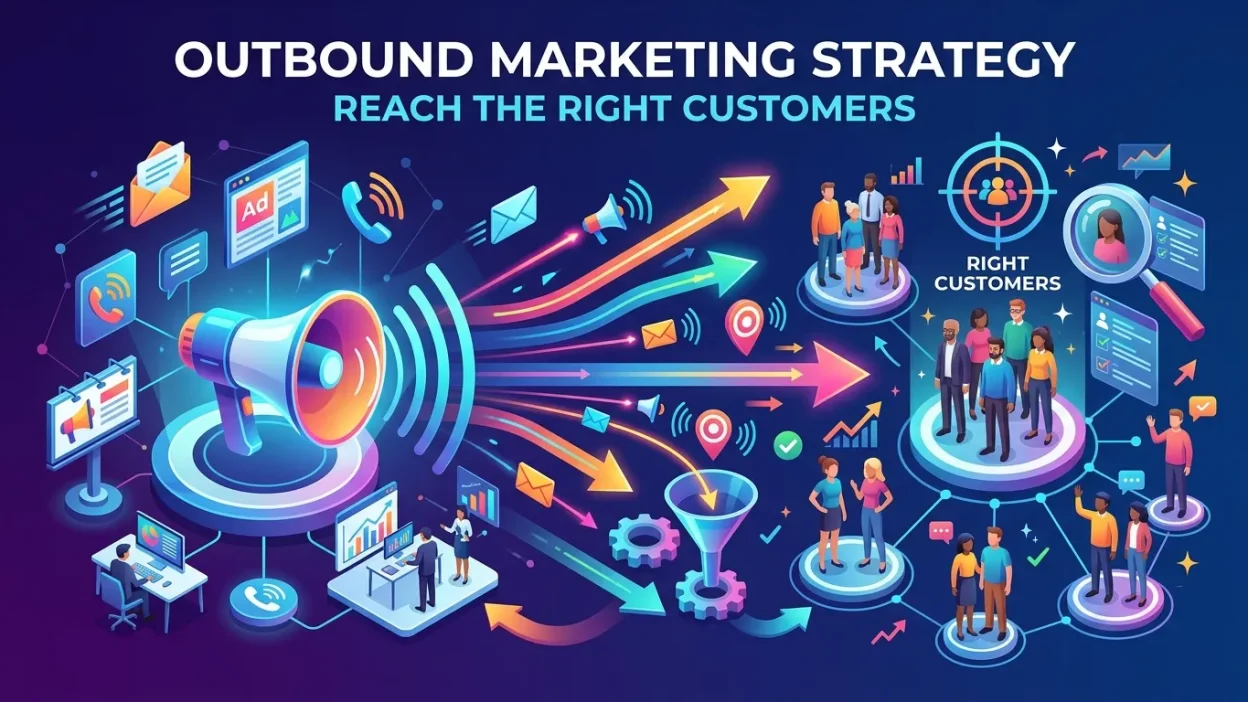
An outbound marketing strategy helps businesses proactively reach potential customers through targeted advertising, email, sales outreach, direct marketing, calls, and other communication channels. When supported by clear audience research, relevant messaging, personalization, and performance tracking, outbound marketing can generate qualified leads, increase brand visibility, and support predictable business growth.
What Is an Outbound Marketing Strategy?
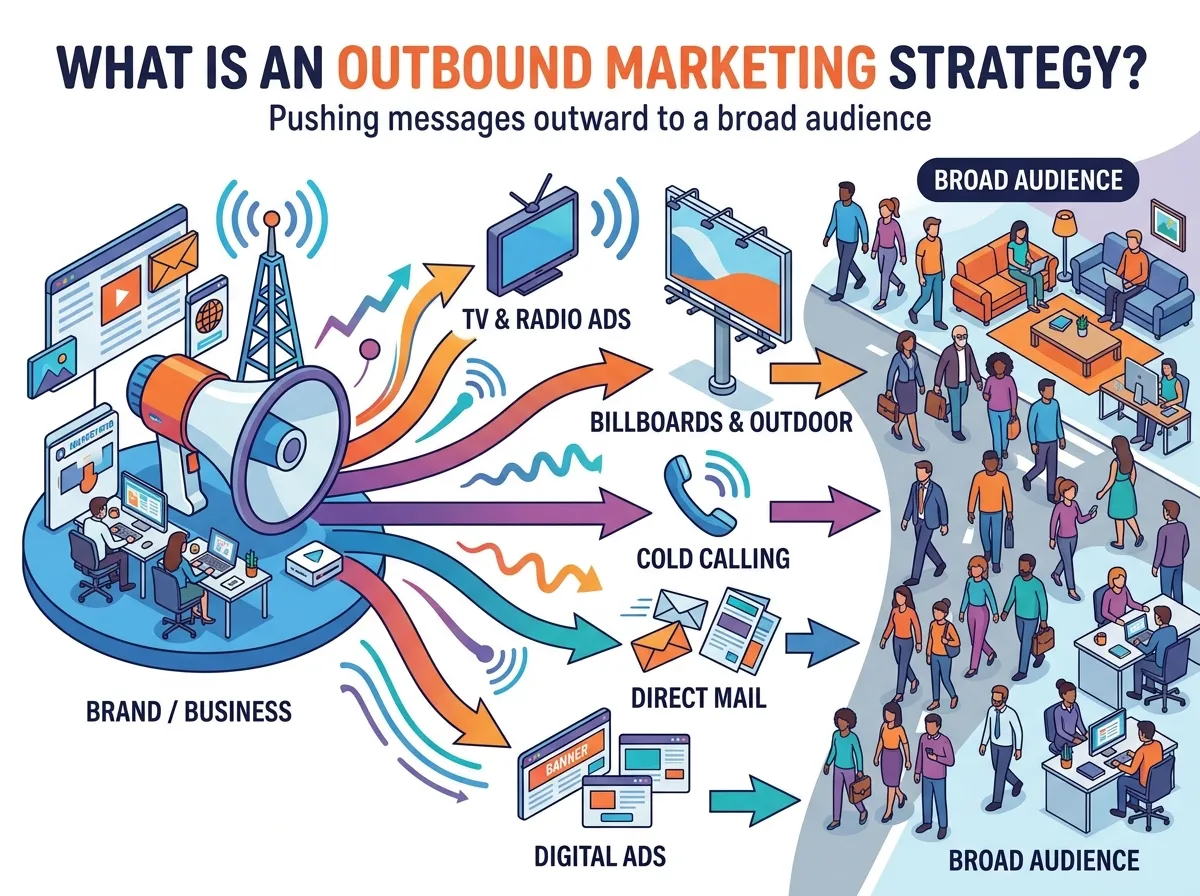
An outbound marketing strategy is a proactive approach to reaching potential customers rather than waiting for them to discover a business on their own. It involves delivering targeted messages to audiences through channels such as email, advertising, direct mail, sales calls, events, and other forms of direct communication.
Outbound marketing has traditionally been associated with television advertising, cold calling, print advertising, and direct mail. However, modern outbound marketing has expanded considerably. Businesses now combine digital advertising, personalized email outreach, account-based marketing, sales development, retargeting, and other data-driven methods.
The goal is not simply to reach as many people as possible. Effective outbound marketing focuses on reaching the right audience with a relevant message at an appropriate time.
When marketing and sales teams work together, outbound campaigns can become a reliable part of a broader customer acquisition strategy. Businesses can identify potential buyers, communicate their value proposition, nurture interest, and guide qualified prospects toward a sales conversation.
Why Outbound Marketing Still Matters
Inbound marketing can attract customers through content, search engines, social media, and other channels, but it can take time to build momentum. Outbound marketing provides businesses with a more proactive way to reach specific audiences.
For example, a B2B company may identify businesses that match its ideal customer profile and directly contact relevant decision-makers. A software company may use targeted advertising to reach professionals in a specific industry. A local company may use direct communication to promote a new service.
Outbound marketing can also help businesses enter new markets. Instead of waiting for awareness to develop organically, companies can actively introduce their products or services to carefully selected audiences.
The most effective approach is often not inbound versus outbound. Businesses can combine both approaches to create multiple paths for customers to discover, evaluate, and purchase their products.
Build a Strong Outbound Marketing Plan
A successful outbound marketing plan should begin with clear objectives. Businesses need to understand what they want their campaigns to achieve before selecting channels or creating messaging.
Common objectives include increasing qualified leads, generating sales appointments, entering a new market, increasing product awareness, promoting a new service, or accelerating the sales cycle.
The next step is defining the ideal customer profile. Businesses should identify characteristics such as industry, company size, job role, location, purchasing needs, challenges, and buying behavior.
Audience research allows businesses to create more relevant campaigns. Instead of sending the same message to everyone, marketers can develop communication that addresses specific problems and motivations.
Budget and resources should also be considered. Some outbound campaigns require significant advertising investment, while others rely more heavily on sales teams and marketing automation.
Finally, businesses should establish measurable key performance indicators. Without clear metrics, it becomes difficult to determine whether an outbound campaign is producing meaningful business results.
Effective Outbound Marketing Tactics
Successful outbound marketing tactics combine targeting, relevance, personalization, and consistency.
Email outreach is one common tactic, particularly for B2B businesses. Personalized emails can introduce a product, address a potential problem, share useful information, or request a sales conversation.
Paid advertising is another important tactic. Businesses can use search, display, social media, video, and other advertising formats to reach specific audiences.
Cold calling can still play a role when it is based on strong prospect research. A sales representative who understands a prospect’s business and likely challenges can have a much more meaningful conversation than someone using a generic script.
Events, direct mail, account-based marketing, and retargeting can also support outbound campaigns.
The most effective tactics depend on the audience. A business should select channels based on where potential customers are most likely to respond rather than simply following popular marketing trends.
Outbound Marketing Techniques That Improve Results
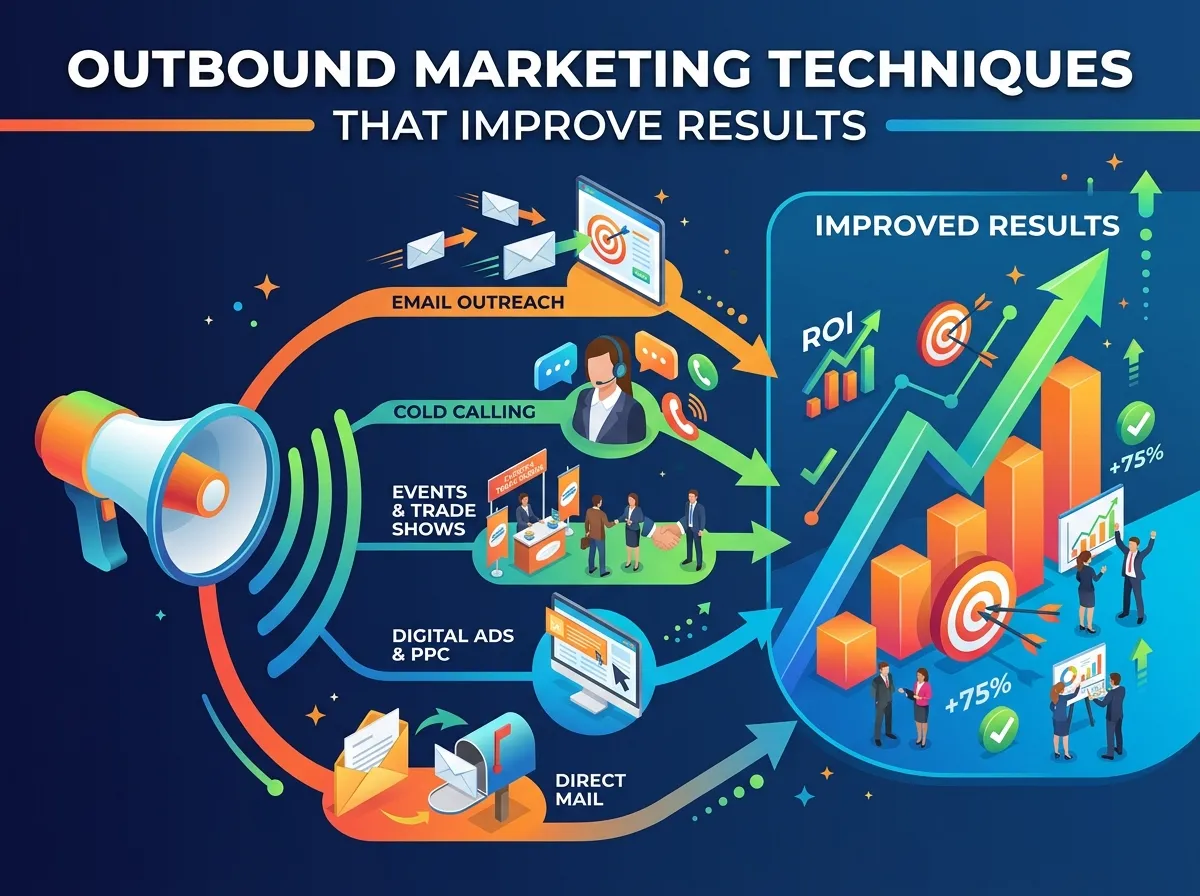
Modern outbound marketing techniques focus heavily on relevance and personalization.
Segmentation allows businesses to divide prospects into groups based on characteristics such as industry, job title, company size, location, or behavior. This makes it easier to create messages that address specific needs.
Personalization can go beyond simply adding a person’s name to an email. Businesses can reference a prospect’s industry, recent business activity, specific challenge, or relevant company information.
Account-based marketing is another useful technique for B2B companies. Instead of targeting a broad audience, marketing and sales teams focus on specific high-value accounts and create customized campaigns for them.
Retargeting can also reconnect with people who have already interacted with a brand. A prospect who visits a product page but does not convert can potentially be shown relevant advertising later.
Testing is equally important. Marketers can test subject lines, offers, messaging, landing pages, advertisements, and calls to action to determine what produces better results.
Developing Effective Outbound Marketing Campaigns
Outbound marketing campaigns should have a clear audience, message, offer, channel, and conversion goal.
The campaign message should explain why the recipient should care. Instead of focusing only on product features, businesses should communicate the problem they solve and the value they provide.
A campaign should also provide a logical next step. Depending on the objective, this could be scheduling a consultation, requesting a demonstration, downloading a resource, visiting a landing page, or making a purchase.
Consistency matters across channels. If an advertisement promotes one value proposition but the follow-up email communicates something completely different, the customer experience can become confusing.
Businesses can also use storytelling to make outbound communication more memorable. A strong storytelling approach in marketing communication can help companies explain customer problems, demonstrate solutions, and create stronger emotional connections.
B2B Outbound Marketing Strategy
A B2B outbound marketing strategy requires a particularly strong focus on targeting and personalization because business purchases often involve multiple decision-makers and longer sales cycles.
B2B companies should identify their ideal accounts and the people involved in purchasing decisions. These may include executives, department leaders, procurement teams, technical specialists, or financial stakeholders.
Marketing and sales alignment is essential. Marketing teams can identify target accounts and provide relevant messaging, while sales teams can use those insights during direct outreach.
Email is often an important component of B2B campaigns. A well-structured B2B email marketing strategy can support prospect communication, lead nurturing, segmentation, and ongoing customer engagement.
B2B outbound campaigns should also consider the prospect’s buying stage. A first-touch message should generally be different from a follow-up sent after a prospect has already interacted with the business.
Outbound Lead Generation
Outbound lead generation focuses on actively identifying and reaching potential customers.
Businesses can build prospect lists using information about their target market, industries, locations, job roles, business needs, or previous interactions. Sales and marketing teams can then prioritize prospects based on their likelihood of becoming customers.
Email outreach, cold calling, targeted advertising, LinkedIn outreach, events, and direct marketing can all support outbound lead generation.
Quality is more important than simply increasing the number of contacts. A large list of poorly matched prospects may create high activity levels without producing meaningful sales opportunities.
Lead qualification is therefore an important part of the process. Businesses should determine whether prospects have a genuine need, appropriate budget, decision-making authority, and reasonable timing.
Content can also support outbound lead generation. Valuable resources can give sales teams something useful to share during prospect communication. A strong content strategy for quality sales lead generation can therefore complement direct outreach and help prospects understand the business’s expertise.
Outbound Sales Strategy and Marketing Alignment
An outbound sales strategy works best when marketing and sales teams share the same objectives.
Marketing can help identify target audiences, develop messaging, create campaign assets, and generate prospect interest. Sales teams can then use those insights to conduct personalized conversations and move qualified prospects through the sales process.
Both teams should agree on what constitutes a qualified lead. Without a shared definition, marketing may focus on generating large numbers of contacts while sales struggles to find prospects who are genuinely ready for a conversation.
Communication between teams can also reveal which messages and offers are producing the strongest results.
Sales feedback can help marketers improve campaigns, while marketing data can give sales representatives more context before contacting prospects.
This collaboration creates a more efficient customer acquisition process and reduces wasted outreach.
Direct Marketing Strategy
A direct marketing strategy involves communicating directly with potential or existing customers and encouraging a measurable response.
Email, direct mail, SMS, telephone outreach, catalogs, targeted promotions, and personalized offers are examples of direct marketing.
The major advantage is measurability. Businesses can track responses, conversions, purchases, appointments, and other actions resulting from a campaign.
Personalization can make direct marketing more effective. Instead of sending a generic message, businesses can create different versions for specific customer segments.
Direct marketing should also respect customer preferences and communication regulations. Permission, transparency, clear identification, and appropriate opt-out options are important for maintaining trust.
When executed responsibly, direct marketing can create a more focused communication experience and help businesses reach customers with offers that are genuinely relevant.
Cold Outreach Marketing Strategy
A cold outreach marketing strategy involves contacting prospects who have not previously interacted with the business.
Cold outreach can be challenging because the recipient may not recognize the company or immediately understand why the message matters.
Research is therefore essential. Before contacting a prospect, businesses should understand the prospect’s role, company, industry, and potential needs.
The opening message should be concise and relevant. Instead of delivering a long sales pitch, it can focus on a specific problem and explain why the communication may be useful.
Follow-ups can improve response opportunities, but they should add value rather than simply repeat the original message.
Businesses should also track response rates and continuously improve their messaging. If prospects consistently ignore a campaign, the issue may involve targeting, timing, offer, messaging, or channel selection.
Choosing the Right Outbound Marketing Channels

Outbound marketing channels should be selected according to audience behavior and campaign objectives.
Email can work well for personalized communication and lead nurturing. Paid search can capture people actively researching solutions, while social advertising can help businesses reach defined audience segments.
Cold calling can be effective for sales-driven campaigns when prospects are properly researched. Direct mail may be useful for specific markets where physical communication creates differentiation.
Events and trade shows can support relationship building, demonstrations, and direct conversations. Retargeting can reconnect with prospects who have already shown interest online.
Call tracking technology can also help businesses understand how marketing campaigns influence phone inquiries. Companies interested in this area can explore the outbound call tracking software market to better understand how call data can support campaign measurement and sales performance.
There is no universal best channel. The right combination depends on the product, audience, sales cycle, budget, and business objectives.
Personalization Makes Outbound Marketing More Effective
One of the biggest changes in modern outbound marketing is the move away from mass communication toward personalized outreach.
Customers are exposed to countless marketing messages every day. Generic communication can easily be ignored, while relevant messages have a better chance of earning attention.
Personalization can include industry-specific messaging, customized offers, account-specific information, behavioral triggers, and content recommendations.
However, personalization should feel useful rather than intrusive. Businesses should use customer information responsibly and focus on providing genuine relevance.
For example, a software company could create different campaigns for small businesses, enterprise organizations, and specific industries rather than sending the same message to everyone.
Measuring Outbound Marketing Performance
Measuring performance helps businesses understand which campaigns are producing meaningful results.
Important metrics can include impressions, response rates, email engagement, click-through rates, qualified leads, meetings booked, conversion rates, customer acquisition costs, and revenue generated.
For sales-focused campaigns, businesses should look beyond activity metrics. A campaign generating thousands of emails or calls may appear successful but still produce poor revenue if the prospects are not qualified.
Attribution can also be challenging. Customers may interact with several marketing channels before making a purchase. Businesses should therefore examine the entire customer journey rather than assigning all credit to a single interaction.
Regular reporting allows marketing and sales teams to identify successful campaigns and improve underperforming ones.
Common Outbound Marketing Mistakes to Avoid
One common mistake is targeting too broad an audience. Without clear targeting, businesses may spend money and time reaching people who are unlikely to become customers.
Another mistake is using generic messaging. Prospects need a reason to pay attention, and a message that does not address their needs may be ignored.
Poor follow-up can also limit results. Some prospects may not respond to the first communication but could become interested after receiving useful additional information.
Businesses should also avoid measuring success solely through impressions, emails sent, or calls made. Business outcomes such as qualified opportunities, conversions, and revenue are more meaningful.
Finally, businesses should not treat outbound marketing as a standalone activity. It works best when coordinated with content, inbound marketing, sales, customer experience, and brand communication.
How to Create a More Effective Outbound Marketing Strategy
A strong outbound marketing strategy can be built through a structured process.
First, define the business objective and ideal customer. Next, identify the problems and needs of that audience. Then develop messaging that clearly communicates the value of the solution.
After that, select the most appropriate outbound marketing channels. Build campaign assets, establish follow-up processes, and define measurable performance indicators.
Once the campaign launches, monitor the results closely. Identify which audiences, messages, channels, and offers generate the strongest responses.
The strategy should then be refined continuously. Outbound marketing becomes more effective when businesses learn from campaign data rather than repeating the same approach indefinitely.
Conclusion
An outbound marketing strategy gives businesses a proactive way to reach potential customers, generate qualified opportunities, and accelerate growth. From outbound marketing tactics and cold outreach to B2B campaigns, direct marketing, email, advertising, and sales calls, businesses have many channels available.
The most effective approach is based on relevance rather than volume. Clear targeting, personalized messaging, strong coordination between marketing and sales, and continuous performance measurement can make outbound campaigns more productive.
When outbound marketing is integrated with content, email, storytelling, sales, and other customer acquisition activities, it can become a powerful part of a complete marketing strategy. Businesses that continually test, measure, and refine their approach can build more predictable lead generation and sales opportunities.
Frequently Asked Questions
1. What is an outbound marketing strategy?
An outbound marketing strategy is a proactive approach to reaching potential customers through channels such as email, advertising, cold calling, direct mail, events, and targeted sales outreach. It focuses on actively placing a business’s message in front of a selected audience.
2. What are the most effective outbound marketing tactics?
Common outbound marketing tactics include personalized email outreach, paid advertising, cold calling, direct mail, account-based marketing, retargeting, event marketing, and targeted sales campaigns. The best tactics depend on the audience and business objectives.
3. Is outbound marketing effective for B2B businesses?
Yes. B2B companies can use outbound marketing to identify specific target accounts, reach decision-makers, generate qualified leads, and support sales conversations. Personalization and alignment between sales and marketing are especially important for B2B campaigns.
4. What is outbound lead generation?
Outbound lead generation is the process of proactively identifying potential customers and contacting them through channels such as email, phone calls, advertising, events, and direct outreach. The goal is to create qualified sales opportunities.
5. How does cold outreach differ from inbound marketing?
Cold outreach involves proactively contacting people who may not have previously interacted with a business. Inbound marketing focuses on attracting potential customers through content, search, social media, and other channels that encourage prospects to discover the business themselves.
6. What is an outbound marketing plan?
An outbound marketing plan outlines the objectives, target audience, messaging, channels, budget, campaign activities, follow-up process, and performance metrics for an outbound campaign. It provides a structured framework for executing and measuring marketing activities.
7. Which outbound marketing channels should businesses use?
Businesses can use email, paid advertising, cold calling, direct mail, social media advertising, events, trade shows, retargeting, and other direct communication channels. The best choices depend on where the target audience is most likely to respond.
8. How can businesses improve cold outreach?
Businesses can improve cold outreach by researching prospects, creating relevant messaging, keeping initial communication concise, personalizing messages, providing value, following up appropriately, and continuously testing campaign performance.
9. How should outbound marketing performance be measured?
Businesses should track metrics such as response rates, qualified leads, meetings booked, conversion rates, customer acquisition costs, pipeline value, and revenue. These metrics provide a better indication of campaign success than activity volume alone.
10. Can outbound and inbound marketing work together?
Yes. Combining inbound and outbound marketing can create a stronger customer acquisition system. Outbound campaigns can actively reach target prospects, while inbound content can educate those prospects and support trust, consideration, and conversion throughout the buying journey.