

A strong target market strategy helps businesses identify the right customers, understand their needs, and create marketing messages that are more relevant and effective. Through market research, segmentation, audience analysis, positioning, and customer-focused communication, businesses can improve marketing performance, strengthen customer relationships, and make better use of their resources.
Every business wants to attract customers, but trying to reach everyone can make marketing less effective. Different customers have different needs, preferences, budgets, expectations, and purchasing behaviors. A message that appeals to one group may have little impact on another. This is why businesses need a clear target market strategy.
A target market strategy helps a business determine which group of customers is most likely to value its products or services. Instead of communicating with a broad and undefined audience, the business can focus its marketing efforts on people who have a stronger connection with its offering.
Effective targeting is not simply about choosing an age group or geographic location. It involves understanding customer needs, behaviors, motivations, challenges, and purchasing decisions. When businesses combine this information with a clear brand position, they can create marketing campaigns that feel more relevant and generate stronger results.
What Is a Target Market Strategy?
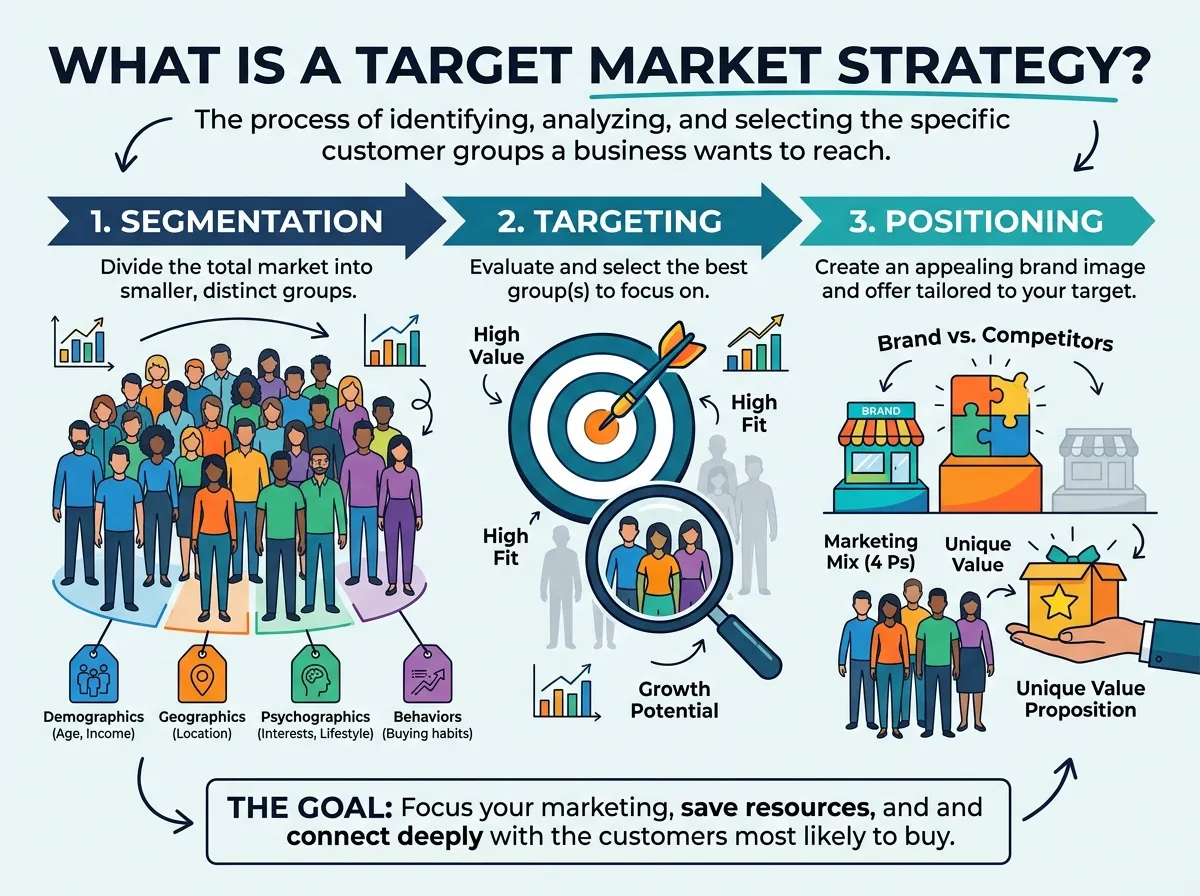
A target market strategy is an approach businesses use to identify and focus on a specific group of potential customers. It connects market research, customer understanding, segmentation, positioning, and marketing communication to help a business reach the people most likely to become customers.
The process begins with understanding the broader market and identifying groups with different characteristics or needs. Businesses can then evaluate these groups and determine which ones offer the greatest opportunity.
A well-developed strategy also considers whether the business can effectively serve the selected audience. A market may be large, but if the business cannot meet its expectations or compete effectively, targeting that audience may not be practical.
The purpose is therefore not simply to find the largest audience. It is to find an audience that fits the company’s products, capabilities, goals, and value proposition.
Why a Target Market Strategy Matters
A clear target market strategy can make marketing more focused. When businesses understand who they are trying to reach, they can develop more relevant content, advertising, offers, and customer experiences.
Without clear targeting, marketing messages can become too general. Generic messaging may fail to address the specific problems or motivations that influence customers. Targeting allows businesses to communicate in a way that feels more personal and useful.
A strong strategy can also improve resource allocation. Marketing budgets, creative resources, sales efforts, and communication channels can be directed toward audiences with greater potential instead of being spread across an undefined market.
This becomes especially important for businesses operating in competitive industries. When multiple companies offer similar products, understanding a specific audience and communicating a distinctive value can help a brand stand out.
Target Market Strategy Development
Target market strategy development involves turning customer and market information into a practical marketing direction. The process requires businesses to understand their broader market before deciding which customer groups deserve the greatest attention.
Businesses can begin by examining existing customers, competitors, industry trends, product demand, and customer behavior. Existing customer information can reveal which types of people are already receiving the most value from the company’s products.
The business can then compare these observations with its future goals. A company may discover that its most profitable customers are not necessarily its largest customer group. Another business may identify an underserved audience that competitors have overlooked.
The resulting strategy should connect the selected market with the company’s broader positioning. This ensures that targeting decisions support both customer needs and business objectives.
Understanding Target Market Analysis
Target market analysis provides a deeper understanding of potential customers and the conditions surrounding a particular market. It examines characteristics such as demographics, location, purchasing behavior, interests, needs, problems, preferences, and competitive alternatives.
Businesses can use customer surveys, website analytics, sales data, social media insights, customer reviews, interviews, and market research to develop this understanding.
Competitor activity is also valuable. Examining how other companies communicate with similar audiences can reveal common customer expectations and potential gaps. A business may discover that competitors focus heavily on price while customers are actually looking for convenience, service, quality, or expertise.
This information can help the company build a more distinctive position and create marketing messages based on genuine customer priorities.
Building a Target Audience Strategy
A target audience strategy focuses on how a business communicates with its chosen customers. Identifying the audience is only one part of the process. Businesses also need to understand how that audience consumes information and makes decisions.
Some audiences may spend significant time on social media, while others may rely more heavily on search engines, email, professional communities, industry publications, or referrals. Understanding these behaviors can help businesses choose appropriate communication channels.
The tone of communication also matters. A professional B2B audience may respond to detailed information, industry expertise, and business outcomes, while a consumer audience may respond more strongly to convenience, lifestyle benefits, emotional value, or social proof.
Cross-channel consistency can strengthen this approach. Businesses can learn more about maintaining connected customer communication through What is Cross-Channel Communication?, particularly when customers interact with a brand across multiple platforms.
Target Market Segmentation

Target market segmentation divides a broader market into smaller groups that share meaningful characteristics. Segmentation helps businesses move beyond a one-size-fits-all approach and create more relevant customer experiences.
Common segmentation factors include demographic, geographic, behavioral, psychographic, and firmographic characteristics. However, effective segmentation should focus on differences that actually influence purchasing behavior or customer needs.
For example, two customers may have the same age and location but completely different motivations for purchasing a product. One may prioritize affordability, while another may prioritize premium quality. A useful segmentation strategy recognizes these differences.
Segmentation can also become more sophisticated as businesses collect additional customer information. Behavioral data can reveal what customers browse, purchase, compare, or engage with, allowing companies to create more relevant audience groups.
Developing a Target Customer Strategy
A target customer strategy connects audience understanding with the way a business creates and delivers value. It focuses on the customers who are most suitable for the company’s products rather than simply attempting to maximize the number of people reached.
Customer value is particularly important here. Businesses should understand what their target customers are trying to accomplish and why existing solutions may not fully meet their expectations.
This can help companies refine product messaging, customer service, pricing, content, and promotional campaigns. Instead of communicating only what a product is, the business can explain how it solves a problem or supports an important customer goal.
Email marketing can also support this relationship by allowing businesses to communicate with specific audience segments. Strong practices around B2B Email Marketing Strategy can help businesses deliver more relevant messages to professional audiences based on their needs and interests.
Target Market Identification
Target market identification involves determining which customer group is most appropriate for a business to prioritize. This decision should be based on evidence rather than assumptions.
Businesses can evaluate factors such as market size, customer demand, purchasing power, competition, accessibility, profitability, and long-term growth potential.
Customer fit is equally important. A target market may appear attractive because it is large, but if the company’s product does not solve an important problem for that audience, marketing efforts may struggle.
Existing customers can provide valuable clues. Businesses can examine which customers have higher retention, stronger engagement, larger purchases, or greater satisfaction. These patterns may reveal characteristics shared by the company’s most valuable audience.
Target Market Research
Target market research helps businesses continuously improve their understanding of customers. Markets change as customer preferences, technology, economic conditions, competitors, and cultural trends evolve.
Research should therefore not be treated as a one-time activity. Customer feedback, reviews, analytics, surveys, and sales information can provide ongoing insight into changing expectations.
Businesses can also identify new opportunities by studying questions customers frequently ask or problems they struggle to solve. These insights can influence everything from content creation to product development and advertising.
Research becomes more useful when businesses compare multiple sources rather than relying on a single data point. Combining quantitative information with direct customer feedback creates a more complete picture of the market.
Market Targeting Strategy
A market targeting strategy determines how a business prioritizes the segments it has identified. A company may decide to focus on one highly specific group, several related segments, or a broader market with differentiated messaging.
The right approach depends on the company’s resources, products, competitive position, and objectives. A smaller company may benefit from concentrating on a narrow niche where it can establish expertise. A larger organization may have the resources to serve multiple segments with different offers and communication strategies.
Targeting should remain flexible. If a segment becomes less profitable or customer needs change, businesses should be prepared to reassess their priorities.
Ideal Customer Targeting
Ideal customer targeting focuses on the people who represent the strongest fit for a business. These customers typically have a relevant need, the ability to purchase, and a reason to choose the company’s solution.
An ideal customer profile can include information about customer challenges, motivations, purchasing behavior, preferred communication channels, and decision-making factors.
For B2B businesses, this may also include company size, industry, job role, purchasing authority, and business objectives. For consumer businesses, lifestyle, preferences, location, income range, and purchasing habits may be more relevant.
The goal is not to exclude every customer who falls outside the ideal profile. Instead, it gives the business a clearer understanding of where its strongest opportunities are likely to exist.
Target Market Positioning Strategy
A target market positioning strategy defines how a business wants its chosen audience to perceive its brand compared with competing alternatives.
Positioning becomes stronger when it connects a specific customer need with a clear and believable value proposition. For example, a company might position itself around affordability, premium quality, specialized expertise, convenience, innovation, sustainability, or personalized service.
The chosen position should be supported by the actual customer experience. If a business claims to provide premium service but fails to deliver consistent quality, the positioning will eventually lose credibility.
Brand architecture can also influence how businesses position products and audiences. A clear brand architecture approach can help organizations create relationships between different offerings while maintaining a coherent overall brand identity.
Using Targeting Across Marketing Channels
A target market strategy becomes more effective when it is reflected consistently across marketing channels. Website content, search optimization, social media, email, paid advertising, mobile marketing, and sales communication should all support the same understanding of the target customer.
This does not mean every channel needs identical content. Each platform can communicate in a way that fits its audience and format while maintaining a consistent value proposition.
For example, a business may use educational website content to attract potential customers, email to nurture prospects, social media to build engagement, and personalized advertising to encourage conversions.
Technology can further improve targeting by helping businesses personalize interactions. AI-powered tools, including chatbots, can support customer engagement by responding to questions and directing users toward relevant information. Businesses interested in this approach can explore Boost Your Mobile App Marketing Strategy with AI Chatbots for additional context on AI-supported audience engagement.
Measuring Target Market Strategy Performance
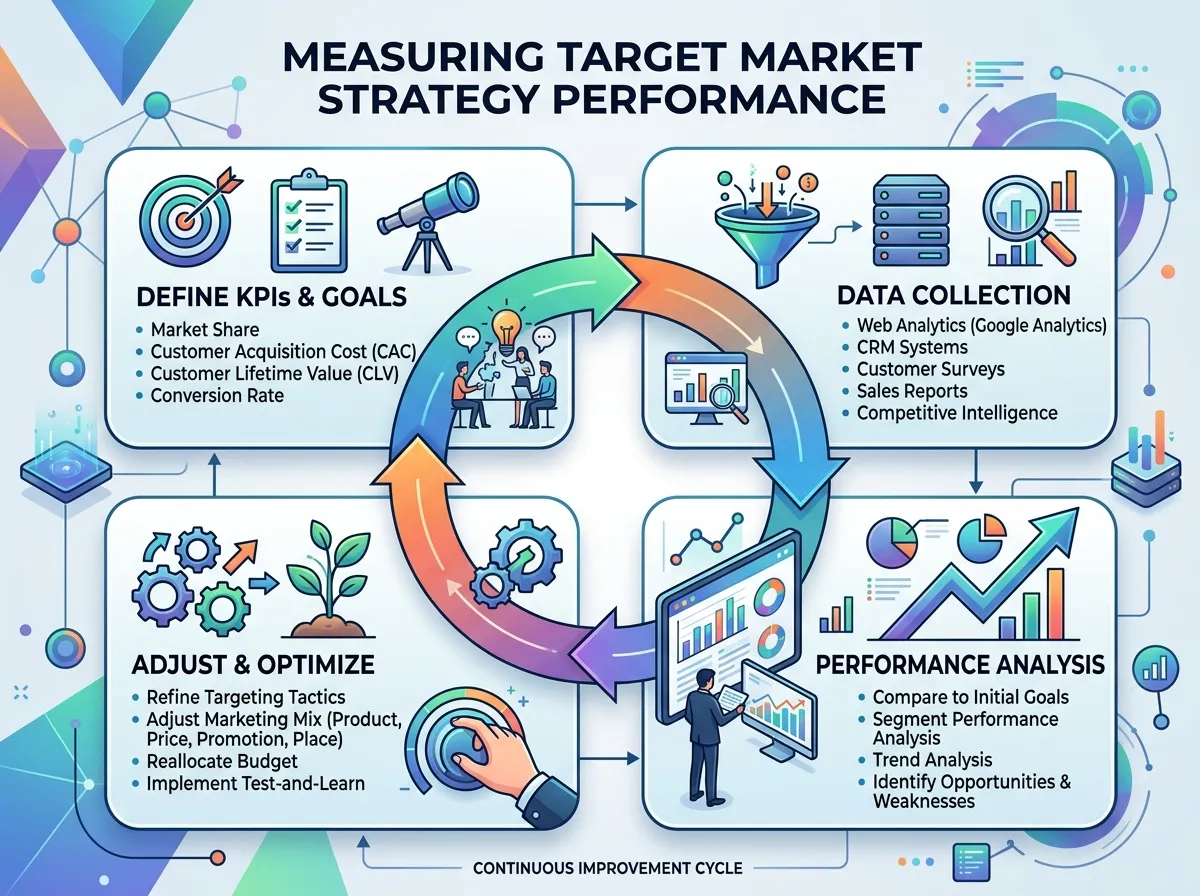
A target market strategy should be evaluated through meaningful business and customer metrics. Website engagement, qualified leads, conversion rates, customer acquisition costs, retention, sales, and customer lifetime value can help determine whether the selected market is producing valuable results.
Businesses should also pay attention to qualitative signals. Customer feedback can reveal whether the brand’s messaging resonates with the intended audience and whether the product is meeting expectations.
If a campaign receives significant traffic but generates few qualified leads, the problem may not be the campaign itself. The audience selection, positioning, offer, or customer fit may need to be reconsidered.
Regular evaluation allows businesses to refine their strategy rather than treating targeting as a permanent decision.
Common Challenges With Target Market Strategy
One common challenge is relying too heavily on assumptions. Businesses may believe they understand their customers without collecting enough evidence. Actual customer behavior can sometimes differ significantly from internal expectations.
Another challenge is making the target market too broad. When businesses attempt to appeal to everyone, their messaging can become vague and less persuasive.
Over-segmentation can also create problems. Dividing audiences into too many small groups can make marketing operations unnecessarily complicated and may reduce consistency.
Successful targeting requires balance. Businesses need enough specificity to make their communication relevant while maintaining a practical approach that can be managed with available resources.
Conclusion
A strong target market strategy helps businesses focus their marketing efforts on customers who are most likely to value their products or services. Through target market analysis, segmentation, research, audience planning, and positioning, companies can create communication that is more relevant and effective.
The best strategy is based on evidence rather than assumptions. Customer behavior, feedback, market conditions, and competitive research can all contribute to better targeting decisions.
As customer expectations continue to change, businesses should regularly review their target markets and adjust their messaging when necessary. A flexible, customer-focused approach can improve marketing efficiency while helping brands build stronger relationships with the audiences that matter most.
Frequently Asked Questions
1. What is a target market strategy?
A target market strategy is a business approach used to identify and focus on a specific group of customers who are most likely to need, value, and purchase a company’s products or services. It combines market research, segmentation, targeting, and positioning.
2. Why is a target market strategy important?
A target market strategy helps businesses avoid wasting resources on audiences that are unlikely to convert. It allows companies to create more relevant messaging, select suitable marketing channels, improve customer experiences, and focus their efforts on higher-value opportunities.
3. What is target market segmentation?
Target market segmentation is the process of dividing a broad market into smaller groups based on shared characteristics such as demographics, geography, behavior, interests, needs, or purchasing patterns. It helps businesses create more relevant marketing for different customer groups.
4. How do businesses identify their target market?
Businesses can identify their target market by analyzing existing customers, conducting market research, studying competitors, reviewing purchasing behavior, examining customer needs, and evaluating factors such as market demand, profitability, accessibility, and growth potential.
5. What is the difference between a target market and a target audience?
A target market is the broader group of customers a business aims to serve, while a target audience is often a more specific group within that market that a particular marketing message or campaign is designed to reach.
6. What is an ideal customer profile?
An ideal customer profile describes the type of customer who is most likely to benefit from and purchase a company’s offering. It can include demographics, business characteristics, needs, challenges, behaviors, motivations, purchasing patterns, and communication preferences.
7. How does market research improve targeting?
Market research provides evidence about customer needs, preferences, behaviors, competitors, and market conditions. This information helps businesses make better targeting decisions instead of relying only on assumptions about who their customers are.
8. Can a business have more than one target market?
Yes. A business can target multiple market segments when its products, resources, and marketing strategy support different customer groups. However, each segment should have a clear reason for being targeted and may require different messaging or offers.
9. How often should a business review its target market strategy?
Businesses should review their strategy regularly, particularly when customer behavior, competition, products, technology, or market conditions change. Ongoing analysis helps ensure that the selected target market remains relevant and profitable.
10. How does target market positioning affect marketing?
Target market positioning determines how a business wants its chosen customers to perceive its brand compared with competitors. Clear positioning can make marketing messages more distinctive and help customers understand why a particular product or service is relevant to their needs.