


Marketing vendor reviews help businesses evaluate supplier quality, campaign performance, communication, costs, and contractual responsibilities. By using consistent evaluation criteria, scorecards, reliable data, and regular performance discussions, organizations can identify improvement opportunities, manage risks, and choose partners that support their marketing objectives.
Marketing vendor reviews help businesses determine whether their external partners are delivering the quality, value, and results expected from their services. Companies often rely on marketing agencies, advertising platforms, analytics providers, content creators, software vendors, and other suppliers to support their campaigns. While these partnerships can improve efficiency and expand capabilities, their long-term value depends on consistent performance, transparent communication, and alignment with business objectives.
A structured marketing vendor evaluation process allows organizations to assess more than price or initial impressions. It examines service quality, campaign outcomes, reliability, responsiveness, contractual obligations, and the vendor’s ability to adapt as business needs change. Regular reviews also help marketing teams identify risks early, improve collaboration, and make informed decisions about whether to continue, adjust, or replace a partnership.
Effective vendor reviews should not be treated as occasional administrative exercises. They are an important part of marketing operations that connects supplier performance with wider business goals. When organizations establish clear evaluation standards and maintain accurate records, they can build stronger relationships with dependable vendors while directing resources toward the partnerships that create the greatest value.
Why Marketing Vendor Reviews Matter
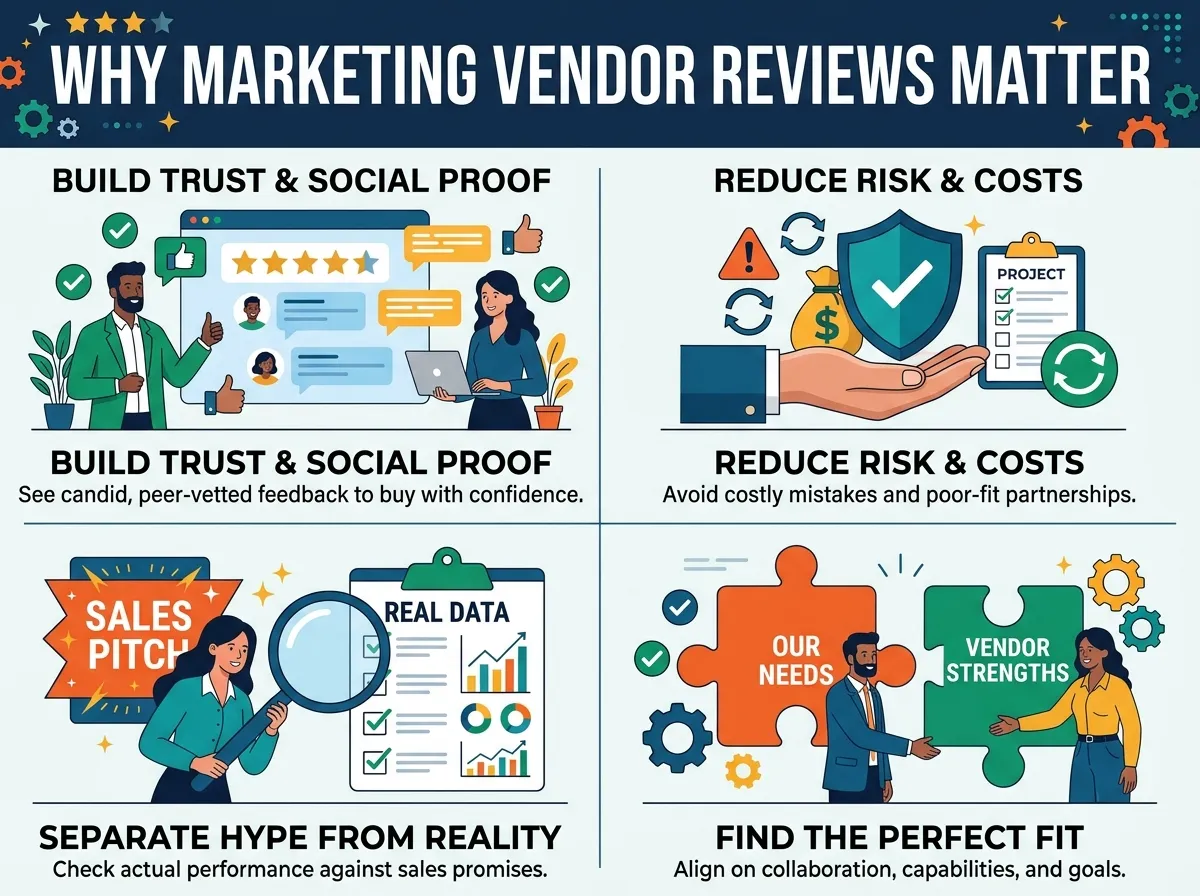
Marketing departments frequently work with several external providers at the same time. One agency may manage paid advertising, another may create content, and a software company may supply automation or analytics tools. Each provider contributes differently to the overall marketing operation, making it difficult to evaluate every relationship using the same measurements.
Marketing vendor reviews create a consistent way to understand how each supplier contributes to business performance. Instead of relying on personal opinions or isolated campaign results, teams can assess vendors against agreed expectations. This approach makes it easier to identify strengths, address service gaps, and determine whether a partnership continues to meet organizational needs.
Regular reviews also improve accountability. When vendors understand how their work will be evaluated, they have a clearer picture of the standards they must maintain. Marketing teams can explain expectations, document concerns, and establish practical improvement targets. These conversations help prevent misunderstandings from developing into larger operational problems.
Another important benefit is better resource allocation. A vendor may provide excellent creative work but struggle with reporting, while another may deliver strong analytics but lack flexibility. Understanding these differences helps businesses determine where each provider fits within their marketing strategy. It also prevents organizations from making decisions based solely on the lowest price or the most impressive sales presentation.
Establishing Clear Marketing Vendor Evaluation Criteria
A successful marketing vendor evaluation begins with clear criteria. Without defined standards, different departments may assess the same supplier in inconsistent ways. One manager might prioritize communication, while another focuses almost entirely on campaign results. A shared evaluation framework makes these assessments more balanced and useful.
The criteria should reflect the type of service being provided. Advertising vendors may be evaluated according to campaign efficiency, targeting accuracy, reporting quality, and budget management. Content suppliers may be assessed on editorial quality, delivery schedules, originality, and adherence to brand guidelines. Marketing technology providers may require additional attention to system reliability, integration capabilities, support quality, and data security.
Businesses should also consider whether vendors understand their commercial objectives. A supplier that completes assigned tasks without understanding the intended audience or campaign purpose may struggle to deliver meaningful results. During a review, marketing teams should examine how well the vendor translates business priorities into practical recommendations and measurable work.
Contractual expectations are equally important. Service levels, deliverables, deadlines, communication requirements, pricing arrangements, and confidentiality obligations should be included in the assessment. Reviewing performance against documented commitments provides a more objective basis for discussion and helps both parties understand where expectations have or have not been met.
Building a Reliable Marketing Vendor Scorecard
A marketing vendor scorecard makes the review process more organized by bringing important performance measures into one evaluation framework. Instead of collecting scattered comments from different employees, the marketing team can use a shared record to compare results over time.
A useful scorecard may include service quality, delivery reliability, communication, strategic contribution, budget control, reporting accuracy, responsiveness, and compliance with agreed requirements. Each category should have a clear definition so that reviewers understand what a strong or weak result means. For example, delivery reliability could measure whether agreed milestones were completed on time, while service quality could examine the accuracy and usefulness of the work delivered.
The scorecard should also reflect the importance of each category. For a paid media vendor, campaign performance and budget management may carry significant weight. For a marketing data provider, data accuracy, access controls, and system availability may be more important. Assigning suitable weights prevents less important details from overshadowing factors that directly affect business performance.
However, a scorecard should support professional judgment rather than replace it. A vendor may receive a lower score during a temporary operational problem but still demonstrate a strong commitment to resolving the issue. Reviewers should record relevant circumstances, evidence, and improvement actions alongside numerical ratings. This makes the final assessment more useful than a score alone.
Measuring Vendor Performance Beyond Campaign Results
Campaign results are an important part of vendor performance reviews, but they do not tell the entire story. Marketing outcomes can be affected by seasonal changes, competitive pressure, budget restrictions, audience behavior, and internal decisions outside a vendor’s control. Evaluating a supplier exclusively on final results may therefore produce misleading conclusions.
A more complete assessment combines outcome-based indicators with operational measures. Outcome-based indicators may include qualified leads, conversion rates, customer acquisition costs, engagement, revenue contribution, or return on marketing investment. Operational measures may include delivery accuracy, response times, revision frequency, reporting consistency, and adherence to project schedules.
The review should distinguish between performance problems caused by the vendor and challenges resulting from the wider marketing environment. For instance, a campaign may underperform because the target audience was incorrectly defined internally, even if the vendor executed the agreed work properly. Conversely, weak reporting or poor campaign management may prevent the business from understanding why results declined.
Accurate measurement depends on dependable information. Businesses should confirm that campaign data is collected consistently and that reporting definitions remain stable throughout the evaluation period. Maintaining reliable records through effective marketing data access practices helps authorized teams review performance while protecting sensitive business information. Clear access policies also reduce confusion about which reports, systems, and records vendors are permitted to use.
Evaluating Marketing Agency Quality and Service

Marketing agency evaluation requires attention to both deliverables and the quality of the working relationship. An agency may produce attractive creative assets or generate strong initial results, yet still create operational difficulties through missed deadlines, unclear communication, or limited transparency.
Reviewers should examine whether the agency understands the company’s audience, positioning, and business priorities. Strategic recommendations should reflect the organization’s actual needs rather than rely on generic solutions. The agency should also be able to explain its decisions, provide evidence for important recommendations, and identify areas where campaign performance could improve.
Communication quality is another essential factor. Marketing teams need timely updates, understandable reports, and prompt responses when priorities change. Delays in communication can affect approvals, campaign launches, and coordination with other suppliers. During a review, businesses should consider whether the agency communicates risks early and provides realistic timelines for completing work.
Creative and technical quality should also be assessed consistently. Content should meet brand standards, campaign assets should follow approved specifications, and technical implementations should work as intended. When problems occur, reviewers should evaluate how quickly the agency identifies the cause and implements a suitable correction.
The purpose is not to demand flawless performance at all times. Rather, it is to determine whether the agency provides dependable service, responds constructively to feedback, and demonstrates the ability to improve. These qualities often matter as much as short-term campaign results when evaluating a long-term marketing relationship.
Comparing Marketing Suppliers Fairly
Marketing supplier assessment becomes more useful when businesses compare providers using consistent standards. Supplier comparison is particularly important when several vendors offer similar services or when an organization is considering replacing an existing partner.
Price is often the most visible comparison point, but it should not be the only consideration. A lower-cost supplier may require more internal supervision, provide limited reporting, or deliver work that needs extensive revisions. A more expensive provider may offer stronger expertise, better service, and more reliable outcomes. The total cost of working with a vendor should include these indirect expenses as well as the quoted fee.
Businesses should also compare experience, technical capabilities, scalability, service coverage, and the quality of previous work. References, demonstrations, sample deliverables, and documented performance results can provide useful evidence, provided they are assessed consistently. Claims made during sales conversations should be verified where possible.
A structured comparison can also support a broader competitive marketing strategy. Reliable suppliers help businesses respond to market changes, maintain campaign quality, and develop differentiated customer experiences. Choosing vendors that understand the organization’s competitive position can therefore contribute to more than immediate operational efficiency.
Nevertheless, supplier comparison should account for the specific requirements of each service. A specialized vendor may outperform a general provider in one area while offering fewer capabilities elsewhere. The best choice is the supplier whose strengths, costs, and service model align most closely with the organization’s actual needs.
Reviewing Marketing Contracts and Commercial Terms
Marketing contract evaluation ensures that vendor agreements continue to support business requirements. A contract that was appropriate at the beginning of a partnership may become less suitable as campaign scope, technology, staffing, or business priorities change.
During a review, organizations should examine pricing arrangements, service descriptions, deliverables, renewal conditions, termination provisions, and procedures for handling additional work. They should also confirm that responsibilities are clearly divided between the vendor and the internal marketing team. Ambiguous responsibilities can lead to delays, unexpected charges, and disagreements about the quality or completeness of deliverables.
Data ownership and access requirements deserve particular attention. Marketing vendors may work with customer information, campaign analytics, advertising accounts, creative assets, and other confidential materials. Contracts should clearly explain who owns the resulting work, how information may be used, which security obligations apply, and what happens to data when a relationship ends.
Businesses should also check whether reporting obligations and performance expectations are sufficiently clear. Agreements that specify only general services may make it difficult to determine whether the vendor has fulfilled its commitments. Where appropriate, service standards and review procedures should be documented so both parties have a shared understanding of acceptable performance.
Legal or procurement specialists may need to participate when agreements involve significant financial commitments, sensitive information, complex intellectual property rights, or unusual termination conditions. Marketing teams can identify operational concerns, but contract interpretation should receive suitable professional review when the risks warrant it.
Improving Data Quality for More Accurate Reviews
Marketing vendor reviews are only as reliable as the information used to support them. Inconsistent naming conventions, duplicate records, missing campaign details, and inaccurate reporting can distort performance comparisons. If one vendor’s results are measured using different definitions from another’s, the review may not provide a fair assessment.
Organizations should establish consistent data standards before comparing vendor performance. Campaign names, lead sources, conversion definitions, reporting periods, and cost calculations should be documented and applied consistently. Teams should also confirm that the information being reviewed comes from appropriate systems and covers the same period.
Maintaining clean records through B2B marketing data cleaning and normalization can make vendor reports easier to compare and interpret. Normalized information reduces inconsistencies that may otherwise create misleading conclusions about campaign quality or supplier contribution.
Data quality also affects accountability. When vendors and internal teams use different definitions for leads, conversions, or campaign success, disagreements can arise even when both parties are working with legitimate information. Agreeing on measurement standards before work begins helps prevent these disputes.
Finally, businesses should document the source of important performance figures and retain the supporting evidence. Reliable records make it easier to explain evaluation decisions, identify changes over time, and support discussions about service improvements or contract renewals.
Using Technology to Support Vendor Reviews
Technology can make marketing vendor reviews more efficient by bringing reports, communication records, project milestones, and performance measures into a consistent workflow. Project management systems help teams monitor deadlines and deliverables, while analytics platforms provide visibility into campaign outcomes. Procurement and contract management tools can also help organizations track renewal dates, agreed services, and commercial terms.
Automation may reduce the manual effort required to gather routine information. For example, a reporting process can consolidate campaign data at regular intervals, while workflow notifications can remind managers when reviews or contract renewals are approaching. These capabilities help prevent important evaluation tasks from being overlooked.
Conversational technology can also support internal coordination and customer-facing marketing operations. When organizations explore how chatbot marketing can contribute to campaign workflows, they should assess relevant vendors on integration quality, response accuracy, data handling, and measurable business value. A chatbot provider should be evaluated according to the service it actually delivers, not simply the novelty of the technology.
Technology should not make the review process unnecessarily complicated. A small marketing team may need only a shared scorecard, reliable reporting, and a regular review meeting. Larger organizations managing many suppliers may benefit from more advanced procurement and analytics systems. The appropriate solution is one that improves visibility and consistency without creating more administrative work than the process saves.
Conducting Regular Vendor Performance Reviews
Vendor performance monitoring should take place throughout the relationship rather than only when a contract is about to expire. Waiting until a major problem occurs may leave insufficient time to correct issues, while reviewing every small task formally can create unnecessary administrative pressure.
A practical approach combines ongoing monitoring with scheduled reviews. Teams can track delivery deadlines, service issues, and important campaign indicators continuously, then conduct more comprehensive assessments at agreed intervals. Review frequency should reflect the vendor’s importance, the complexity of the service, the level of risk, and the speed at which performance can change.
Review meetings should focus on evidence and practical outcomes. Marketing teams can discuss completed commitments, missed targets, recurring challenges, and opportunities to improve collaboration. Vendors should have an opportunity to explain their results, identify dependencies, and propose realistic solutions. This creates a more constructive process than presenting a score without discussing the circumstances behind it.
Every significant review should conclude with clear next steps. These may include improving reporting, changing approval procedures, adjusting deliverables, revising service expectations, or arranging additional training. Responsibilities and deadlines should be documented so that progress can be checked during the next review.
Consistency is essential. If a business agrees on improvement actions but never checks whether they were completed, the review process loses much of its value. Following up on commitments turns evaluation into an ongoing management practice rather than a routine paperwork exercise.
Managing Vendor Risks and Compliance
Marketing vendors may introduce financial, operational, reputational, and data-related risks. A supplier might miss a critical campaign deadline, mishandle customer information, use unapproved creative assets, or fail to comply with advertising requirements. Regular reviews help organizations recognize these risks before they cause more serious damage.
Risk assessment should be proportionate to the vendor’s role. Suppliers that handle sensitive customer data, manage significant advertising budgets, or represent the brand publicly may require more detailed scrutiny than providers performing limited, low-risk tasks. Businesses should evaluate relevant security practices, access permissions, staff responsibilities, continuity arrangements, and compliance procedures.
Organizations should also confirm that vendors follow applicable brand and communication standards. Inconsistent messaging, inaccurate claims, unauthorized use of assets, or poor disclosure practices can affect customer trust. Clear approval processes and documented responsibilities help reduce these risks.
When a serious issue emerges, the response should follow the organization’s established procedures. Depending on the circumstances, this may involve corrective actions, restricted access, additional monitoring, legal consultation, or termination of the relationship. The decision should be supported by documented evidence and the applicable contractual requirements.
A balanced risk review protects the business without treating every vendor as inherently unreliable. Strong relationships can continue to develop when both parties understand their responsibilities and demonstrate a consistent commitment to responsible operations.
Turning Review Findings Into Better Vendor Relationships
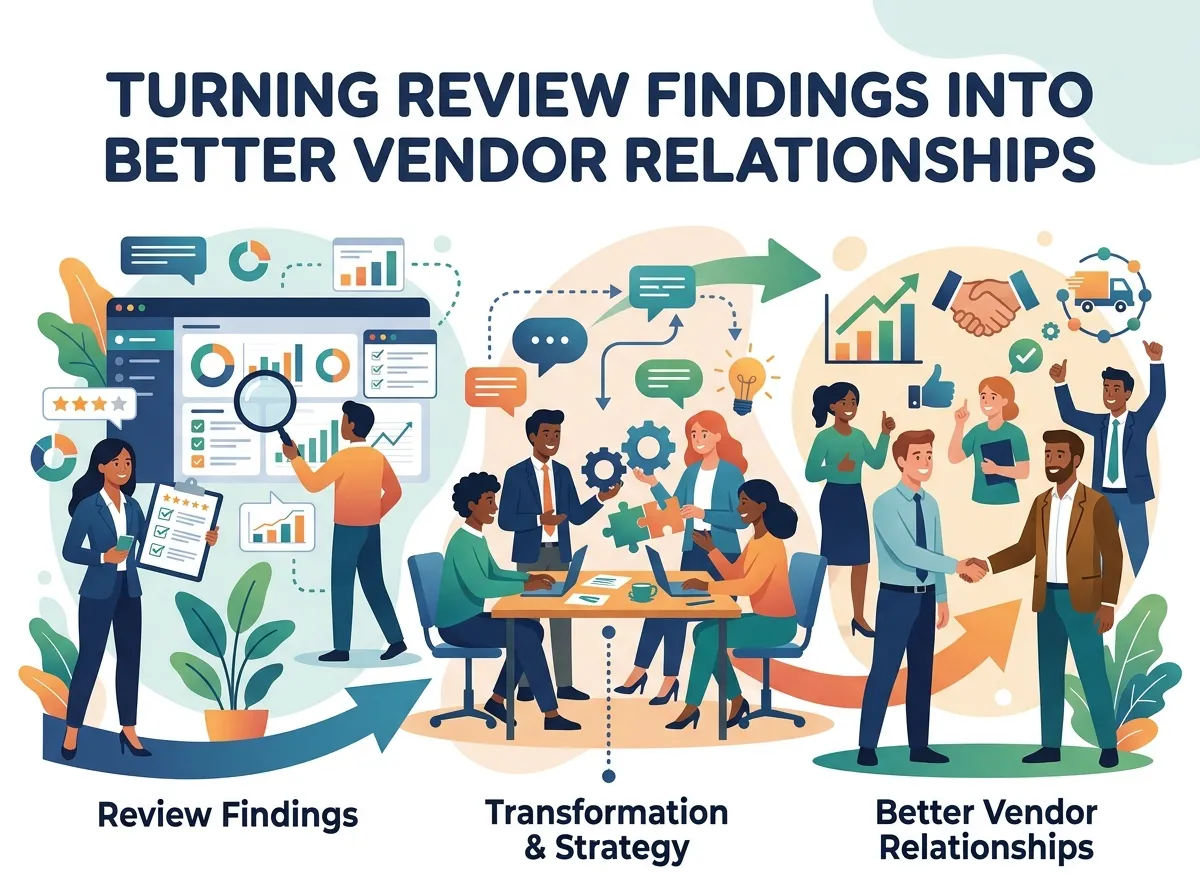
The greatest benefit of marketing vendor reviews comes from using the findings to improve future performance. Identifying a problem is only the first step. Marketing teams must determine why it occurred, agree on a suitable response, and assess whether the corrective action produces the intended result.
Some issues may require better internal coordination rather than a change of supplier. Unclear briefs, delayed approvals, frequently changing requirements, and inconsistent feedback can prevent vendors from delivering their best work. Reviewing these internal processes alongside supplier performance provides a more balanced understanding of the relationship.
Other situations may require changes to the partnership itself. A vendor may need revised service expectations, additional reporting requirements, a different communication schedule, or a more suitable project scope. Where the provider consistently fails to meet important obligations despite reasonable opportunities to improve, the organization may need to consider alternative suppliers.
Feedback should remain specific and professional. Instead of stating that a vendor is unreliable, a marketing manager can identify repeated missed milestones, explain the effect on campaign delivery, and agree on a measurable improvement target. This gives the supplier a clearer opportunity to respond and makes future progress easier to assess.
Businesses should also recognize strong performance. Vendors that communicate proactively, solve problems effectively, and contribute valuable strategic ideas can become important long-term partners. A fair review process acknowledges these contributions while maintaining clear standards for accountability.
Conclusion
Marketing vendor reviews help organizations understand whether external partners are delivering dependable service, meaningful results, and appropriate value. By combining clear evaluation criteria, performance scorecards, contract reviews, reliable data, and regular communication, businesses can make better-informed decisions about their supplier relationships.
An effective review process considers more than short-term campaign outcomes. It examines service quality, operational reliability, commercial terms, strategic alignment, and risk management. It also recognizes that vendor performance depends partly on the quality of internal processes and the clarity of shared expectations.
When review findings lead to specific actions and consistent follow-up, marketing teams can improve collaboration, reduce unnecessary costs, and strengthen accountability. Over time, marketing vendor reviews become a practical foundation for building stronger partnerships and supporting sustainable marketing performance.
Frequently Asked Questions
1. What are marketing vendor reviews?
Marketing vendor reviews are structured assessments of external marketing suppliers, agencies, and service providers. They examine service quality, performance, reliability, costs, communication, and alignment with business goals.
2. Why are marketing vendor reviews important?
They help businesses identify performance gaps, manage supplier risks, improve accountability, control costs, and determine whether a vendor continues to meet organizational needs.
3. How often should marketing vendors be reviewed?
Review frequency depends on the vendor’s importance, service complexity, risk level, and contract terms. Many organizations monitor performance continuously and schedule formal reviews quarterly or semiannually.
4. What should a marketing vendor scorecard include?
A scorecard may include service quality, delivery reliability, communication, campaign outcomes, reporting accuracy, budget management, compliance, and responsiveness. The categories should reflect the vendor’s responsibilities.
5. How can businesses evaluate marketing agency performance?
Businesses can review campaign results, creative quality, strategic recommendations, communication, delivery schedules, reporting transparency, and the agency’s response to feedback.
6. Should price be the main factor when comparing marketing vendors?
No. Price matters, but businesses should also consider service quality, expertise, reliability, internal management costs, scalability, and the vendor’s contribution to business objectives.
7. How does data quality affect vendor reviews?
Inaccurate or inconsistent data can distort performance comparisons. Standardized reporting definitions, clean records, and reliable measurement practices make vendor assessments more objective.
8. What should businesses do when a vendor performs poorly?
They should document the issues, discuss their causes, establish measurable improvement targets, and monitor progress. If significant problems continue, they may need to revise the agreement or evaluate alternative providers.
9. How do vendor reviews help manage marketing risks?
Reviews help identify concerns involving data security, compliance, missed deadlines, budget control, brand consistency, and contractual obligations before these problems become more serious.
10. What makes a marketing vendor review effective?
An effective review uses clear criteria, reliable evidence, consistent evaluation standards, open communication, and documented follow-up actions. Its purpose is to improve performance and support informed partnership decisions.