


Marketing data access determines who can view, use, modify, and share the information that supports marketing activities. As businesses rely on customer databases, campaign analytics, advertising platforms, and automation systems, controlling access becomes essential for protecting privacy and maintaining reliable operations. Effective access management combines clear permissions, strong security, consistent governance, and compliance with relevant requirements. When organizations provide the right information to the right people, they can encourage collaboration, reduce unnecessary risks, and make better marketing decisions.
When Marketing Data Becomes a Business Responsibility

Marketing teams work with a growing range of information, including customer contact details, campaign performance, website analytics, purchase histories, audience preferences, advertising reports, and lead records. These data sources help businesses understand their audiences and make informed decisions about communication, customer acquisition, and growth.
However, the value of this information depends partly on how responsibly it is accessed. When employees, agencies, contractors, and external partners can view or modify data without appropriate restrictions, businesses may face privacy concerns, accidental changes, unauthorized sharing, and unreliable reporting.
Marketing data access refers to the rules and processes that determine who can interact with marketing information, what actions they can perform, and under which conditions. It covers more than granting employees access to a dashboard. It also involves protecting sensitive customer records, managing third-party permissions, controlling integrations, and ensuring that information remains available to authorized people.
For example, an advertising specialist may need campaign performance data but have no reason to download an entire customer database. A content writer may need access to approved audience insights without being able to edit customer consent records. A marketing manager may require broader reporting permissions but still need additional authorization before exporting sensitive information.
These distinctions help organizations maintain productivity without giving every user unrestricted access. A well-designed access system supports collaboration while reducing unnecessary exposure and operational mistakes.
As marketing technology becomes more interconnected, businesses need to treat access management as a core part of their data strategy rather than an occasional administrative task.
Why Marketing Data Access Deserves Greater Attention
Marketing data often passes through multiple platforms and teams. Information collected through a website may enter a customer relationship management system, connect with an email platform, and later appear in advertising reports or analytics dashboards. Each connection creates another point where access needs to be managed.
The challenge becomes more complicated when agencies, freelancers, consultants, or technology vendors support marketing operations. These partners may need access to specific accounts or reports to complete their work, but their responsibilities rarely justify unrestricted control over every system.
Poor access management can create several problems. An employee might accidentally delete campaign information, a former contractor might retain access to an advertising account, or a third-party integration might receive more data than its function requires. Even when no malicious activity occurs, inconsistent permissions can lead to errors and uncertainty about who is responsible for changes.
There is also a business continuity concern. If account ownership depends on one employee’s personal credentials, the organization may struggle to manage campaigns when that person leaves or becomes unavailable. Shared access without clear accountability can create a similar problem because it becomes difficult to identify who performed a particular action.
A structured approach helps prevent these situations. Businesses can define responsibilities, establish approval processes, and maintain a clear record of who has access to each marketing resource.
The objective is not to restrict information unnecessarily. It is to make sure access supports legitimate work while protecting the business, its customers, and the reliability of its marketing operations.
Marketing Data Permissions: Giving Each Role the Right Access
Marketing data permissions determine what individual users can do within a system. Depending on the platform, permissions may allow someone to view reports, create campaigns, edit records, export information, manage integrations, or administer user accounts.
A practical permissions model begins with job responsibilities. Campaign specialists need access to the tools required to launch and monitor campaigns. Analysts need reliable reporting data. Content teams may need audience research and approved performance insights. Administrators require broader technical control, but that level of access should be limited to people who genuinely need it.
This approach follows the principle of least privilege: each user receives only the access necessary to perform their assigned work. It reduces the consequences of accidental mistakes and limits the amount of information exposed if an account is compromised.
Permissions should also distinguish between viewing and changing information. An employee who only needs to review campaign results should not automatically receive permission to alter tracking configurations or delete records. Similarly, the ability to manage subscribers should not necessarily include the ability to change account security settings.
Temporary permissions can be useful for short-term projects. An external agency may receive access to a particular advertising account for the duration of a campaign, with that access reviewed or withdrawn when the engagement ends.
A clear permissions structure improves accountability because responsibilities are connected to defined capabilities. It also makes onboarding easier: new employees can receive access based on their roles instead of relying on informal requests and ad hoc account sharing.
Marketing Data Security and the Risks of Uncontrolled Access
Marketing data security protects the information used throughout marketing operations from unauthorized viewing, modification, loss, or disclosure. Access controls are a major part of security, but they work best alongside technical safeguards and established organizational practices.
Strong authentication is an important starting point. Multi-factor authentication can help protect accounts even when passwords are exposed. Unique user accounts make it easier to identify activity, while secure password practices reduce the risks associated with reused or shared credentials.
Businesses should also pay attention to the security of connected applications. Marketing platforms frequently exchange information through integrations, APIs, tracking tools, and automation services. Each connection should have a clear purpose and receive only the permissions needed to perform its function.
Sensitive information deserves additional care. Customer contact details, purchase histories, and behavioral data may reveal information that should not be broadly accessible. Businesses should avoid exporting complete databases when a smaller, filtered dataset would support the same task.
Access logs and monitoring can help identify unusual activity, such as unexpected downloads, unfamiliar sign-ins, or permission changes. These signals do not automatically indicate wrongdoing, but they provide a basis for investigation when activity falls outside normal patterns.
Security also depends on employee awareness. Staff should understand how to handle data, recognize suspicious requests, and report potential incidents. When technical controls and responsible behavior work together, businesses can reduce the likelihood that a routine marketing task becomes a security problem.
Marketing Data Governance: Establishing Ownership and Accountability
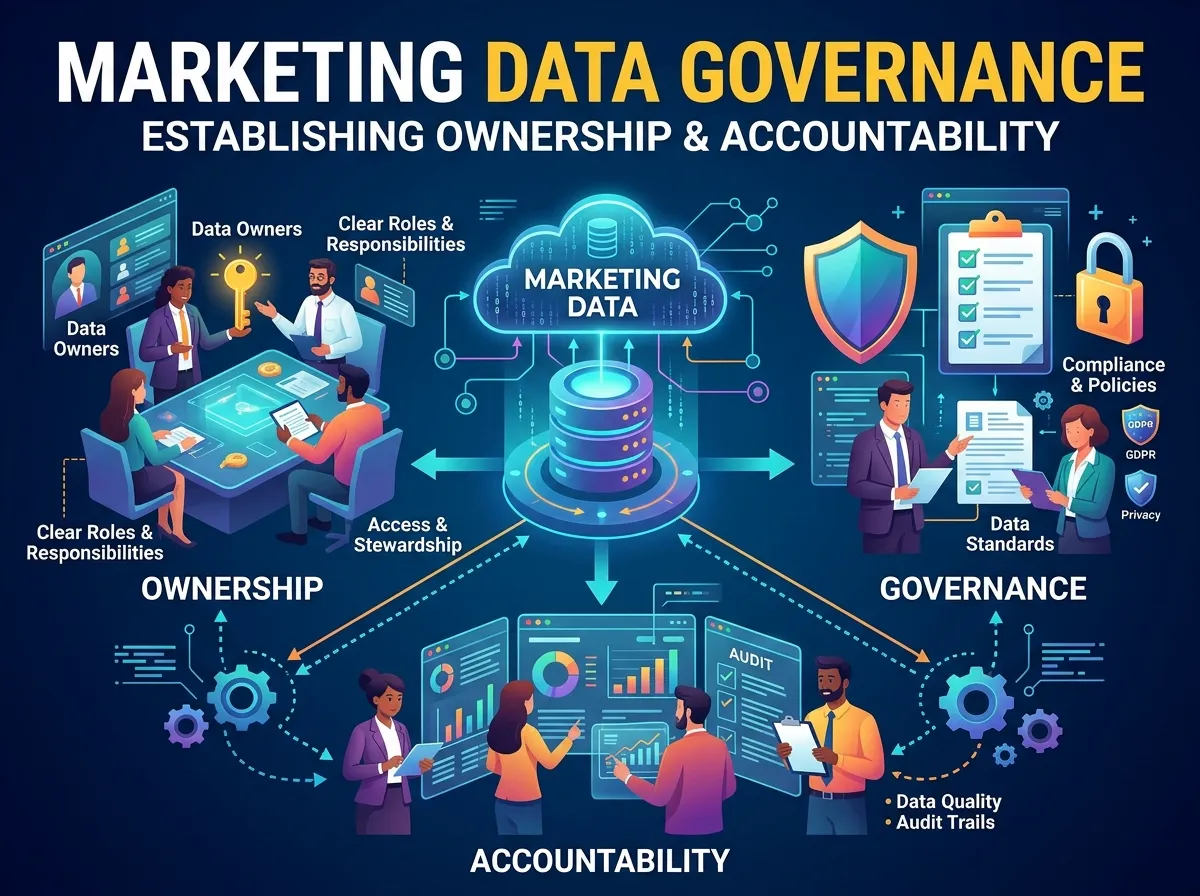
Marketing data governance defines how an organization manages, protects, interprets, and uses its marketing information. It establishes responsibilities and policies so that data remains consistent, trustworthy, and appropriately controlled across teams.
Without governance, different departments may collect similar information in incompatible formats, use inconsistent definitions for campaign metrics, or maintain separate customer records without a clear owner. These inconsistencies make reporting less reliable and complicate decisions about who can access or change particular information.
A governance structure identifies who is responsible for important datasets and decisions. Marketing operations may manage campaign data, analytics teams may maintain reporting definitions, and privacy or security specialists may oversee relevant requirements. The precise arrangement depends on the organization’s size and regulatory environment.
Governance also establishes standards for data collection, naming conventions, quality checks, retention, and permitted uses. For example, teams should agree on what qualifies as a marketing-qualified lead and which system holds the authoritative record of a subscriber’s preferences.
Documentation is essential because policies are difficult to follow when they exist only in people’s memories. A documented Marketing Documentation process can preserve responsibilities, workflows, approvals, and operating decisions in a format that authorized team members can reference.
Governance should support practical work rather than create unnecessary bureaucracy. Clear standards help teams understand which decisions they can make independently, which require approval, and where to find reliable information.
When ownership and accountability are established, marketing data becomes easier to manage and more useful for strategic planning.
Marketing Data Privacy and Responsible Customer Information
Marketing data privacy concerns how personal information is collected, used, shared, stored, and retained. It is closely connected to access management because restricting who can see customer data helps reduce unnecessary exposure.
Businesses should first understand why particular information is being collected. Contact details may be needed to deliver a requested newsletter, while other information might support order updates, customer service, or campaign measurement. Each purpose should be considered separately rather than treating all collected data as universally available for marketing use.
Permission to access information internally does not automatically establish permission to use it for every external purpose. A team may have technical access to customer records but still need to respect consent choices, applicable legal requirements, contractual restrictions, and internal policies.
Data minimization is useful here. If a marketing analysis only requires aggregated performance statistics, the team may not need access to individual customer identities. Where possible, aggregated or de-identified information can support analysis while reducing exposure of personal details.
Organizations should also consider retention. Keeping customer information indefinitely increases the amount of data that must be protected and may conflict with applicable requirements. Retention schedules should reflect legitimate business needs and relevant legal obligations.
Privacy responsibilities extend to vendors and external partners. Before sharing information, businesses should understand what data the partner will receive, why it needs that information, how it will be protected, and whether the arrangement meets applicable requirements.
Responsible privacy practices help maintain customer trust while making marketing operations more disciplined and transparent.
Marketing Database Access Across Connected Platforms
Modern marketing operations rarely rely on a single database. Contact records, campaign activity, website analytics, advertising audiences, and sales information may be stored across several platforms. Marketing database access therefore requires a coordinated view of users, permissions, and data flows.
One common challenge is inconsistent access across systems. An employee may leave the organization but retain permissions in an advertising platform, an email service, or a reporting tool. Another employee may have broad access to several connected systems because permissions were granted over time without a coordinated review.
A central inventory of important marketing systems can help address this issue. It should identify each platform, its business purpose, its owner, the types of data it contains, and the people or integrations that can access it.
Where supported, single sign-on and centralized identity management can make it easier to manage user access. However, these tools do not eliminate the need to review permissions inside individual platforms. A user may still have excessive privileges within an application even when login management is centralized.
Integration permissions deserve particular attention. A connector that synchronizes contact details may not need access to account administration, billing information, or unrelated datasets. Limiting the scope of integrations reduces the impact of potential errors or compromised credentials.
Businesses should also define how updates move between systems. If a customer changes a subscription preference, that change should reach the platforms responsible for sending marketing communications. If a record is corrected, connected systems should not continue relying on outdated information.
Coordinated access management helps preserve both security and data consistency across the marketing technology environment.
Marketing Access Control for Employees and External Partners
Marketing access control turns general security policies into practical restrictions within the systems people use. It can determine who can open a campaign dashboard, edit customer records, approve email sends, manage advertising budgets, or download reports.
Role-based access control is a useful model when different job functions have predictable responsibilities. Users are assigned roles, and each role carries a defined set of permissions. This makes it easier to grant consistent access to employees who perform similar work.
Some situations require more specific controls. A campaign may contain confidential launch information, or a report may include sensitive customer-level data. In such cases, access can be limited to a project team or approved individuals rather than an entire department.
External partners need the same level of consideration. Agencies may require campaign-management permissions but not ownership of the company’s accounts. Consultants may need temporary access to analytics reports without being able to export customer records. These boundaries should be defined before work begins.
Approval processes can provide an additional layer of control for high-impact activities. For instance, creating a campaign may require fewer permissions than exporting a large customer dataset or changing account ownership. Separating these responsibilities can reduce the risk of unauthorized or accidental changes.
When a project ends, access should be reviewed promptly. This includes removing user accounts, revoking temporary permissions, checking integrations, and confirming that account ownership remains with the organization.
Clear access control makes collaboration more manageable because people understand both what they can do and where approval is required.
Marketing Data Compliance and Regulatory Responsibilities
Marketing data compliance involves ensuring that data access and use follow applicable laws, contractual obligations, platform policies, and organizational requirements. The exact responsibilities depend on the jurisdictions involved, the types of data collected, and the nature of the marketing activity.
For example, some privacy laws establish requirements concerning transparency, lawful processing, access requests, deletion, or consent. Email and advertising activities may also be subject to specific rules. Businesses operating across multiple markets should not assume that a single policy automatically satisfies every applicable requirement.
Access management supports compliance by limiting unnecessary exposure and helping organizations demonstrate how information is handled. Records of permissions, approvals, data sharing, and relevant access changes can assist with internal reviews and investigations.
Documentation should reflect actual practices. A company may have a written policy restricting access to sensitive customer data, but if employees regularly exchange shared passwords or download unrestricted spreadsheets, the policy is not being implemented effectively.
Third-party relationships deserve particular attention. Businesses should understand the responsibilities of vendors that process marketing data, review appropriate contractual protections, and assess whether information sharing is necessary for the stated purpose.
Compliance also benefits from regular reviews. Changes in regulations, business processes, platform features, or marketing technology can create new requirements. Periodic assessments help identify gaps before they become more serious problems.
Although access controls cannot guarantee compliance on their own, they provide an important foundation for responsible data handling, accountability, and risk management.
Marketing Data Management and Reliable Decision-Making
Marketing data management connects access controls with the wider task of keeping information accurate, organized, and useful. Even when data is protected appropriately, inconsistent records or unclear definitions can undermine the decisions based on it.
Businesses should identify the authoritative source for important information. If campaign performance is reported differently across several dashboards, teams may struggle to compare results. If multiple systems maintain separate versions of customer preferences, communications may become inconsistent.
Clear ownership and standard definitions reduce these problems. Teams can document which system controls particular records, how metrics are calculated, and how changes should be communicated to other platforms.
Data quality checks can identify missing fields, duplicate contacts, outdated records, and unexpected changes. Access to correct information also matters: employees should be able to reach the data they need without relying on unofficial exports or manually maintained spreadsheets that quickly become outdated.
Reporting permissions should be designed around responsibilities. Some users may need aggregated statistics for planning, while a smaller group may require record-level access to investigate specific issues. Providing the appropriate level of detail improves usability while limiting exposure.
Reliable management also supports better strategic decisions. When teams can trust their campaign reports, audience insights, and lead records, they can evaluate performance with greater confidence and identify opportunities for improvement.
The connection between data access and data quality is important: protecting information is only part of the goal. Organizations also need to ensure that authorized users receive accurate, relevant, and appropriately presented data.
Connecting Secure Data Access With Marketing Growth
Access management should enable effective marketing rather than become a barrier to collaboration. Teams need timely information to identify audience needs, evaluate campaigns, improve customer experiences, and allocate resources effectively.
A well-designed access system allows specialists to work independently within defined boundaries while preserving oversight for sensitive activities. It also helps leadership access consistent performance information without requiring unrestricted access to every customer record.
This balance is particularly valuable when businesses expand their acquisition activities. A Growth Marketing Strategy may involve experimentation across channels, frequent campaign adjustments, and collaboration between marketing, sales, and analytics teams. Clear permissions help those teams share useful insights without creating unnecessary data exposure.
Paid acquisition also relies on reliable information. Teams managing Paid Lead Generation may need access to campaign results, lead quality indicators, and conversion reporting. Those requirements do not automatically justify giving every advertising user unrestricted access to personal customer information.
Businesses should design access around the specific decisions and tasks each role performs. Aggregated reporting may be sufficient for campaign optimization, while detailed lead records may be reserved for authorized sales or operations staff.
This approach makes security part of the operating model rather than a separate obstacle. The organization can move quickly, learn from campaign results, and support growth while maintaining appropriate control over its information.
Building a Sustainable Marketing Data Access Framework
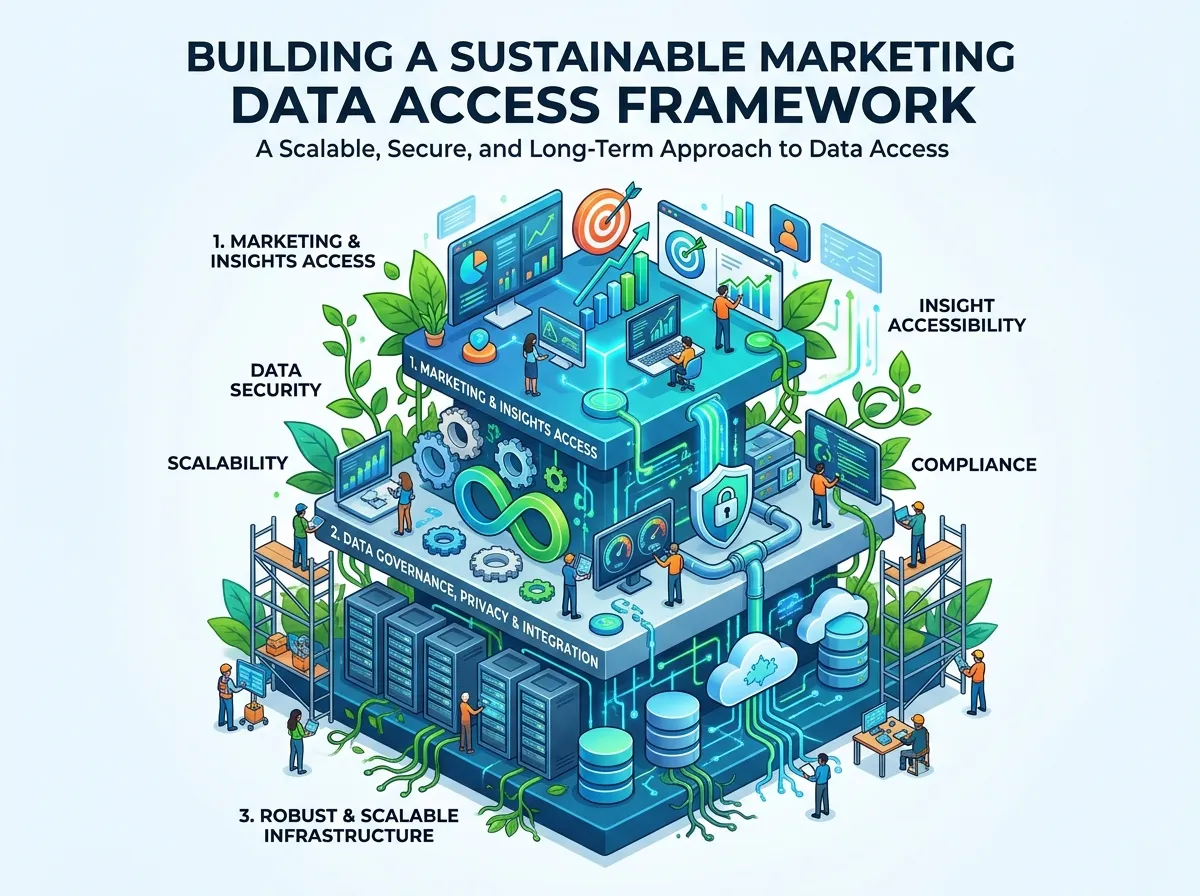
A sustainable framework combines policies, technology, ownership, and regular review. It should be clear enough for employees to follow and flexible enough to accommodate changes in team structure, marketing platforms, and business priorities.
The starting point is visibility. Organizations need to know which systems hold marketing data, who owns those systems, what information they contain, and which users or integrations have access. Without this understanding, excessive permissions and forgotten accounts are difficult to identify.
The next element is consistency. Similar roles should receive comparable permissions, sensitive activities should have appropriate approval requirements, and temporary access should have a clear purpose and end point. Exceptions can be necessary, but they should be documented rather than becoming permanent arrangements by default.
Reviews should happen regularly and after meaningful changes, such as employee departures, agency transitions, acquisitions, or platform migrations. These reviews should include human accounts, service accounts, connected applications, and shared resources.
Training also matters. Employees should know how to request access, handle sensitive exports, report suspicious activity, and avoid unsafe practices such as sharing credentials. Policies are more effective when staff understand the reasons behind them.
Finally, organizations should monitor whether the framework supports real work. If employees repeatedly create unofficial copies of data because approved access is too difficult to obtain, the system may need improvement. Appropriate controls should protect information while allowing legitimate work to continue efficiently.
Conclusion
Marketing data access is a critical part of modern marketing operations because it determines how information is used, protected, and shared across teams and platforms. Clear permissions, strong security, effective governance, and responsible privacy practices help businesses reduce risks while maintaining the data access required for productive work.
A successful approach does not give everyone unrestricted access, nor does it prevent teams from collaborating. Instead, it connects permissions to responsibilities, protects sensitive information, and establishes accountability for how data is handled.
By reviewing connected systems, controlling third-party access, maintaining accurate records, and adapting policies as business needs change, organizations can create a more reliable marketing environment. Secure and well-managed access ultimately supports better decisions, stronger customer trust, and sustainable marketing growth.
Frequently Asked Questions
1. What is marketing data access?
Marketing data access refers to the rules and processes that determine who can view, modify, export, or share marketing information across systems such as customer databases, analytics platforms, and advertising tools.
2. Why is marketing data access important?
It helps protect sensitive information, prevent unauthorized changes, support collaboration, maintain accountability, and ensure that employees can access the information needed for their responsibilities.
3. What are marketing data permissions?
Marketing data permissions define the actions a user can perform within a marketing system. These may include viewing reports, editing campaigns, managing contacts, exporting data, or administering accounts.
4. How can businesses improve marketing data security?
Businesses can use multi-factor authentication, individual user accounts, least-privilege permissions, secure integrations, access monitoring, employee training, and regular reviews of user privileges.
5. What is marketing data governance?
Marketing data governance establishes the ownership, standards, policies, and responsibilities used to manage marketing information. It supports data quality, consistency, accountability, and appropriate access.
6. How does marketing data access relate to privacy?
Access management limits who can view personal information and helps prevent unnecessary exposure. It should work alongside appropriate collection, use, sharing, retention, and privacy practices.
7. What is role-based marketing access control?
Role-based access control assigns permissions according to job responsibilities. For example, analysts may view performance reports, while administrators manage user accounts and security settings.
8. How often should marketing data permissions be reviewed?
Permissions should be reviewed periodically and after important changes, such as employee departures, new agency relationships, system migrations, or changes in job responsibilities. The appropriate frequency depends on the organization’s risks and requirements.
9. How can businesses manage third-party access to marketing data?
They should define the partner’s responsibilities, grant only the necessary permissions, use individual accounts where possible, document relevant agreements, monitor access, and revoke permissions when the engagement ends.
10. What is the relationship between marketing data access and compliance?
Appropriate access controls help organizations limit data exposure, demonstrate accountability, and support compliance with applicable legal, contractual, and platform requirements. They are an important part of a broader data protection program.