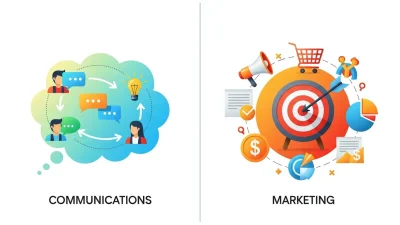


A competitive marketing strategy helps businesses understand competitors, customer expectations, market opportunities, and positioning. By combining competitive research with customer insights, strategic planning, differentiated messaging, content, automation, and performance measurement, businesses can create more focused and relevant marketing activities.
A competitive marketing strategy helps businesses understand their market, evaluate competitors, identify opportunities, and communicate their value more effectively. In competitive industries, simply offering a good product or service may not be enough. Businesses also need to understand what customers expect, how competing brands position themselves, and where there are opportunities to create meaningful differentiation.
A strong strategy does not require copying competitors. Instead, it involves studying the market carefully and using those insights to make informed decisions about positioning, messaging, pricing, customer experience, content, promotion, and marketing channels. When these activities are connected through a clear plan, businesses can respond more effectively to changing customer needs and market conditions.
What Is a Competitive Marketing Strategy?

A competitive marketing strategy is a structured approach to understanding competitors and using market insights to develop stronger marketing decisions. It considers how a business compares with other companies offering similar products or services and identifies areas where the business can communicate a distinct value.
The strategy can involve competitor research, customer research, market segmentation, positioning, messaging, channel selection, content development, and performance measurement. It is not limited to tracking what competitors are doing. Businesses also need to understand why certain approaches may be working and whether those approaches are appropriate for their own audience.
For example, a company may discover that competitors focus heavily on price. Instead of entering a price-based competition, the company could emphasize service quality, specialized expertise, convenience, product features, or customer support. The right approach depends on the market, audience, resources, and business objectives.
Why Competitive Marketing Matters
Markets change continuously as customer expectations, technologies, products, and communication channels evolve. A company that does not monitor its competitive environment may miss important changes in customer behavior.
Competitive marketing helps businesses recognize patterns and opportunities. By reviewing competitor websites, advertisements, content, social media activity, offers, customer reviews, and positioning, marketers can gain a clearer understanding of the market.
The purpose is not simply to imitate successful campaigns. Instead, competitive insights can help businesses identify gaps, clarify their own messaging, and make better decisions about where to invest marketing resources.
Competitive thinking is also useful when entering a new market. Before launching a product or service, businesses can examine existing providers and determine what customers already have available. This information can help shape the value proposition and marketing approach.
Conducting a Competitive Marketing Analysis
A competitive marketing analysis examines how competing businesses attract, engage, and retain customers. It typically considers competitors’ products, pricing, positioning, content, advertising, websites, customer experience, and promotional activities.
The first step is identifying relevant competitors. Direct competitors offer similar products or services to the same audience, while indirect competitors may solve the same customer problem in a different way.
Once competitors have been identified, marketers can examine their communication and customer-facing activities. Website messaging can reveal how competitors describe their value. Blog content can show which topics they prioritize. Social media can provide insight into how they communicate with audiences.
Customer reviews can also provide useful information. Positive reviews may reveal what customers appreciate, while recurring complaints can highlight areas where expectations are not being met. These observations can contribute to a more complete understanding of the competitive environment.
Understanding Marketing Competitive Analysis
Marketing competitive analysis should go beyond collecting surface-level information. Knowing that a competitor publishes several blog posts each month, for example, is less useful than understanding which topics attract attention and how those topics connect with the company’s broader marketing objectives.
Marketers can examine the customer journey from discovery to purchase. This may include search visibility, landing pages, lead forms, email communication, offers, product demonstrations, and follow-up campaigns.
It is also useful to compare messaging rather than simply comparing marketing volume. A competitor may publish more content but communicate a less specific value proposition. Another company may have fewer campaigns but maintain a highly focused brand position.
The goal is to identify meaningful differences that can inform strategic decisions.
Developing a Competitor Marketing Strategy
A competitor marketing strategy should turn research into action. After identifying competitor strengths, weaknesses, market gaps, and customer expectations, businesses can decide where they want to differentiate.
Differentiation may involve product features, customer service, specialization, pricing structure, convenience, expertise, content quality, or overall customer experience.
For example, if competitors primarily target large companies, a business may focus its marketing on smaller organizations with specialized needs. If competitors use highly technical messaging, a company may choose clearer language that makes its product easier to understand.
The strategy should be based on genuine business capabilities. Marketing claims need to be supported by the actual customer experience. A positioning statement may attract initial attention, but long-term success depends on delivering the value promised.
Building a Competitive Positioning Strategy
A competitive positioning strategy defines how a brand wants to be understood in relation to alternatives in the market. It answers an important question: why should a particular customer consider this business instead of another available option?
Effective positioning usually connects a specific audience need with a meaningful business strength. Rather than attempting to appeal to everyone, a company can focus on the customers it is best equipped to serve.
Positioning should also be consistent across marketing channels. Website messaging, advertising, social media, email, sales materials, and content should communicate compatible ideas about the brand.
Strong positioning does not necessarily mean claiming to be better at everything. A focused position can be more useful because it gives customers a clearer understanding of what the company offers and who it serves.
Using Competitive Market Research
Competitive market research provides the information needed to make informed marketing decisions. Research can include competitor websites, search results, advertisements, product pages, customer reviews, industry publications, social media activity, pricing information, and public company communications.
Customer research should also be part of the process. Competitors may appear successful from the outside, but customers may have different opinions about their experiences. Surveys, interviews, reviews, customer service conversations, and sales feedback can provide valuable context.
Market research should be updated periodically because competitive conditions can change. A company that was differentiated several years ago may now face many businesses offering similar products and messages.
Regular research helps marketers identify these changes before they significantly affect their marketing performance.
Creating a Market Competition Strategy

A market competition strategy should connect competitive insights with the company’s broader business objectives. Instead of reacting to every competitor campaign, marketers should determine which competitive developments actually matter.
For example, a competitor launching a new social media campaign may not require an immediate response. However, if several competitors begin targeting the same customer segment with similar messaging, it may be useful to review the company’s positioning.
A market competition strategy can also help businesses decide where not to compete. Resources are limited, and trying to match every competitor across every channel may create unnecessary costs.
Strategic focus allows businesses to concentrate on channels, audiences, and messages where they can provide meaningful value.
Building Competitive Advantage in Marketing
Competitive advantage in marketing comes from communicating and delivering value that is meaningful to a target audience. It can be based on several factors, including expertise, product quality, customer service, convenience, innovation, specialization, pricing, distribution, or customer experience.
Marketing plays an important role in making this advantage visible. Even when a business has a strong product, customers need to understand what makes it relevant to them.
Content can demonstrate expertise. Customer stories can illustrate results. Product demonstrations can explain functionality. Educational resources can answer common questions. Email campaigns can maintain relationships with prospects and customers.
Competitive advantage should not depend entirely on marketing language. The underlying business experience needs to support the claims being made.
Understanding Competitor Analysis in Marketing
Competitor analysis in marketing becomes more valuable when it is connected to customer needs. A competitor’s campaign may look successful, but copying it without understanding the audience can produce very different results.
Marketers should examine what customers appear to value and how competitors address those needs. They can then identify areas where their own business has a legitimate opportunity to differentiate.
For example, if customers frequently complain about slow support from competitors, a company with responsive customer service may emphasize support as part of its positioning. If customers find competitor products difficult to understand, a company could focus on simplicity and education.
This approach turns competitor research into customer-focused marketing rather than competitor-focused marketing.
Strategic Marketing Planning and Competitive Insights
Strategic marketing planning provides the framework for turning market research into coordinated action. It can include objectives, target audiences, positioning, messaging, channels, content priorities, budgets, timelines, and performance indicators.
Competitive information can influence each of these areas. If research shows that competitors dominate a particular channel, the business can decide whether to compete there, find an underserved channel, or develop a different approach.
Planning should also include flexibility. Competitive environments can change quickly, so marketing teams should review performance and market developments regularly.
Lead nurturing is one area where strategic planning can connect competitive positioning with customer communication. Businesses can explore Creating Lead Nurturing Workflows That Convert to understand how structured follow-up can support prospects throughout the customer journey.
Using Customer Segmentation to Strengthen Competitive Strategy
Customer segmentation allows businesses to understand whether different groups have different needs, priorities, or buying behaviors. A competitive strategy can become more focused when marketers understand which segments are most relevant to the business.
For example, one customer group may prioritize price while another may care more about convenience or specialized expertise. The same positioning may not appeal equally to both groups.
Demographic, geographic, behavioral, and firmographic information can help marketers develop more relevant campaigns. Businesses using marketing automation can also use segmentation to create more personalized communication.
Scoring models may provide another layer of insight when businesses need to prioritize leads. For example, Building a Demographic Scoring Model in Marketo explores how demographic information can be incorporated into lead evaluation and marketing processes.
Competitive Strategy and Marketing Automation
Marketing automation can help businesses execute competitive marketing strategies consistently. Once audience segments and customer journeys are established, automation can deliver appropriate content and follow-ups based on customer interactions.
Automated campaigns can support lead nurturing, email communication, content distribution, and customer engagement. However, automation should be guided by strategy rather than used simply because the technology is available.
Businesses should define the audience, objective, message, timing, and desired action before building automated workflows.
Companies that are developing automation programs can also learn from resources such as Build Marketo Program from Scratch for Beginners when planning structured marketing processes.
Using Content to Support Competitive Positioning
Content marketing can help businesses communicate their expertise and differentiate their brand. Educational articles, case studies, reports, videos, webinars, comparison content, and customer resources can all support a competitive positioning strategy.
The most useful content addresses questions that matter to the target audience. Competitive research can reveal information gaps, but content should provide original value rather than simply reproducing competitor material.
A company can also use content to explain complex products, demonstrate expertise, answer objections, and show customers how its solutions address specific problems.
Over time, a consistent content strategy can strengthen brand recognition and provide useful resources throughout the customer journey.
Maintaining an Ethical Competitive Marketing Strategy
Competitive research should be conducted responsibly. Businesses can analyze publicly available information, customer feedback, market trends, and legitimate industry data without misleading customers or attempting to obtain confidential competitor information.
Ethical marketing also matters when comparing products or services. Businesses should avoid unsupported claims about competitors and ensure that comparative statements are accurate and understandable.
The same principle applies to affiliate and partner marketing. Companies interested in this area can review Ethical Affiliate Marketing for additional perspective on maintaining transparency and responsible promotional practices.
An ethical approach can also reduce reputational risks while helping businesses build trust with customers.
Measuring Competitive Marketing Performance
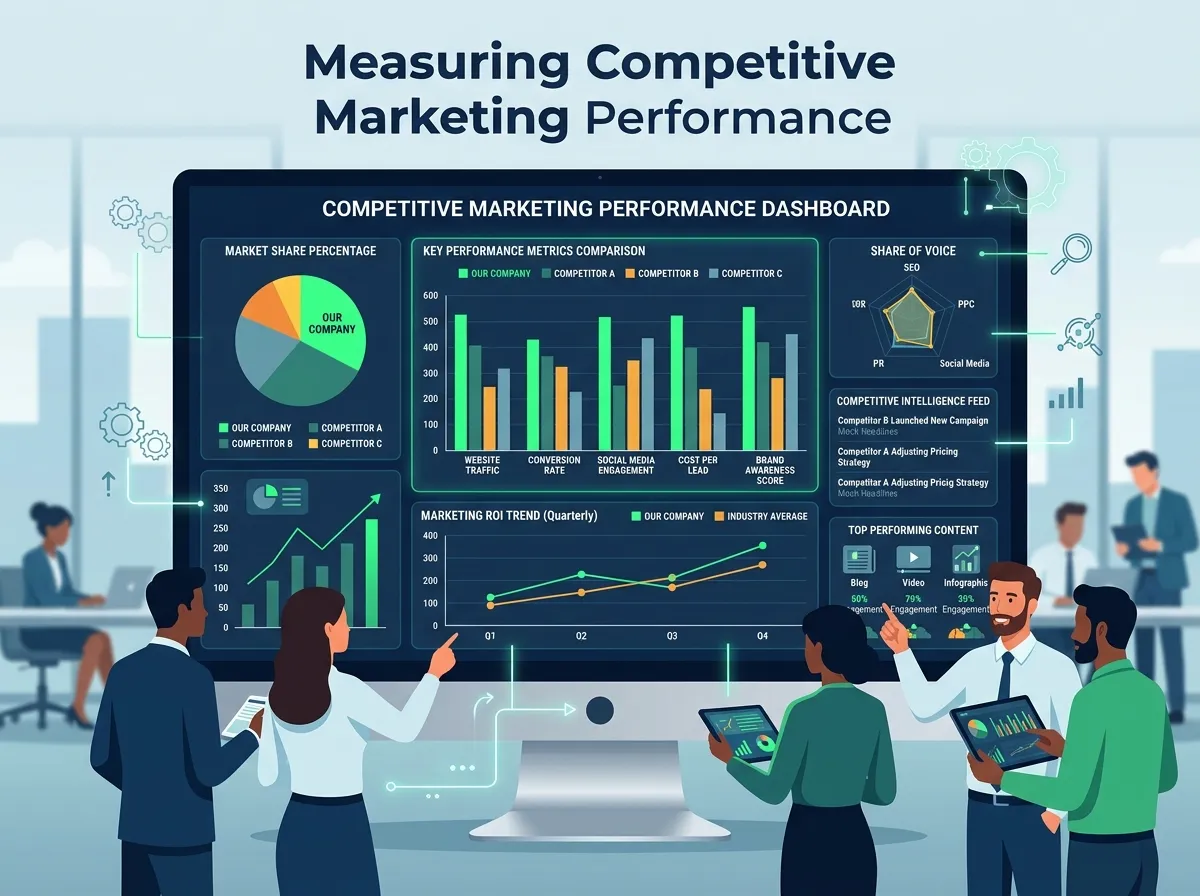
A competitive marketing strategy should be measured using metrics connected to business objectives. Depending on the strategy, useful measurements may include website traffic, qualified leads, conversion rates, customer acquisition costs, engagement, sales, retention, and revenue.
Businesses can also monitor changes in market visibility and customer perception. Search rankings, brand mentions, customer feedback, and content engagement can provide additional context.
It is important not to interpret one metric in isolation. A campaign may generate significant traffic but relatively few qualified leads. Another campaign may attract a smaller audience but produce stronger customer engagement and conversions.
Regular performance analysis allows marketers to refine their strategy based on actual results rather than assumptions.
Conclusion
A competitive marketing strategy helps businesses make more informed decisions in markets where customers have multiple choices. Through competitive marketing analysis, competitive market research, customer research, and careful positioning, businesses can understand their environment and identify meaningful opportunities.
The goal is not to copy competitors or respond to every market movement. Instead, businesses can use competitive insights to clarify their value, understand customer needs, improve marketing communication, and focus resources on strategic priorities.
When combined with competitive positioning strategy, competitive advantage in marketing, marketing automation, content, lead nurturing, and ongoing measurement, competitive strategy becomes part of a broader approach to sustainable marketing planning.
Frequently Asked Questions
1. What is a competitive marketing strategy?
A competitive marketing strategy is an approach that uses competitor, customer, and market information to guide marketing decisions. It can influence positioning, messaging, content, pricing, channel selection, customer targeting, and promotional activities.
2. Why is competitive marketing analysis important?
Competitive marketing analysis helps businesses understand how other companies communicate with customers and position their products or services. It can reveal market trends, customer expectations, potential gaps, and opportunities for differentiation.
3. What is included in competitive market research?
Competitive market research can include competitor websites, products, pricing, advertising, content, social media, customer reviews, search visibility, promotional campaigns, and publicly available industry information. Customer research should also be included to provide additional context.
4. How does competitor analysis in marketing help businesses?
Competitor analysis in marketing can help businesses identify how competitors address customer needs and where there may be opportunities to differentiate. It can also help marketers understand market expectations and improve their own messaging and customer experience.
5. What is a competitive positioning strategy?
A competitive positioning strategy defines how a business wants its brand or product to be understood compared with available alternatives. It connects a target audience’s needs with a specific and credible business value.
6. How can a business create a competitive advantage in marketing?
A business can communicate its competitive advantage through genuine strengths such as expertise, customer service, product features, convenience, specialization, quality, innovation, or customer experience. Marketing should clearly communicate these strengths while ensuring the actual business experience supports the claims.
7. How often should businesses conduct competitive research?
The appropriate frequency depends on the industry and pace of market change. Businesses in rapidly changing industries may monitor competitors more frequently, while others may conduct deeper reviews periodically and monitor major changes throughout the year.
8. Should businesses copy their competitors’ marketing strategies?
Competitor research can provide useful insights, but directly copying another company’s strategy may not reflect a business’s own customers, capabilities, positioning, or goals. Competitive research is generally more useful when it informs original marketing decisions.
9. How does strategic marketing planning use competitor information?
Strategic marketing planning can use competitor information to define target audiences, positioning, messaging, channels, content priorities, and marketing objectives. Competitive information is one input into planning rather than the sole basis for decisions.
10. Can marketing automation support a competitive marketing strategy?
Yes. Marketing automation can help businesses execute planned customer journeys, segmentation, lead nurturing, email communication, and follow-up consistently. The automation should be based on clear strategic objectives and relevant customer information.