
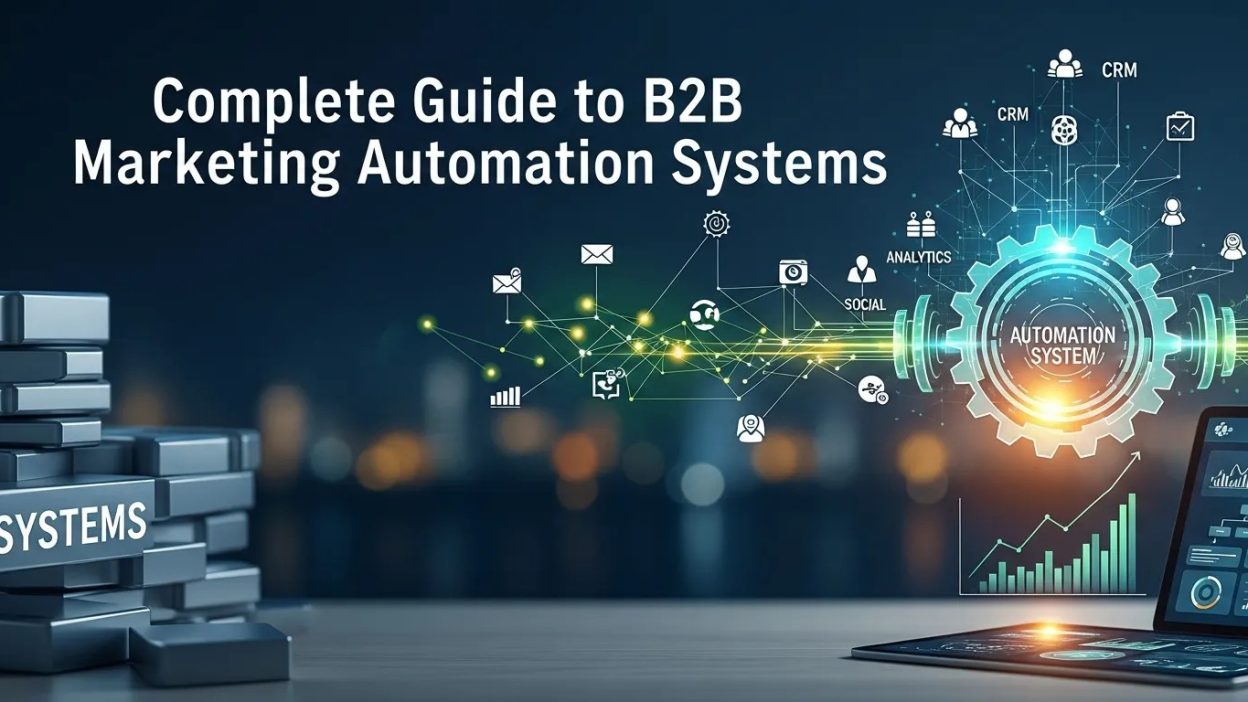
B2B Marketing Automation streamlines lead generation, nurturing, and conversion through data-driven workflows, improving personalization, efficiency, and revenue growth across the complete B2B buyer journey.
B2B Marketing Automation sits at the center of modern demand generation because it helps teams respond to buying intent with speed, precision, and consistency. When a prospect downloads a guide, visits a pricing page, or returns to a comparison page multiple times, B2B Marketing Automation makes it possible to act on those signals immediately. That is important because B2B buyers rarely convert after one touch. They evaluate, compare, discuss internally, and only then decide.
A strong Marketing Automation strategy does more than save time. It gives the business a repeatable way to turn attention into pipeline. Instead of relying on manual follow-up that depends on memory or availability, B2B Marketing Automation creates a system where the right message can reach the right person at the right moment. That timing matters because intent fades quickly, and delay often means lost opportunity.
B2B Marketing Automation is also valuable because B2B purchase cycles are crowded with friction. Multiple stakeholders need reassurance, budgets need approval, and vendors need to prove fit. A well-designed system reduces that friction by guiding the buyer with helpful content, consistent messaging, and behavior-based next steps. In practice, B2B Marketing Automation becomes a revenue infrastructure, not just a software feature.
For many companies, the first real benefit of B2B Marketing Automation is clarity. Once workflows, lead scoring, and lifecycle stages are mapped correctly, teams can see where prospects stall and where momentum is strong. That visibility helps marketing and sales stop guessing and start improving. B2B Marketing Automation turns scattered activity into measurable movement.
The Buyer Psychology Behind Every Automation Decision
B2B buyers are not impulsive, and that is exactly why B2B Marketing Automation works when it is used thoughtfully. The emotional driver in B2B is rarely excitement alone. It is safety, credibility, and the feeling that a choice will not create professional risk. B2B Marketing Automation should therefore reinforce trust at each stage rather than push too aggressively.
At the awareness stage, the buyer wants to understand the problem. At the consideration stage, the buyer wants to compare options. At the decision stage, the buyer wants confidence that the chosen solution will work internally and externally. B2B Marketing Automation helps the brand match this psychological progression with content that feels relevant instead of repetitive.
A good Marketing Automation strategy respects attention. It avoids creating pressure too early and instead builds familiarity through useful touchpoints. the system should feel like a helpful guide that anticipates questions before they become objections. That is why behavioral triggers, educational content, and well-timed follow-ups matter so much.
Trust also grows when communication feels coherent. If one message is educational, the next one should not feel random or overly promotional. This approach is strongest when each touchpoint builds on the previous one. Buyers sense continuity, and continuity makes a company feel more credible.
Defining the Strategy Before Choosing the Tool

Many companies think B2B Marketing Automation starts with software, but it actually starts with strategy. If the business goals are unclear, the automation will only accelerate confusion. A successful Marketing Automation strategy begins by defining the revenue problem that needs solving. Is the company trying to increase lead quality, shorten the sales cycle, re-engage dormant prospects, or improve conversion from content downloads? The answer changes the entire architecture.
Once the goal is clear, the team can design workflows around actual behavior. B2B Marketing Automation becomes far more effective when the business knows what counts as interest, what counts as readiness, and what counts as a bad-fit lead. Those definitions should not be vague. They need to be shared across marketing and sales so the system can operate with consistency.
The next step is audience clarity. B2B Marketing Automation is more effective when the team knows exactly who the best-fit customer is, what pain points matter most, what objections appear most often, and which content formats build confidence. This is where buyer personas, account segmentation, and lifecycle mapping come together. Once the audience is well understood, B2B Marketing Automation can deliver messages that feel personal and timely.
A practical Marketing Automation strategy also requires internal ownership. Marketing, sales, and sometimes customer success need to agree on handoff rules, scoring rules, and escalation triggers. Without that alignment, B2B Marketing Automation can create activity without revenue impact. With it, the whole funnel becomes easier to manage and optimize.
Start with the customer profile
Before building workflows, create a clear customer profile. Include industry, company size, job role, buying triggers, common objections, and success outcomes. B2B Marketing Automation works best when the messaging reflects real business context instead of generic assumptions.
Map trigger moments carefully
A strong B2B Marketing Automation system depends on trigger moments such as content downloads, pricing-page visits, webinar attendance, demo requests, or repeated email engagement. Each trigger should connect to a meaningful next step. If the trigger is weak, the response will feel weak too.
Why B2B Brands Need Repeatable Systems
The phrase B2B Brands Automation Is Essential for Growth reflects a simple truth: growth cannot rely on manual effort alone. As lead volume increases, every manual task becomes more expensive in time and inconsistency. B2B Marketing Automation solves that problem by turning repeatable actions into repeatable systems. It gives the company a structure that can handle scale without degrading the experience.
Repeatability matters because B2B buying is rarely linear. A prospect may disappear for weeks and return later with new urgency. Another may engage with five touchpoints and still need internal approval. B2B Marketing Automation keeps these journeys organized so no lead is lost just because timing is imperfect. That makes the brand feel reliable and responsive.
The best systems do not sound robotic. B2B Marketing Automation should preserve a human voice while using automation to manage timing and workflow. That balance is what allows brands to scale without sounding cold. Buyers want to feel that a real company understands their problem. They do not want to feel trapped in a machine.
A strong Marketing Automation Platform supports that balance by connecting data, content, scoring, and reporting in one place. When the platform is aligned with the strategy, this becomes easier to govern. Teams can see which campaigns influence pipeline, which segments respond best, and where the customer journey needs refinement.
Building the Foundation with Clean Data and Segmentation
B2B Marketing Automation depends heavily on data quality. If the data is incomplete, duplicated, or outdated, the automation logic will produce poor results. Clean data is not glamorous, but it is essential. Without it, personalization breaks down, reporting becomes unreliable, and lead routing becomes inaccurate.
Segmentation is the engine that gives B2B Marketing Automation relevance. A useful segment is not just a broad industry label. It should reflect value, intent, and context. For example, two companies in the same sector may be at completely different stages of readiness. One may be researching solutions; the other may be comparing vendors. B2B Marketing Automation should treat those audiences differently.
Segmentation can be based on firmographic data, behavioral signals, lifecycle stage, geography, job function, and engagement depth. The key is not to over-segment too early. Start with the distinctions that matter most to revenue. Then refine as the data reveals patterns. B2B Marketing Automation becomes more precise over time when the team keeps learning from actual behavior.
A clean data foundation also helps with reporting. If records are consistent, the team can trust what the dashboards show. That means the Marketing Automation strategy can evolve with evidence rather than guesswork. Every improvement becomes easier to justify when the data is dependable.
Data hygiene before launch
Before launching B2B Marketing Automation, review duplicates, missing fields, inconsistent naming, and broken source attribution. If the database is messy, the system will amplify the mess. Clean inputs make clean automation possible.
Segment by behavior and fit
B2B Marketing Automation performs best when it combines behavioral data with fit data. A lead that behaves like a buyer but does not match your ICP may not be worth immediate sales attention. A strong-fit lead with low engagement may need more nurturing. The system should recognize both.
Lead Nurturing That Builds Trust Instead of Pressure
One of the strongest advantages of B2B Marketing Automation is its ability to nurture leads over time. Many prospects are interested but not ready, and that is normal in B2B. Nurturing gives the business a way to stay useful during that middle period without becoming intrusive. The goal is not to force a decision. The goal is to move the buyer toward confidence.
Good nurturing starts with education. The buyer should feel that each message answers a real question, reduces a real concern, or clarifies a next step. B2B Marketing Automation should guide, not push. That approach works because it respects the buyer’s pace while still keeping the brand present. Over time, that presence builds familiarity, and familiarity supports trust.
Nurturing also works better when content is varied. B2B Marketing Automation can use articles, case studies, webinars, checklists, product explainers, and comparison pages to create a richer sequence. Variety prevents fatigue and makes the journey feel more natural. A prospect who only receives promotional messages will disengage quickly. A prospect who receives useful and relevant messages is more likely to continue the conversation.
Welcome sequences matter
The first sequence a lead sees should create clarity. B2B Marketing Automation works best when the welcome path explains what the prospect will get, what the next step is, and how the brand can help. That first impression shapes everything that comes after.
Educational nurture creates momentum
Educational nurture works because it lowers resistance. When people feel informed, they feel safer moving forward. B2B Marketing Automation should therefore prioritize value at the beginning of the journey, especially when the prospect is not yet ready to talk to sales.
Lead Scoring and Sales Readiness
Lead scoring is one of the most practical ways B2B Marketing Automation creates efficiency. Instead of treating every lead as equal, scoring helps teams identify which prospects deserve immediate follow-up and which ones still need nurturing. That matters because sales time is finite, and poor prioritization wastes opportunity.
A good scoring model includes both behavior and fit. Behavioral signals can include page visits, email clicks, webinar attendance, and form submissions. Fit signals can include company size, industry, role, and geography. B2B Marketing Automation works well when these signals are combined into one clear view of readiness. A lead that is highly engaged and a good fit should rise to the top quickly.
Scoring should also include negative signals. Inactive contacts, irrelevant roles, and low-intent behavior may indicate that a lead is not ready or not suitable. That does not mean the lead should be discarded. It means B2B Marketing Automation should route them into the right nurture path instead of pushing them into sales too early.
When scoring is set up correctly, the handoff between marketing and sales becomes smoother. Sales teams can see not just who the lead is, but how they behaved, what they consumed, and what kind of value they likely seek. That context makes conversations more relevant and more productive. In that sense, B2B Marketing Automation improves both operational speed and customer experience.
Behavioral scoring
Behavioral scoring is useful because it reflects actual interest. A person who repeatedly visits the pricing page is demonstrating stronger intent than someone who only opened one email. B2B Marketing Automation should reward the signals that matter most.
Fit scoring
Fit scoring measures how closely a lead matches the ideal customer profile. B2B Marketing Automation becomes more effective when fit and behavior work together. Strong behavior with weak fit may still require caution, while strong fit with moderate behavior may justify continued nurture.
Content Mapping Across the Funnel
B2B Marketing Automation cannot perform well without strong content. The system only works when it has the right assets to send at the right time. Each stage of the funnel needs a different type of content because the buyer’s mindset changes over time. Content should follow that mindset closely.
At the top of the funnel, educational content should help the buyer understand the problem. At the middle, content should help the buyer compare approaches and evaluate tradeoffs. At the bottom, content should reduce risk and reinforce confidence. B2B Marketing Automation is strongest when every message serves a specific role in that sequence.
The emotional side of content matters too. B2B buyers often worry about making a bad choice, wasting money, or creating internal resistance. Content that speaks to those concerns indirectly can be more persuasive than content that simply repeats features. The best Marketing Automation strategy blends information, proof, and reassurance.
Awareness content
Awareness content should reduce confusion. It can include explainers, industry insights, and educational resources that help the buyer understand the problem. B2B Marketing Automation should use this stage to build credibility gently.
Consideration content
Consideration content should help buyers compare methods and solutions. B2B Marketing Automation can use guides, frameworks, and comparison articles to support this phase. The goal is to make the evaluation process easier.
Decision content
Decision content should lower risk. Case studies, implementation timelines, FAQs, and product walkthroughs work well here. B2B Marketing Automation should help the prospect feel that the choice is practical and safe.
Workflow Design That Creates Momentum

B2B Marketing Automation becomes highly valuable when workflows are carefully designed. A workflow is a defined sequence of steps triggered by a behavior, a date, or a status change. Good workflows reduce delay, increase consistency, and keep the buyer moving through the funnel.
The best workflow design begins with a single purpose. Do not try to make one sequence solve everything. One workflow may welcome new leads. Another may recover abandoned opportunities. Another may re-engage dormant accounts. B2B Marketing Automation works better when every workflow has one clear job and one measurable outcome.
A useful workflow also feels human. The messages should match the context of the trigger. If someone downloaded a case study, the follow-up should relate to that theme. If someone viewed a demo page, the next step should make it easier to learn more or book time. B2B Marketing Automation should create continuity between action and response.
Triggered follow-up
Triggered follow-up is one of the highest-value uses of B2B Marketing Automation. Speed matters because buyer intent can cool quickly. A timely message can preserve momentum that would otherwise disappear.
Re-engagement workflows
Re-engagement workflows help revive dormant prospects. B2B Marketing Automation can use new insights, fresh content, or a different angle to bring attention back. The tone should be useful and respectful rather than desperate.
CRM and Lifecycle Alignment
B2B Marketing Automation performs best when it is connected with CRM and sales pipeline automation processes. That connection creates a single view of the lead and makes it easier for teams to act on the same information. When marketing data and sales data live together, follow-up becomes more relevant and pipeline management becomes easier.
The relationship between CRM and Automation Tech is especially important when teams want to move from isolated campaigns to revenue operations. The CRM stores the history, while the automation system drives the engagement. Together, they create a more complete picture of the buyer’s journey. That picture helps the business understand what happened, when it happened, and what to do next.
Lifecycle alignment is another important piece. Marketing, sales, and customer success should agree on what each stage means. If those definitions are unclear, B2B Marketing Automation can produce confusion instead of clarity. Shared definitions create smoother handoffs and more predictable pipeline movement.
Unified lifecycle stages
Unified lifecycle stages help teams speak the same language. B2B Marketing Automation becomes more effective when everyone understands what counts as a new lead, a marketing-qualified lead, a sales-qualified lead, and an opportunity.
Better handoff quality
A strong handoff is more than transferring a name. B2B Marketing Automation should ensure that engagement history, content consumption, and fit data travel with the lead so the next team can respond intelligently.
Personalization at Scale Without Losing Efficiency
One reason B2B Marketing Automation is so powerful is that it enables personalization without requiring endless manual work. Personalization at scale means the message changes based on who the buyer is, what they care about, and what they have done. That is far more effective than one-size-fits-all communication.
A CFO and a marketing director may both be part of the same account, but they care about very different outcomes. One wants financial confidence; the other wants operational results. B2B Marketing Automation can adjust the message accordingly. That makes the system feel relevant to each person while staying manageable for the team.
The psychology here is simple. People respond more positively when they feel understood. Personalization reduces friction because it removes irrelevant information and highlights the details that matter most. B2B Marketing Automation should use that principle to create stronger response rates and better conversion quality.
Dynamic content
Dynamic content allows B2B Marketing Automation to adapt messages based on segment or behavior. This reduces manual production effort while keeping communication highly relevant.
Timing relevance
Timing is a form of personalization too. B2B Marketing Automation can send messages when engagement is most likely, based on prior behavior or lifecycle stage. That often improves open rates and click-through rates.
Measurement, Testing, and Continuous Improvement
A serious B2B Marketing Automation program needs measurement from the start. Without measurement, the team cannot tell whether the system is working or merely producing activity. The right metrics depend on the funnel stage, but common indicators include engagement, lead-to-opportunity conversion, speed to lead, pipeline influence, and revenue contribution.
Testing is equally important. A/B testing can improve subject lines, calls to action, email timing, landing pages, and workflow logic. B2B Marketing Automation should evolve from real evidence, not assumptions. Small adjustments can create meaningful gains over time, especially when the volume is high.
Attribution is not always simple in B2B. Buyers may interact with multiple touchpoints before converting. B2B Marketing Automation should therefore be evaluated as a system of influence rather than a single-campaign machine. The question is not only which message closed the deal, but which sequence created the conditions for the deal to happen.
Leading metrics
Open rates, click rates, and form fills are useful because they indicate engagement. B2B Marketing Automation should monitor these signals, but not rely on them alone.
Lagging metrics
Revenue, pipeline value, and retention show the deeper effect. B2B Marketing Automation must ultimately be judged by whether it improves business outcomes, not just channel metrics.
Errors That Break Momentum
Even strong teams can make mistakes when implementing B2B Marketing Automation. One common issue is overcomplication. If the workflow logic becomes too complicated too early, the system becomes hard to manage and easy to break. Simplicity is usually better at the start.
Another issue is poor content quality. If the message is vague, repetitive, or overly promotional, B2B Marketing Automation will not fix it. The system can deliver messages efficiently, but it cannot make weak communication stronger. The offer itself must be useful.
A third mistake is failing to maintain data quality. Bad records, broken tags, and unclear sources can weaken segmentation and reporting. That is why a good Marketing Automation strategy includes regular audits. Clean data protects the effectiveness of the system.
The bigger point is that Automation Mistakes to Avoid for Growth are usually strategy mistakes first and technical mistakes second. The tool is rarely the main problem. The structure behind the tool is usually where the issue begins.
Over-automation
Too much automation can make the brand feel distant. B2B Marketing Automation should support human judgment, not erase it.
Weak segmentation
If the audience grouping is too broad, the message will feel generic. B2B Marketing Automation works best when the segments are precise enough to be meaningful.
Poor offer design
Automation cannot rescue a weak value proposition. B2B Marketing Automation performs best when the offer is relevant and the next step is clear.
Choosing the Right Platform and System Architecture
The right Marketing Automation Platform should fit the business model, team size, and future growth plan. Some companies need simplicity and fast setup. Others need advanced branching, reporting, and multi-department coordination. The platform itself is important, but its fit with the process matters even more.
A good platform should support lead scoring, segmentation, workflow logic, CRM sync, analytics, and scalable campaign management. If a system is too difficult to use, the team may avoid it. If it is too limited, the strategy may outgrow it. B2B Marketing Automation works best when the tool supports the strategy instead of dictating it.
Architecture matters too. Forms, CRM, analytics, and campaign logic should connect in a clean flow. If the tools are disconnected, data gets lost and optimization becomes difficult. A connected system makes B2B Marketing Automation easier to manage and easier to improve over time.
Integration priorities
Forms, CRM, website behavior, webinar tools, and reporting systems should work together. B2B Marketing Automation becomes more reliable when the entire stack shares data in a consistent way.
Scalability planning
The system should be built for the next stage of growth, not just the current one. B2B Marketing Automation should be able to handle higher lead volume, more complex segmentation, and more advanced reporting as the business expands.
Human Psychology, Trust, and B2B Momentum

At a deeper level, B2B Marketing Automation is about trust architecture. Buyers move forward when they feel understood, safe, and supported. That is why message timing, proof, consistency, and clarity matter so much. Good automation respects the psychology of decision-making.
Social proof can reduce uncertainty. Educational content can reduce fear. Timely follow-up can reduce friction. A coherent journey can reduce confusion. B2B Marketing Automation uses all of these effects to guide prospects toward action without forcing them. That is why the best programs do not feel pushy. They feel helpful.
Small commitments matter too. A download, webinar registration, or repeat visit can create momentum. B2B Marketing Automation should recognize these micro-signals and respond in a way that encourages the next step. The system should make progress feel easy.
Trust signals in the journey
Case studies, testimonials, transparent explanations, and clear next steps all strengthen trust. B2B Marketing Automation should place these signals where doubt is most likely to appear.
Momentum through consistency
Consistency creates familiarity, and familiarity reduces resistance. B2B Marketing Automation should therefore keep the experience coherent across channels and stages.
Operational Planning for Long-Term Success
A strong B2B Marketing Automation program begins with one narrow use case and grows gradually. This helps the team learn, test, and improve without getting overwhelmed. Starting small also makes it easier to measure impact. Once the first workflow works well, the business can expand into more segments and more advanced journeys.
Operational planning should include workflow ownership, content maintenance, data review, performance reporting, and optimization cycles. If those responsibilities are not assigned, B2B Marketing Automation can become stale. The system should be treated as a living part of the revenue engine, not a one-time setup.
The best teams treat B2B Marketing Automation as an ongoing process of alignment, experimentation, and refinement. They keep the strategy connected to real buyer behavior. They keep the content relevant. They keep the data clean. And they keep the system focused on business outcomes rather than vanity activity.
Start with one journey
One high-value journey is better than five unfinished ones. B2B Marketing Automation becomes easier to scale after the first path is proven.
Keep optimizing
Optimization should never stop. B2B Marketing Automation improves when teams continue to test, learn, and refine based on actual performance.
Conclusion
In conclusion, B2B Marketing Automation has become a core driver of modern business growth by transforming how companies attract, nurture, and convert leads. It enables organizations to deliver personalized experiences at scale while improving efficiency and reducing manual workload. When implemented with a clear strategy, strong data foundation, and aligned CRM and automation tech, it creates a seamless journey from awareness to decision. However, success depends on avoiding automation mistakes to avoid for growth such as poor segmentation or over-automation. Ultimately, businesses that adopt a thoughtful approach to B2B Marketing Automation gain stronger pipelines, better customer relationships, and sustainable long-term revenue growth.
Frequently Asked Questions (FAQ)
What is B2B Marketing Automation?
It is a system that automates marketing tasks like lead nurturing, email campaigns, and segmentation to improve efficiency and conversions.
Why is B2B Marketing Automation important?
It helps businesses scale operations, improve lead quality, and deliver personalized experiences across the buyer journey.
How does B2B Marketing Automation work?
It uses data, triggers, and workflows to send targeted messages based on user behavior and intent.
What is a Marketing Automation strategy?
It is a structured plan for using automation tools to attract, nurture, and convert leads effectively.
What are Marketing Automation platforms?
These are tools like HubSpot or Marketo that manage campaigns, CRM integration, and customer engagement workflows.
What is CRM and Automation Tech?
It refers to the integration of customer relationship management systems with automation tools to improve sales and marketing alignment.
What are Automation Mistakes to Avoid for Growth?
Common mistakes include poor segmentation, over-automation, weak data quality, and lack of strategy.
What is lead scoring in B2B Marketing Automation?
It is a method of ranking leads based on behavior and engagement to identify sales-ready prospects.
Can small businesses use B2B Marketing Automation?
Yes, small businesses can use it to save time, improve lead nurturing, and scale marketing efficiently.
Does B2B Marketing Automation replace human marketers?
No, it supports marketers by automating repetitive tasks while humans focus on strategy and creativity.