
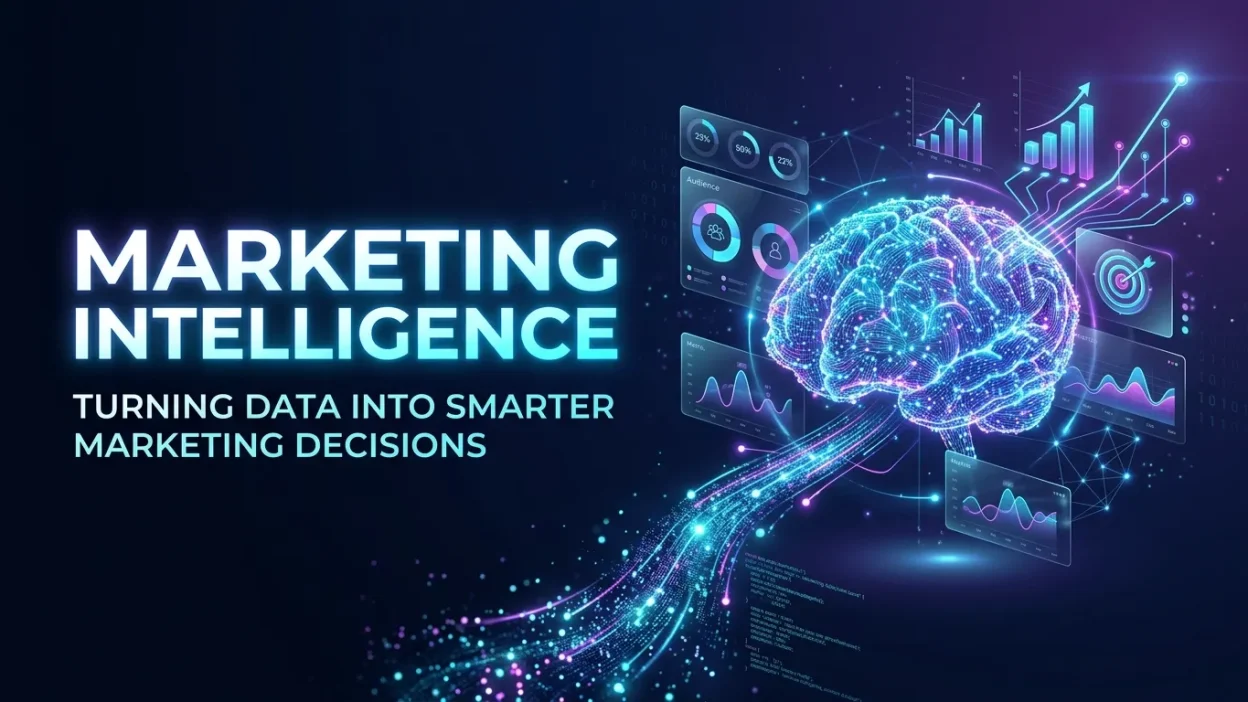
Marketing Intelligence helps businesses transform customer information, market research, competitor observations, and campaign data into actionable insights. By understanding customer behavior, tracking consumer trends, and evaluating marketing performance, companies can make better strategic decisions, improve campaign effectiveness, and identify growth opportunities. A structured intelligence approach also strengthens coordination across marketing, sales, and customer service.
Businesses collect information from nearly every marketing activity, including website visits, customer inquiries, advertising campaigns, email interactions, and sales conversations. Yet having access to large amounts of information does not automatically lead to better decisions. The real advantage comes from understanding what the information reveals about customer needs, market changes, and business performance. This is where Marketing Intelligence becomes valuable.
Marketing Intelligence brings together market information, customer insights, competitor observations, and performance data to help organizations make informed marketing decisions. Rather than relying entirely on assumptions or isolated campaign results, businesses can use a broader understanding of their environment to identify opportunities, recognize risks, and respond to changing expectations.
For example, a company may notice that website traffic is increasing while sales inquiries remain unchanged. Looking only at traffic could make the campaign appear successful. A deeper investigation might reveal that visitors are searching for information the company does not provide, that its landing pages lack clear messaging, or that competitors offer more relevant solutions. Marketing Intelligence helps connect these observations and uncover the reasons behind performance.
When used effectively, it allows marketing teams to move beyond simply reporting what happened. They can develop a clearer understanding of why it happened, what may happen next, and which decisions are most likely to create value.
Understanding the Information Behind Customer Decisions

Marketing Intelligence is not limited to collecting reports or monitoring campaign statistics. It involves organizing information from different sources and interpreting it in a way that supports practical business decisions.
A company’s marketing information may include customer demographics, purchase history, search behavior, industry developments, competitor pricing, product reviews, and sales feedback. Each source provides a different perspective. Website analytics may show which pages attract attention, while customer interviews can explain what visitors hope to find. Sales conversations may reveal objections that are not visible in digital reports.
Combining these sources creates a more complete picture of the market. A business selling project management software, for instance, might discover that smaller companies frequently visit its pricing page but rarely request a demonstration. Customer feedback could reveal that the available plans appear too complicated for teams with limited technical resources. This insight suggests that clearer plan comparisons or simpler onboarding information may be more useful than increasing advertising expenditure.
Effective marketing data intelligence depends on asking the right questions before interpreting the numbers. Teams should understand what they are trying to discover, which information can help answer the question, and how the findings will influence a decision. Without this focus, businesses may accumulate dashboards and spreadsheets that contain useful information but offer little practical direction.
Reading Market Changes Before They Become Business Problems
Markets rarely remain static. Customer expectations evolve, new competitors introduce alternatives, technologies change purchasing habits, and economic conditions influence spending decisions. Companies that recognize these developments early may be better positioned to adjust their offerings and communication.
Market intelligence analysis helps businesses interpret these external changes. It can involve monitoring industry reports, customer discussions, competitor activity, pricing movements, regulatory developments, and emerging product categories. The objective is not to predict every market change accurately, but to understand the forces that may affect business performance.
Consider a company selling office furniture. A growing number of customers may begin asking about ergonomic designs, flexible workspaces, and sustainable materials. If the business tracks these requests alongside industry developments and competitor offerings, it may recognize an opportunity to expand its product range or update its messaging.
Market information becomes more valuable when it is connected to commercial relevance. Not every industry trend deserves an immediate response. A trend may receive substantial attention online without creating enough demand to justify a new product or campaign. Businesses should evaluate the size of the opportunity, the needs of their target audience, the resources required, and the potential effect on existing operations.
This approach helps organizations distinguish meaningful market developments from temporary noise. It also reduces the risk of making expensive decisions based on a single headline, an isolated customer comment, or a competitor’s latest announcement.
Discovering What Customers Actually Want
Customer behavior often reveals a difference between what people say they prefer and how they make decisions in practice. A survey might indicate strong interest in a product, while purchasing data shows that customers consistently choose a different option. Understanding this difference is essential for developing relevant marketing messages.
Customer behavior insights help explain how people discover products, compare alternatives, evaluate prices, respond to promotions, and decide whether to purchase. These insights may come from customer surveys, interviews, website behavior, support conversations, reviews, and transaction records.
Suppose an online retailer notices that visitors repeatedly compare two similar products before leaving the website. The behavior alone does not explain why they hesitate. Some may be uncertain about quality, others may be comparing delivery costs, and some may simply be researching future purchases. Reviewing product-page feedback, search terms, and customer questions can help the business identify the most likely reasons.
The findings can then influence product descriptions, comparison tables, support content, and promotional messaging. Instead of offering a generic discount to everyone, the retailer might clarify product differences or provide better delivery information.
Customer intelligence should also account for changing expectations throughout the relationship. New prospects may need reassurance about a brand, while returning customers may care more about convenience, availability, or service quality. Recognizing these differences helps businesses communicate in ways that feel useful rather than repetitive.
Information should be collected and used responsibly. Companies need to respect customer privacy, follow applicable data protection requirements, and avoid collecting personal information that is unnecessary for the intended purpose. Trust is an important part of the customer relationship, not a separate consideration from marketing performance.
Understanding Competitors Without Copying Them
Competitor activity can reveal useful information about market expectations, customer preferences, and potential gaps in a company’s offering. However, competitive research is most valuable when it helps a business make independent decisions rather than simply imitate another company’s campaigns.
Competitive marketing intelligence examines how other organizations position their products, communicate their value, price their offerings, serve customers, and respond to market developments. It can include reviewing publicly available product information, advertising messages, customer reviews, website content, and changes in service offerings.
For example, a software company might discover that competitors emphasize ease of use while providing little information about implementation support. This could indicate an opportunity to differentiate through clearer onboarding explanations and stronger service communication. The insight comes from understanding the competitive environment, not from copying the competitors’ slogans or page designs.
Competitive intelligence also helps companies recognize areas where their own marketing may be falling behind. If customers consistently mention that competing businesses provide more transparent pricing or more detailed product comparisons, the company can investigate whether its own communication creates unnecessary uncertainty.
Still, competitor observations should be interpreted carefully. A competitor’s high visibility does not prove that its strategy is profitable, and a widely promoted product does not necessarily have strong customer retention. Public marketing activity reveals only part of a business’s performance.
The strongest decisions combine competitor observations with customer evidence and internal results. This allows companies to find opportunities that match their strengths rather than chasing every move made by another organization.
Connecting Marketing Insights With Strategic Decisions
Marketing reports often contain numerous metrics, but the presence of data does not guarantee that the information will influence business strategy. The challenge is to translate observations into decisions that have a clear purpose.
Marketing insights and analytics help bridge this gap. Analytics identifies patterns and relationships within available information, while insights explain why those patterns matter and how the business might respond. For example, a report may show that a particular campaign attracts a high volume of visitors. An insight emerges when the team discovers that those visitors are also more likely to request a quotation or become repeat customers.
This distinction matters because marketing teams can easily become focused on measurements that are convenient rather than meaningful. Impressions, clicks, and page views can help evaluate exposure and engagement, but they do not always reflect customer quality or commercial value.
A useful analysis connects marketing activity with the objectives the business is trying to achieve. If the priority is acquiring qualified leads, the team should investigate lead quality, cost per qualified inquiry, and progression into sales opportunities. If the priority is retaining existing customers, repeat purchases, renewal behavior, and customer feedback may be more relevant.
Organizations can strengthen this process by connecting intelligence with their broader marketing strategy analysis. Reviewing market evidence alongside campaign objectives and business priorities helps teams determine whether their current approach remains appropriate or requires adjustment.
The goal is not to generate more reports. It is to make each report useful for a decision, whether that means refining a campaign, changing a target audience, improving an offer, or reallocating resources.
Recognizing Consumer Trends Before Demand Shifts
Consumer preferences often change gradually before the impact becomes visible in sales figures. Search behavior, product reviews, customer questions, and discussions across relevant channels may reveal early signs of a shift in expectations.
Consumer trend analysis helps businesses examine these patterns over time. Rather than treating every new interest as a lasting movement, marketers compare information from multiple sources and look for evidence that a change is becoming more consistent.
A food retailer, for example, may notice increasing customer interest in convenient meal options. Search activity might indicate growing demand for quick preparation, while product reviews reveal that customers also value clear nutritional information. Together, these observations could suggest that convenience alone is not the full opportunity; shoppers may want products that make everyday decisions easier.
Trend analysis can influence product development, messaging, content planning, and distribution decisions. It can also help businesses decide when not to act. If a trend is limited to a small audience or conflicts with the company’s capabilities, monitoring it may be more sensible than immediately investing in a new offering.
The timing of a trend matters as well. Some developments reflect temporary events, while others indicate deeper changes in customer expectations. Businesses should examine how long a pattern has persisted, which audience segments are adopting it, and whether actual purchasing behavior supports the initial signals.
By interpreting trends in context, marketers can make more measured decisions and avoid confusing short-lived attention with sustainable demand.
Improving the Quality of Marketing Decisions

Marketing teams frequently face competing priorities. One department may want to increase brand awareness, another may focus on lead generation, and sales teams may request more qualified opportunities. Without a shared evidence base, these priorities can create conflicting decisions and inefficient spending.
Marketing decision intelligence brings relevant information together to support choices about audiences, channels, budgets, offers, and campaign timing. It helps teams compare alternatives using consistent criteria rather than relying solely on personal preferences or recent results.
For example, a business deciding between expanding paid search advertising and investing in educational content could compare the likely audience reach, acquisition costs, lead quality, time required to see results, and long-term usefulness of each option. Historical performance can inform the decision, while market research and customer feedback can reveal additional opportunities.
Decision intelligence does not remove uncertainty. Data can be incomplete, customer behavior can change, and past performance may not predict future results. Instead, it gives businesses a more disciplined way to evaluate available evidence, identify assumptions, and decide what to test.
The quality of a decision also depends on whether the people involved understand the information. Reports should present findings clearly, explain limitations, and distinguish observed facts from assumptions. A complicated dashboard that only specialists can interpret may have limited value if business leaders cannot connect it to their priorities.
When teams use intelligence consistently, decisions become easier to explain and evaluate. Businesses can learn from unsuccessful experiments, refine their assumptions, and gradually improve how marketing resources are used.
Building a Strong Market Research Foundation
Reliable intelligence requires more than reviewing internal analytics. Businesses also need to understand the people and conditions surrounding their market.
Market research intelligence combines structured research with ongoing market observation. Research may involve customer surveys, interviews, focus groups, competitor reviews, industry reports, and analysis of publicly available information. Each method has different strengths, and the appropriate choice depends on the question being investigated.
Surveys can reveal broad preferences across a target audience, while interviews may explain the reasons behind those preferences. Competitor reviews can highlight recurring customer frustrations, and sales conversations may reveal objections that prevent prospects from moving forward. Combining these sources helps businesses avoid depending too heavily on one perspective.
Research quality is particularly important when making major decisions. A survey conducted only among existing customers may not represent people who chose a competitor. Similarly, feedback from a small group of highly engaged users may not reflect the needs of the wider market.
Businesses should therefore consider who provided the information, when it was collected, how the questions were framed, and whether the findings can reasonably be applied to the intended audience. Research should also be refreshed when market conditions or customer expectations change.
The outcome should be a practical understanding of the market, including customer needs, unmet demand, competitive alternatives, and possible barriers to growth. This foundation makes it easier to develop campaigns that respond to real opportunities instead of relying on assumptions.
Creating a Customer Intelligence Strategy Across Channels
Customer information often sits in separate systems. Website analytics may be managed by the digital marketing team, customer inquiries may be stored in a lead management platform, and purchase history may exist in a sales or commerce system. When these sources remain disconnected, the organization may struggle to understand the complete customer relationship.
A clear customer intelligence strategy establishes how customer information will be collected, organized, interpreted, and used across the business. It should define the questions the company wants to answer, the information required, the responsibilities of different teams, and the safeguards needed to protect customer privacy.
For instance, a company may discover that prospects who read detailed service pages are more likely to request consultations. If the marketing and sales teams share relevant information, they can improve follow-up communication and identify which topics deserve more attention in future content.
Website interactions can also reveal where visitors need additional information. Businesses that want to understand how to make these experiences more effective can explore this guide to website lead capture without being intrusive. The central principle is to make it easy for interested visitors to express their needs without interrupting their experience or demanding unnecessary information.
A customer intelligence strategy should not attempt to collect every possible data point. It should prioritize information that supports clear business purposes and can be maintained accurately. Consistent definitions, appropriate access controls, and regular data-quality checks help ensure that the information remains useful.
When customer knowledge is shared responsibly, marketing, sales, and service teams can develop a more consistent understanding of customer needs and respond with greater relevance.
Turning Performance Insights Into Measurable Growth
Intelligence becomes valuable when it improves how businesses evaluate results and plan future activity. Marketing performance insights help explain which campaigns contribute to business objectives, which customer groups respond most effectively, and where resources may be underperforming.
A company might discover that one advertising channel generates many inquiries but few sales, while another produces fewer inquiries with a much higher purchase rate. If the company evaluates channels only by lead volume, it may continue investing in the weaker source. Looking at the complete progression from inquiry to customer provides a more accurate picture.
Performance analysis should include both short-term results and longer-term effects. Some campaigns generate immediate responses, while others build awareness and trust that influence future purchasing decisions. Businesses should choose measurement periods that reflect their sales cycle and avoid attributing every result to the most recent marketing interaction.
Different channels also require different performance measures. An SMS campaign may be evaluated through delivery, engagement, response, and resulting business actions. Businesses looking to assess these outcomes can explore SMS marketing ROI measurement and optimization to understand how campaign activity can be connected with financial results.
The purpose of performance intelligence is to support better resource allocation. Teams should identify what is working, investigate weak results, and test improvements where evidence suggests a worthwhile opportunity. This process should remain flexible because an approach that works for one audience or period may not perform equally well elsewhere.
Making Marketing Intelligence Part of Everyday Business

Marketing Intelligence should not be treated as an occasional research project completed only when a major decision arises. Its greatest value comes from building a continuous connection between market observation, customer understanding, campaign measurement, and business action.
Organizations can establish regular reviews to discuss changes in customer behavior, competitor activity, campaign performance, and emerging opportunities. These discussions should focus on a manageable number of important findings rather than overwhelming teams with every available metric.
Clear ownership is also necessary. Someone must be responsible for maintaining data quality, while marketing and business leaders need to determine how insights influence priorities. Sales and customer service teams can contribute valuable information about customer objections, recurring questions, and changing expectations.
Over time, this approach helps businesses develop a stronger understanding of their market and respond with greater confidence. Decisions become more evidence-based, marketing investments can be evaluated more accurately, and customer communication can become increasingly relevant.
Ultimately, Marketing Intelligence is not simply about having more information. It is about using the right information to understand customers, recognize market opportunities, assess competitors, and improve business decisions. When intelligence is connected to clear objectives and consistent action, it becomes a practical foundation for stronger marketing performance and sustainable growth.
Frequently Asked Questions
1. What is Marketing Intelligence?
Marketing Intelligence is the process of collecting, analyzing, and interpreting information about customers, competitors, market conditions, and marketing performance. It helps businesses understand their environment and make informed decisions about campaigns, products, pricing, and customer communication.
2. Why is Marketing Intelligence important for businesses?
Marketing Intelligence reduces dependence on assumptions by providing evidence about customer needs and market opportunities. It can help businesses identify emerging trends, recognize competitive gaps, improve marketing investments, and respond more effectively to changes in customer behavior.
3. What are the main sources of Marketing Intelligence?
Common sources include website analytics, customer surveys, sales feedback, customer reviews, purchase records, competitor websites, industry reports, search trends, and campaign performance data. Businesses should select sources according to the questions they need to answer and evaluate the quality and relevance of the information.
4. What is the difference between Marketing Intelligence and marketing analytics?
Marketing analytics focuses on examining data to identify patterns, measure performance, and understand relationships between variables. Marketing Intelligence has a broader scope, combining analytical findings with market research, customer knowledge, and competitor information to support strategic decisions.
5. How does competitive marketing intelligence help a business?
Competitive marketing intelligence helps businesses understand how competitors position their products, communicate value, price offerings, and respond to customer needs. These observations can reveal opportunities for differentiation, identify gaps in the market, and help companies assess their own strengths and weaknesses.
6. How can businesses use customer behavior insights?
Businesses can use customer behavior insights to understand how people discover products, compare alternatives, respond to messages, and make purchasing decisions. These findings can improve customer segmentation, website content, product descriptions, campaign targeting, and follow-up communication.
7. What is consumer trend analysis?
Consumer trend analysis examines changes in customer preferences, expectations, and purchasing behavior over time. It helps businesses identify potential opportunities and risks by comparing patterns across research, customer feedback, market activity, and actual buying behavior.
8. Which tools support Marketing Intelligence?
Useful tools may include web analytics platforms, customer relationship management systems, business intelligence dashboards, survey software, social listening tools, advertising reports, and market research databases. The right combination depends on the organization’s goals, available resources, data quality, and privacy requirements.
9. How can a company measure the effectiveness of Marketing Intelligence?
A company can assess its effectiveness by examining whether insights lead to better decisions and measurable improvements. Relevant outcomes may include stronger lead quality, improved campaign returns, more accurate forecasting, better customer retention, faster identification of market changes, and more efficient use of marketing resources.
10. How often should Marketing Intelligence be reviewed?
Marketing Intelligence should be monitored continuously where practical, with formal reviews scheduled according to business needs. Campaign performance may require frequent monitoring, while market positioning and broader customer trends may benefit from monthly or quarterly reviews. Significant changes in customer behavior or competitor activity may justify an earlier assessment.