

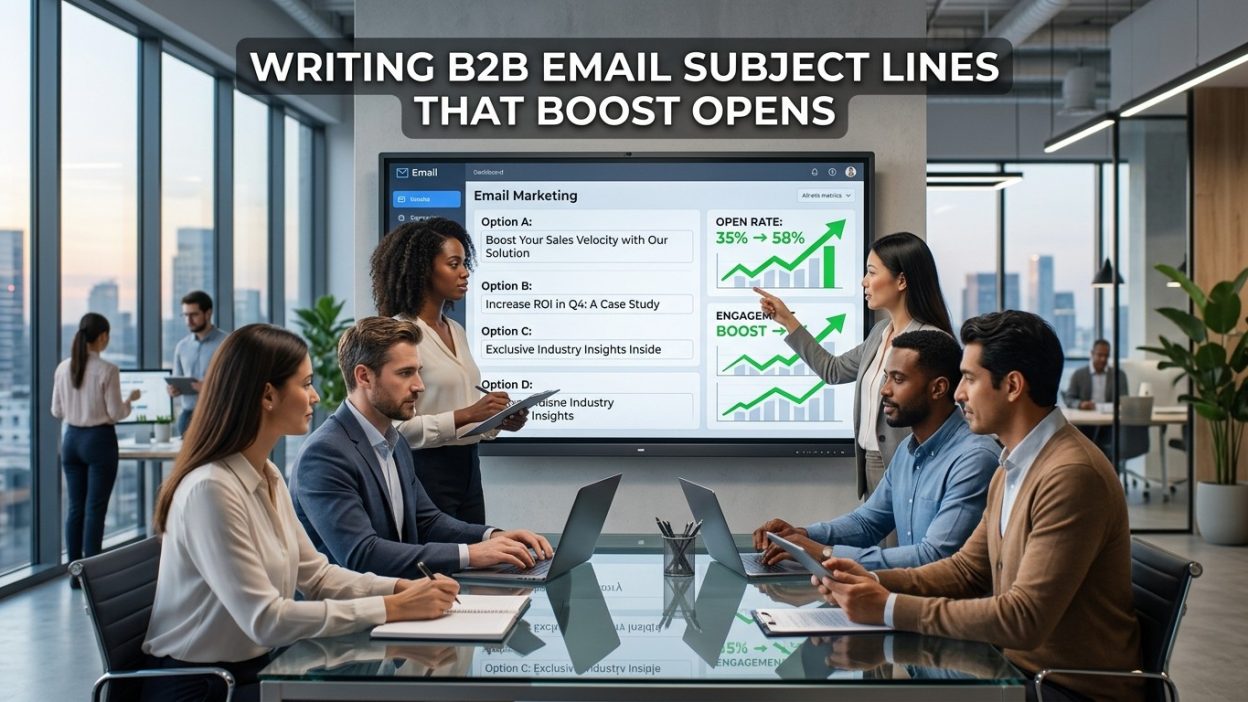
B2B Email Subject Lines win opens when they are clear, relevant, and trustworthy, because busy buyers open only what feels useful, timely, and worth their attention.
In modern inboxes, B2B Email Subject Lines are not decorative copy; they are the first proof of relevance. A buyer decides in seconds whether an email deserves attention, and B2B Email Subject Lines must make that decision easier, not harder.
Because B2B readers protect their time, B2B Email Subject Lines work best when they sound practical, specific, and honest. They should promise a useful outcome, reflect the reader’s business reality, and feel like they were written for a real person rather than a generic list.
The highest-performing lines usually support a broader message. When the subject line, preview text, body copy, and call to action all reinforce the same promise, opens feel natural. When they clash, trust drops quickly and future engagement suffers.
Why subject lines matter so much in B2B
B2B Email Subject Lines carry more weight in B2B than many teams realize. They are not just about curiosity; they are about clarity, credibility, and fit. B2B Email Subject Lines matter because they shape the first decision in the inbox.
Business buyers are flooded with vendor emails, content offers, and automated sequences. That makes attention expensive. B2B Email Subject Lines that show respect for time create a better first impression because they reduce effort before the reader even clicks open.
Open rates also influence downstream performance. If the wrong people open because the subject line overpromised, click quality falls. If the right people open because the subject line was accurate and relevant, the rest of the funnel usually becomes stronger.
The psychology behind an open
People open emails for emotional reasons even in professional contexts. Curiosity, usefulness, urgency, certainty, and risk reduction all affect behavior. Strong B2B Email Subject Lines usually combine one of those triggers with a clear business benefit.
Curiosity works only when it is controlled. A subject line can create enough tension to invite the open, but it should not hide the offer so completely that the reader feels tricked. In B2B, trust is more valuable than theatrical mystery.
Urgency can help when it is real. Deadlines, launches, product changes, and live events are legitimate reasons to open. Fake urgency, exaggerated wording, or empty countdown language can improve short-term clicks while damaging long-term credibility.
Relevance beats cleverness

The best B2B Email Subject Lines are usually more useful than witty. B2B Email Subject Lines should never ask the reader to work too hard. B2B audiences are not browsing for amusement; they are looking for solutions, insights, and decisions. A direct promise of value often outperforms a playful line that leaves the reader guessing.
Specificity is powerful because it reduces uncertainty. If the reader can quickly understand who the email is for, what problem it addresses, or what result it offers, the message feels easier to open. That simplicity can be more persuasive than elaborate phrasing.
Relevance also improves brand memory. When your B2B Email Subject Lines consistently match real problems and practical needs, readers start to associate your sender name with utility. That recognition increases the chance of future opens even when the offer changes.
How to write subject lines that feel human
Human-sounding B2B Email Subject Lines do not read like machine output or overworked sales copy. They sound like a clear note from one professional to another. That tone is especially important in cold outreach, where the audience is already cautious and scanning for signs of spam.
A human subject line often uses plain language instead of promotional noise. Words that show a concrete business outcome, a known challenge, or a practical resource tend to feel more authentic. The line should sound useful enough to earn attention on its own.
It also helps to avoid language that feels inflated. Overclaims and dramatic promises may attract initial interest, but they often lower trust. Professional readers usually respond better to subject lines that are confident, calm, and believable.
Length, mobile view, and scan behavior
Because many inboxes are read on phones first, B2B Email Marketing Strategy should front-load the key idea. Mobile users may only see part of the line, so the beginning must carry the main value. If the most important words come first, the line remains effective even when truncated.
Long subject lines are not always bad, but they need structure. A slightly longer line can work when it stays clear and readable. The problem is not length itself; it is buried meaning. If the reader has to decode the line, the email becomes easier to ignore.
Preview text should support the subject line, not repeat it. Together, they should create a complete and compelling message. A weak subject line paired with weak preview text usually loses to a stronger pair that communicates value quickly.
Using subject line types strategically
Different campaign goals call for different B2B Email Subject Lines. A cold email, a nurture message, a product announcement, and a re-engagement note should not sound identical because each one serves a different stage of the buyer journey.
Direct-benefit lines work well when the value is obvious. Curiosity-based lines can be effective when the audience already knows the brand. Problem-solution lines are especially useful when you want the reader to feel understood before they read the body.
Social-proof subject lines can support trust when you have credible results to reference. Timely-update lines are useful when the message is tied to something real and time-sensitive. The right style depends on the intent of the campaign.
Cold outreach subject lines
In cold outreach, B2B Email Subject Lines must do extra work because the reader does not know you yet. That means the line needs to be low-pressure, relevant, and easy to understand. The first goal is to feel legitimate enough to open, not pushy enough to delete.
One common mistake is trying too hard to stand out. Loud punctuation, gimmicky phrasing, and exaggerated claims often have the opposite effect in B2B. A calm line that points to a practical reason for reaching out is usually more effective.
Another useful tactic is to signal brevity or usefulness. Readers appreciate efficiency. When the line suggests that the email is focused and worth a moment, it lowers resistance and improves the chance of a first open.
Email Follow-Up Sequences are especially important in cold outreach because most replies do not happen on the first touch. The subject line for each follow-up should feel like a natural continuation, not a brand-new sales pitch. That continuity helps the recipient remember the original context and decide whether the message is worth a second look.
Personalization that does not feel automated
Personalization works best when it is meaningful. Adding a first name is rarely enough on its own. Strong B2B Email Subject Lines use context such as role, industry, business stage, recent company activity, or a visible challenge that matters to the recipient.
Good personalization feels tailored, not invasive. The reader should understand why the message fits their situation without feeling that the sender knows too much. That balance builds trust and keeps the email from sounding overly engineered.
When personalization is done well, it helps the recipient feel seen. In B2B, that feeling matters because buyers are more likely to open messages that seem to understand their priorities rather than simply chase their attention.
Subject lines and deliverability
Deliverability and engagement are connected, which makes B2B Email Subject Lines important beyond copywriting. When people open, reply, and interact, inbox providers receive positive signals. When people ignore, delete, or mark as spam, those signals weaken.
That is why safe, natural language matters. If a subject line looks aggressive, deceptive, or over-optimized, it can reduce trust before the email even loads. The issue is not just filters; it is also the human reaction to language that feels manipulative.
To protect performance, keep sender names consistent, segment responsibly, and write lines that match the actual content. A message that promises something real and delivers something real is much more sustainable than one that relies on tricks.
Building a testing process
A strong testing process helps you learn what your audience responds to instead of guessing. Compare one variable at a time, such as curiosity versus clarity, short versus moderately detailed, or benefit-led versus problem-led B2B Email Subject Lines.
Testing only works when the segments are meaningful. A line that resonates with executives may not resonate with practitioners. A line that performs well on warm leads may fall flat with cold prospects. Context matters as much as the wording itself.
Keep a record of winning patterns. Over time, the data will show which words, structures, and angles consistently outperform others. That record becomes a practical library for future campaigns and makes your subject line process faster.
Matching subject lines to email intent
When the message is educational, B2B Email Subject Lines should sound informative. When the message is promotional, they should sound clear and commercially useful. When the message is a reminder or follow-up, they should sound like a continuation rather than a reset.
Intent matching lowers friction because the reader does not have to guess what kind of email is waiting inside. The subject line gives a promise, and B2B Email Subject Lines should help frame it before the body begins. That alignment is one of the strongest drivers of trust.
If you use the same style for every campaign, the audience may stop noticing the difference between message types. A more disciplined approach treats each email as a distinct moment in the buyer journey and adjusts the subject line accordingly.
Building better lines with business language

Professional readers respond well to language that sounds concrete. Words like template, benchmark, checklist, update, example, insight, and result can make B2B Email Subject Lines feel more useful because they describe a real type of value.
Numbers can also help when they add clarity. They can signal structure, scope, or brevity. For example, a line that promises three steps or five examples feels easier to judge than a vague promise with no shape.
Plain language is usually stronger than flowery language. B2B readers are often scanning for answers, not entertainment. The more your line sounds like a practical business note, the more likely it is to earn a click.
Common mistakes teams make
One of the biggest mistakes in B2B Email Subject Lines is trying to sound too clever. Clever wording can hide the point and force the reader to interpret the message. In a crowded inbox, ambiguity is expensive.
Another mistake is overusing urgency. If every message feels urgent, then nothing feels urgent. Readers learn to tune it out. Real urgency should be reserved for messages that genuinely require quick action.
A third mistake is poor alignment between the subject line and the email body. If the email does not deliver what the line promised, readers feel misled. That hurts the current campaign and the next one too.
Writing for cold, warm, and active audiences
Cold audiences need clarity and reassurance. Warm audiences can handle more context and nuance. Active audiences, especially those already evaluating your solution, may respond to stronger proof or next-step language. B2B Email Subject Lines should reflect those differences.
With cold leads, keep the promise small and the language safe. With warm leads, highlight value and progress. With active opportunities, use wording that supports the buyer’s immediate decision-making process.
Audience stage matters because people open emails based on what is most relevant in that moment. A subject line that works for one stage may feel off-target in another, even if the sentence itself looks polished.
Improving opens without gaming the inbox
Good email marketing is not about tricking the reader. It is about helping the right reader recognize a useful message. B2B Email Subject Lines should create honest anticipation, not false drama. That approach supports both short-term opens and long-term brand trust.
When your subject lines are aligned with the real reason for the email, the open becomes a natural next step. The reader does not feel manipulated into clicking because the offer makes sense from the start.
That is one reason consistent messaging matters. A steady pattern of useful subject lines teaches your audience that your emails are worth opening. Over time, that reputation becomes a powerful advantage.
Practical formulas you can adapt
Simple formulas can speed up writing without making the result robotic. Problem plus outcome, insight plus benefit, update plus context, or resource plus relevance can all support strong B2B Email Subject Lines.
The formula is only a starting point. The real work is choosing the right angle for the audience. A subject line should feel like a useful doorway into the message, not a rigid template pasted onto every campaign.
Once you find a formula that fits your audience, adapt it rather than copying it exactly. That keeps the writing fresh while preserving the structure that helped it work in the first place.
Strategic use of follow-ups
Email Follow-Up Sequences deserve their own subject line strategy because the goal is continuity. A follow-up should remind the reader of the original context while adding a new reason to care, rather than sounding like a brand-new pitch with no memory of the first one.
Good follow-up subject lines are often shorter and more conversational. They can reference the previous message, a new asset, or a simple next step. The point is to move the conversation forward without causing the reader to feel pressure.
When follow-ups are respectful and relevant, they increase the odds of a later open. Many replies happen after the second, third, or fourth touch, so the subject line should help the sequence feel persistent without becoming annoying.
Aligning design and copy
Modern Email Template Design influences how the email feels after the open, which is why subject line promises must match the layout inside. If the design is cluttered, the message feels harder to trust. If the design is clean, the email feels easier to read and act on.
A good template does not distract from the message. B2B Email Subject Lines and template design should support the same reader experience. It reinforces the main point, supports scanning, and makes the CTA obvious. That way, the reader feels that the open was worth the time.
Design and subject line should operate as a team. The subject line earns the click, and the design confirms that the click was a smart decision.
Segmenting by audience behavior
Not all readers respond to the same angle. Some care about efficiency, some care about risk, some care about revenue, and some care about implementation details. B2B Email Subject Lines improve when they reflect those priorities.
Segmentation can be built around job title, industry, company size, funnel stage, or recent engagement. The more specific the segment, the easier it is to write a line that feels personally relevant without being overfitted.
The benefit of segmentation is not just better opens. It also helps protect the sender reputation because you are less likely to send mismatched messages that produce poor engagement or unwanted unsubscribes.
Avoiding spammy language and risky patterns
Avoid Spam Triggers in Outreach should be a daily habit, not an afterthought. Overly promotional wording, excessive symbols, all caps, or misleading claims can all make a subject line feel unsafe to readers and inbox systems alike.
The best approach is to sound like a helpful professional, not a hype machine. Honest subject lines create a better chance that the open will lead to a real conversation rather than a quick deletion.
Spam avoidance is partly technical and partly psychological. If the line feels natural, specific, and credible, it is more likely to perform well. If it feels loud or evasive, the audience often reacts before the email body has a chance to help.
The role of proof and specificity
Proof can make B2B Email Subject Lines much stronger. A result, statistic, customer win, or concrete resource helps the reader understand why the email is worth opening. Specificity makes the promise easier to believe.
Vague lines create friction because the reader has to guess what they will get. Specific lines reduce that mental work. In business communication, reducing friction is often the simplest way to improve performance.
The key is to be specific without becoming cluttered. One clear proof point is often enough. Too many details in the subject line can weaken the message by making it harder to scan quickly.
When curiosity helps and when it hurts
Curiosity is useful when it guides the reader toward a practical insight. It is risky when it hides the point. B2B Email Subject Lines can use curiosity, but only in a way that respects the reader’s time and expectations.
A curiosity line should make sense as soon as it is opened. If the email body fails to deliver a satisfying answer, the subject line may have attracted a click but damaged trust. In B2B, that trade-off is usually not worth it.
A better approach is to create open-worthy tension around a real problem, real benchmark, or real change. That gives the reader a reason to explore without feeling baited.
How to create a reusable swipe file

A swipe file is a simple collection of subject lines that performed well across campaigns. It helps you spot patterns in tone, structure, and value. Over time, B2B Email Subject Lines become easier to write because you are not starting from zero every time.
Include lines by audience type, goal, and result. Then review them periodically to find what works across segments. You may notice that your best lines share a common trait, such as directness or measurable value.
The benefit of a swipe file is speed with memory. It preserves what worked, but it also gives you a place to test new angles against proven ones.
Bringing it all together
To improve B2B Email Subject Lines, start with audience insight, then choose one clear value proposition, then write a line that reflects the reader’s stage and need. When those pieces are aligned, the subject line feels effortless to open.
Strong B2B Email Subject Lines are rarely built on one trick. They are built on a system: clarity, relevance, consistency, and follow-through. The more often your emails meet the expectation they set, the more reliable your results become. B2B Email Subject Lines improve fastest when every test is tied to a clear audience hypothesis.
That reliability is what makes email such a durable channel. Even when tactics change, the fundamentals stay the same. Respect the inbox, and the inbox becomes more willing to reward you.
Conclusion
B2B Email Subject Lines are one of the most influential parts of email performance because they decide whether the message gets seen. The best lines are clear, specific, and matched to the reader’s business needs. They create interest without deception, use psychology without pressure, and support the rest of the campaign with a promise the email can actually keep.
When you treat subject lines as a strategic asset instead of an afterthought, opens become more meaningful and more predictable. That leads to better engagement, better conversations, and better results across the whole funnel.
Keep testing, keep segmenting, and keep refining the promise. B2B Email Subject Lines improve fastest when every test is tied to a clear audience hypothesis. With enough consistency, stronger subject lines will improve not only opens but also trust, which is the real engine behind long-term B2B email success.
B2B Email Subject Lines should stay specific. B2B Email Subject Lines should stay honest. B2B Email Subject Lines should stay aligned with the offer. B2B Email Subject Lines should respect the reader. B2B Email Subject Lines should match the stage. B2B Email Subject Lines should be tested regularly.
Frequently Asked Questions (FAQ)
1. What makes B2B Email Subject Lines effective?
They are effective when they are relevant, specific, credible, and matched to the audience’s current need. B2B Email Subject Lines should make the reason to open obvious in a single glance.
2. How long should subject lines be?
They should be short enough to scan quickly, but clarity matters more than a strict character count. The best B2B Email Subject Lines front-load the value so mobile readers can understand them fast.
3. Should I personalize every subject line?
Not always. Personalization works best when it is meaningful and context-based. Strong B2B Email Subject Lines use role, industry, stage, or behavior instead of relying only on a name token.
4. Do questions perform well?
They can, especially when the question mirrors a real business challenge. The strongest B2B Email Subject Lines ask something the reader has already thought about, which makes the open feel natural.
5. How do I avoid spam triggers?
Use natural language, avoid exaggerated claims, and make sure the email delivers what the line promises. Keeping B2B Email Subject Lines honest is one of the simplest ways to reduce spam risk.
6. Is urgency always helpful?
No. Urgency works only when it is real. False urgency can hurt trust and make readers ignore future emails. B2B Email Subject Lines should create momentum only when the deadline or event truly matters.
7. What works best for cold outreach?
Low-pressure, relevant, and easy-to-read lines usually perform best. In cold campaigns, B2B Email Subject Lines should feel legitimate before they feel persuasive.
8. How often should I test new lines?
Regularly. Every audience segment can behave differently, so ongoing testing helps you learn which B2B Email Subject Lines deserve to become part of your standard playbook.
9. Can one subject line work for every audience?
Usually not. Different roles, industries, and funnel stages respond to different angles. The same B2B Email Subject Lines may be strong for one segment and weak for another.
10. Why do subject lines matter so much?
They are the first trust signal in the inbox. Strong B2B Email Subject Lines help the right people open, which improves the quality of the entire email journey.