
Marketing Data Privacy focuses on protecting customer information throughout marketing activities, from data collection and storage to campaign personalization and audience targeting. Through responsible data handling, consent management, security practices, and regulatory compliance, businesses can maintain customer trust while creating effective data-driven marketing strategies.
Customer Trust Begins With Responsible Data Collection

Modern marketing depends heavily on information. Businesses collect customer preferences, website interactions, purchase histories, communication records, and demographic details to understand their audiences and create relevant campaigns. These insights help organizations personalize experiences, improve targeting, and evaluate marketing performance.
However, collecting customer information also creates responsibilities. People want to understand how their information is used, who can access it, and whether it remains protected after being shared with a business.
This makes Marketing Data Privacy an essential part of responsible digital marketing. It involves managing personal information in ways that respect customer expectations, follow applicable regulations, and reduce the possibility of unauthorized access or misuse.
Privacy is no longer simply a technical concern handled by IT departments. It influences advertising decisions, email campaigns, customer relationship management, analytics, and communication across digital platforms.
A business may have sophisticated marketing technology and detailed audience insights, but these capabilities become difficult to sustain when customers lose confidence in how their information is handled.
The relationship between marketing and privacy therefore requires a balance. Organizations need useful information to understand customer needs, while individuals deserve transparency, control, and appropriate protection over their personal data.
The Changing Expectations Around Customer Data Protection
Customers interact with businesses through websites, mobile applications, social platforms, online stores, and email communication. Each interaction may generate information that contributes to a broader customer profile.
Customer Data Protection ensures that this information is handled responsibly throughout its lifecycle. It includes safeguards against unauthorized access, accidental exposure, inappropriate sharing, and unnecessary collection.
For example, an ecommerce business may collect names, email addresses, delivery information, and purchase records. This information supports order processing and customer communication, but it should not automatically become available to every employee or external marketing partner.
Access should depend on legitimate business requirements and appropriate permissions.
Customer expectations have also changed. People increasingly want to know why a business requests particular information and whether they can control promotional communication. Privacy notices, consent options, and clear communication practices help address these expectations.
Protection also extends beyond preventing data breaches. Businesses should consider whether information is being used for the purpose customers reasonably expect and whether unnecessary personal details are being retained.
A responsible approach recognizes that customer information represents both a business resource and a responsibility.
Marketing Data Security Within Connected Digital Systems
Marketing platforms rarely operate independently. Businesses often connect customer relationship management software, email marketing systems, analytics platforms, advertising tools, and automation applications.
These connections improve operational efficiency, but they also create additional points where information may be accessed, transferred, or exposed.
Marketing Data Security focuses on protecting information across these connected environments. It includes technical and organizational measures that help maintain confidentiality, integrity, and availability.
For instance, a company using several marketing applications should establish appropriate account permissions, secure authentication, and controlled data-sharing arrangements. Employees should only access the information necessary for their responsibilities.
Third-party integrations also deserve attention. When customer information moves between platforms, businesses need to understand what information is transferred, how it is protected, and whether the receiving provider meets relevant security requirements.
This is particularly important when marketing departments use external agencies, advertising networks, analytics providers, or outsourced communication services.
The way organizations manage Marketing Data Access is closely connected to these responsibilities. Clear access permissions help businesses determine who can view, modify, export, or share customer information.
Security is strongest when it becomes part of everyday marketing operations rather than an occasional technical review.
Consumer Privacy Regulations and the Responsibilities of Marketers
Privacy regulations influence how organizations collect, process, store, and share personal information. Their requirements differ according to jurisdiction, business activities, the types of information involved, and the individuals whose data is being processed.
Important regulatory frameworks include the European Union’s General Data Protection Regulation (GDPR), the California Consumer Privacy Act as amended by the California Privacy Rights Act (CCPA/CPRA), and other national or regional privacy laws.
These frameworks establish different obligations concerning transparency, lawful processing, individual rights, data security, and organizational accountability.
Consumer Privacy Regulations are particularly relevant to marketing because advertising and customer engagement frequently involve personal information.
For example, businesses may need to provide clear privacy notices, establish an appropriate legal basis for processing, honor applicable opt-out requests, and obtain consent where required.
The GDPR emphasizes principles such as purpose limitation, data minimization, accuracy, storage limitation, and accountability. Meanwhile, California privacy laws provide qualifying consumers with rights that include access, deletion, correction, and certain opt-out choices.
Not every regulation applies to every business in the same way. Applicability depends on legal definitions, geographic connections, organizational activities, and other requirements.
Marketing teams should therefore work with appropriate legal and compliance professionals rather than assuming that one privacy policy satisfies every regulatory obligation.
Understanding these responsibilities helps organizations develop campaigns that respect consumer rights while supporting legitimate marketing objectives.
Personal Data Handling: From Collection to Retention
Customer information passes through several stages during its use in marketing. It may be collected through registration forms, stored in customer databases, analyzed through marketing platforms, and used to deliver personalized communication.
Personal Data Handling concerns how information is managed throughout these stages.
The collection process is an important starting point. Businesses should understand what information they actually need and avoid requesting unnecessary details simply because their forms or software allow them to do so.
For example, a newsletter subscription generally requires an email address, while requesting a residential address or date of birth may be unnecessary unless a specific and justified purpose exists.
Storage practices are equally important. Customer records should be maintained in appropriately protected systems with access limited to authorized individuals.
Retention also deserves attention. Businesses should not automatically keep every piece of customer information indefinitely. Data should be retained according to applicable legal obligations, business purposes, and established retention policies.
When information is no longer necessary, organizations should consider appropriate deletion, anonymization, or other lawful disposal methods.
Accurate handling also involves maintaining updated records. Incorrect email addresses, outdated customer preferences, and duplicate profiles can create communication problems and increase unnecessary data exposure.
A consistent approach to personal information management supports both marketing efficiency and customer confidence.
Marketing Consent Management and the Meaning of Customer Permission
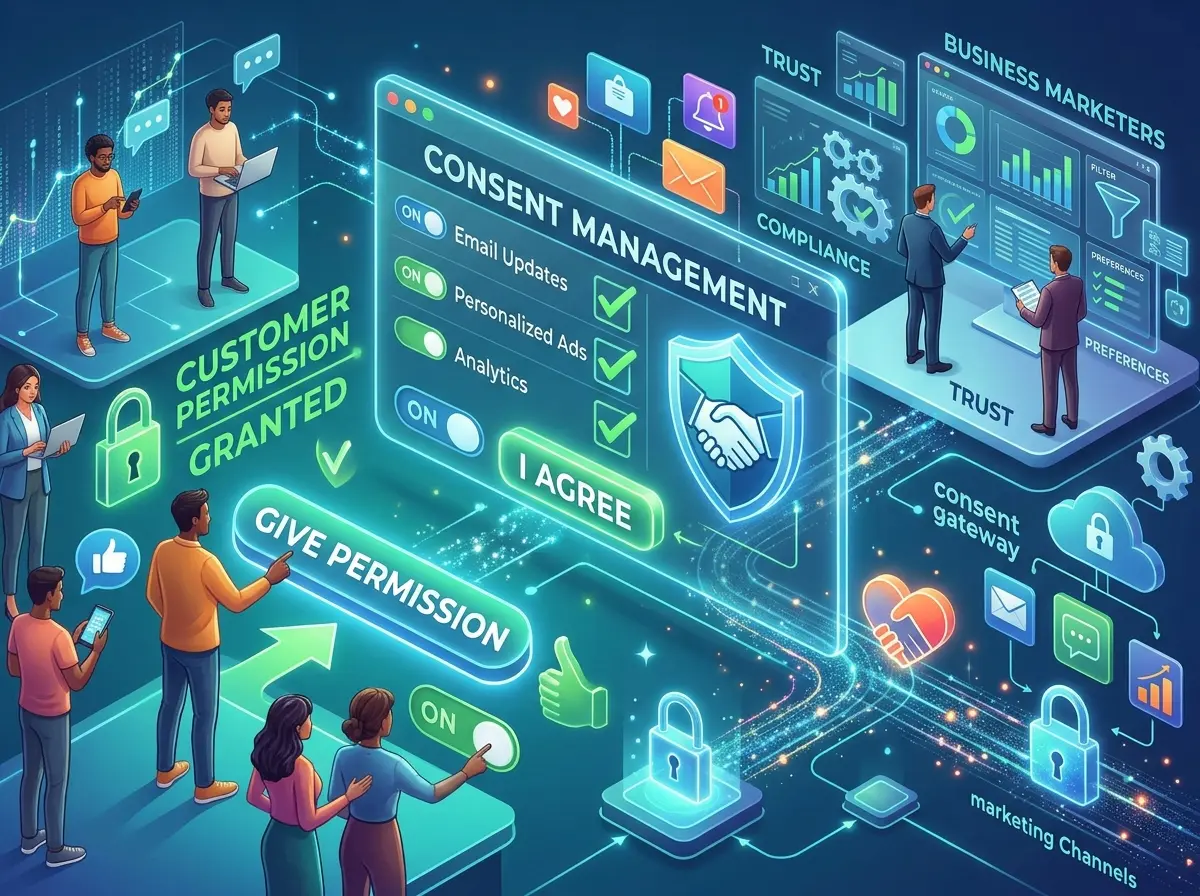
Permission is an important part of responsible customer communication. People should understand when they are agreeing to receive promotional messages and what that agreement covers.
Marketing Consent Management involves recording, maintaining, and respecting customer permissions across marketing channels.
For example, someone registering for an online event may agree to receive event-related updates without necessarily agreeing to receive unrelated promotional emails. These purposes should not be treated as automatically interchangeable.
Consent requirements also vary according to the relevant laws and communication channels. Under the GDPR, consent, where used as the legal basis, must meet specific standards, including being freely given, specific, informed, and unambiguous. Other lawful bases may apply in appropriate circumstances.
Businesses should maintain reliable records of consent where required and provide accessible methods for people to withdraw it.
Email subscriptions, promotional notifications, SMS campaigns, and other communication channels may involve different permission requirements.
The language used in registration forms matters as well. Complicated explanations and unclear selection options can make it difficult for customers to understand what they are agreeing to.
Effective consent management connects customer preferences with actual marketing activity. When someone changes their communication preferences, relevant systems should reflect that change appropriately.
This helps prevent unwanted communication and reduces the risk of using personal information outside its permitted purpose.
Customer Information Privacy and the Value of Transparent Communication
Customers are more likely to feel comfortable sharing information when businesses explain their practices clearly.
Customer Information Privacy is not maintained through technical controls alone. It also depends on how organizations communicate about data collection, personalization, sharing, and customer choices.
Privacy notices should explain what information is collected, why it is needed, how it is used, and which parties may receive it. The information should be accessible and understandable rather than hidden behind unnecessarily complicated language.
Transparency becomes particularly important when businesses use customer information to personalize advertising.
For example, a customer who previously purchased a product may receive recommendations for related items. This can be useful when the personalization is relevant and consistent with the applicable legal requirements and the customer’s expectations.
However, personalization may feel intrusive when people cannot understand why they are seeing particular advertisements or how their information influenced the message.
This is where marketing communication and privacy practices intersect.
The principles behind a strong Target Market Strategy can support more responsible audience targeting by emphasizing audience relevance rather than indiscriminate collection of personal details.
Businesses can often improve campaign relevance through appropriate segmentation and contextual information without collecting every possible customer attribute.
Transparency makes these practices easier for customers to understand and evaluate.
Data Privacy Compliance Across Marketing Activities
Data Privacy Compliance requires businesses to translate privacy principles and legal requirements into actual operational practices.
A privacy policy alone is not enough. Organizations need consistent procedures for managing information across the systems and departments involved in customer communication.
Consider a business running a lead generation campaign. Visitors may submit information through a landing page, after which their records enter a CRM platform and an automated email workflow.
Each stage creates privacy considerations. The business needs to understand the purpose of collection, the relevant legal basis, the information being transferred, the people who can access it, and the communication preferences associated with the record.
This becomes more complex when several departments and external providers participate.
Marketing teams should also coordinate with legal, security, and data management professionals when introducing new campaigns or technologies that involve personal information.
Documentation is another important component. Organizations may need to maintain records of processing activities, consent information, data-sharing arrangements, security measures, and procedures for handling individual requests.
The exact documentation obligations depend on the applicable legal framework and the organization’s circumstances.
A well-established compliance approach reduces uncertainty and makes privacy responsibilities easier to manage across marketing operations.
First Party Data Protection in a Changing Marketing Environment
First-party data has become increasingly important as businesses reconsider how they collect and use audience information.
This information is obtained directly through a company’s interactions with its customers or audience. Examples include newsletter subscriptions, website account activity, purchase records, customer preferences, and feedback submitted through business-owned channels.
First Party Data Protection focuses on managing this information responsibly while preserving its usefulness for marketing activities.
Direct customer relationships can provide valuable insights without depending entirely on information obtained from unrelated external sources.
However, first-party information is not automatically free from privacy obligations. Businesses must still consider transparency, purpose limitation, appropriate legal bases, security, retention, and applicable customer rights.
For example, a company collecting customer preferences through a registration form should explain how those preferences will influence future communication.
It should also avoid assuming that providing information for one purpose creates unrestricted permission for unrelated activities.
First-party data can support personalization, audience segmentation, customer retention, and campaign measurement when managed responsibly.
The goal is to create useful customer experiences while maintaining clear boundaries around information collection and use.
Marketing Data Governance and Organizational Accountability
Privacy protection becomes difficult when information is scattered across departments, applications, and external service providers. Different teams may maintain separate customer records, use inconsistent naming conventions, or follow different retention practices.
Marketing Data Governance provides a framework for managing these responsibilities consistently.
It establishes how customer information is classified, accessed, maintained, shared, and reviewed across the organization.
For example, marketing departments may use CRM platforms, campaign management tools, analytics software, and event registration systems. Without shared governance standards, customer records can become inconsistent and difficult to manage.
A governance framework helps clarify responsibilities. It can establish who owns particular data processes, who approves access, how records are updated, and which procedures apply when information needs to be corrected or deleted.
This is especially relevant to B2B demand generation, where information may pass between marketing teams, sales representatives, event platforms, and external service providers.
The broader structure of a B2B Demand Gen Engine depends on coordinated lead generation, audience targeting, and campaign management. Privacy governance should be considered within these activities rather than added only after a campaign has been launched.
Accountability becomes stronger when employees understand their responsibilities and when organizations regularly review how information moves through their marketing systems.
Consumer Data Rights and the Importance of Individual Control
Privacy protection should recognize that customers are not simply sources of marketing information. They are individuals with rights concerning how their personal data is processed.
Consumer Data Rights vary between privacy laws, but they may include rights to access personal information, request correction, seek deletion, obtain a copy of certain information, and object to or opt out of particular processing activities.
For example, an individual may want to know what personal information a business maintains about them. Another person may request correction of inaccurate details or ask for deletion where the applicable legal conditions are satisfied.
Some laws also provide specific choices concerning targeted advertising, the sale or sharing of personal information, and certain forms of automated processing.
Organizations need appropriate procedures to receive, verify, assess, and respond to these requests within applicable legal timeframes.
Marketing systems should also reflect the outcomes of valid requests. If someone withdraws marketing consent or exercises an applicable opt-out right, the business should ensure that relevant communication activities are updated.
These responsibilities are important because privacy rights must work in practice, not simply appear in a legal notice.
When customers can exercise their choices without unnecessary difficulty, businesses demonstrate greater respect for individual privacy.
Event Marketing and Privacy in Customer Communication
Events create additional opportunities to collect audience information through registrations, attendance records, surveys, networking activities, and post-event communication.
This information can help organizers understand audience interests and improve future events. However, event-related data should also be managed according to clear purposes and appropriate privacy practices.
For example, someone registering for a business conference may provide contact information to receive registration confirmation and event updates. That information should not automatically be treated as unrestricted permission for every future promotional campaign.
The communication itself also influences how customers perceive the organization.
Effective Event Marketing Messaging demonstrates the importance of clear, relevant, and audience-focused communication. Privacy transparency should support the same objective by making it understandable why attendees receive particular messages.
Businesses should also consider how registration providers, event applications, sponsors, and other partners handle participant information.
The more organizations involved in an event, the more important it becomes to establish appropriate data-sharing responsibilities.
Building a Privacy-Conscious Marketing Culture

Technology can support privacy protection, but sustainable results depend on organizational behavior.
Employees who understand customer privacy are more likely to recognize unnecessary data collection, questionable sharing practices, and inappropriate access requests.
Training should therefore extend beyond technical and compliance teams. Marketing professionals, content creators, campaign managers, sales representatives, and customer support employees may all interact with personal information.
Privacy considerations should also influence decisions about new campaigns and marketing technologies.
Before adopting a new platform, businesses should understand what information it collects, how it processes that information, where data may be transferred, and which contractual or legal protections are necessary.
Regular reviews can identify outdated customer records, unnecessary access permissions, and information that is no longer required.
A privacy-conscious culture also encourages transparency when problems occur. Businesses should have appropriate procedures for investigating potential incidents and fulfilling any applicable notification obligations.
The objective is to make responsible information management a normal part of marketing decision-making.
Conclusion: Making Data Privacy Part of Sustainable Marketing Growth
Marketing success depends on understanding customers, delivering relevant communication, and building relationships that continue over time. However, these objectives should not come at the expense of personal information and individual privacy.
Marketing Data Privacy connects customer protection with everyday marketing operations. It influences how businesses collect information, manage permissions, secure platforms, organize customer records, and respond to individual rights.
Strong privacy practices also support better organizational accountability. When teams understand their responsibilities and customers know how their information is used, businesses can develop more transparent and dependable relationships.
As marketing technology continues to evolve, privacy will remain an important consideration in personalization, automation, audience targeting, and data-driven decision-making.
Ultimately, protecting customer information is not simply a regulatory obligation. It is part of building a marketing environment where customers can engage with businesses while maintaining confidence in how their personal data is handled.
Frequently Asked Questions About Marketing Data Privacy
1. What is Marketing Data Privacy?
Marketing Data Privacy refers to the responsible collection, use, storage, and sharing of personal information during marketing activities. It focuses on protecting customer information while respecting privacy expectations and applicable regulations.
2. Why is customer data protection important in marketing?
Customer data protection helps prevent unauthorized access, misuse, and exposure of personal information. It also strengthens customer confidence and supports responsible business communication.
3. What are the major consumer privacy regulations?
Important privacy frameworks include the GDPR in the European Union, the CCPA as amended by the CPRA in California, and other national and regional privacy laws. Their requirements depend on the organization, location, and processing activities.
4. What is marketing consent management?
Marketing consent management involves obtaining, recording, maintaining, and respecting customer permissions for relevant marketing communication. It also includes providing appropriate methods for customers to change or withdraw their consent.
5. How can businesses improve marketing data security?
Businesses can improve marketing data security through access controls, secure authentication, encryption where appropriate, employee training, vendor assessments, regular security reviews, and incident response procedures.
6. What is the difference between first-party data and third-party data?
First-party data is collected directly through a business’s own interactions with its customers or audience. Third-party data is obtained from external sources that are not the direct customer relationship between the business and the individual.
7. What is marketing data governance?
Marketing data governance establishes the policies, responsibilities, and processes used to manage customer information. It helps maintain data accuracy, appropriate access, consistent handling, and organizational accountability.
8. What rights do consumers have over their personal information?
Depending on applicable privacy laws, consumers may have rights to access, correct, delete, or obtain their personal information and to object to or opt out of certain processing activities.
9. How does data privacy compliance affect marketing campaigns?
Data privacy compliance influences how businesses collect information, obtain permissions, target audiences, share customer records, and communicate with individuals. It helps ensure campaigns follow applicable legal requirements.
10. Can businesses personalize marketing while protecting customer privacy?
Yes. Businesses can use appropriately collected information, relevant audience segmentation, transparent practices, and suitable privacy safeguards to create personalized marketing experiences while respecting customer expectations and applicable legal requirements.